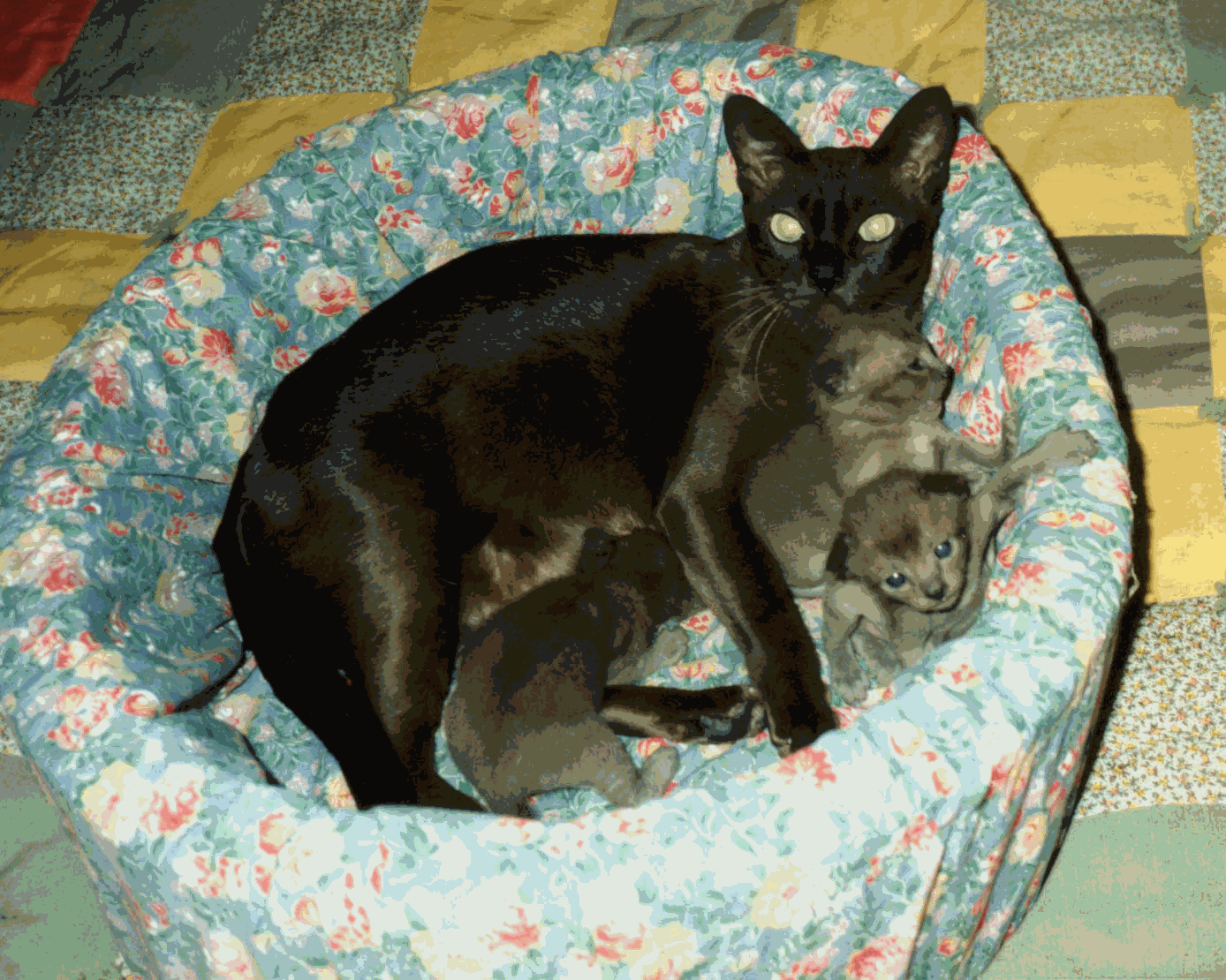
Karree
Written by Karen Lease on 12th December 1994
She is big, beautiful, and brown. She leaves a impression of all those who meet her. No one is indifferent to her-love her, hate her, but certainly they remember her. What more could you want from a breeding queen.
As a Burmese, her type may not be fabulous but her litters of kittens are large(usually 8 or 9), healthy and always well within the standard with one or two being Best in Show material. It is her sense of presence that command you. She knows her beauty and value. She is as she is and as she was bred to be. She is a great brood queen.
Although a popular stud can influence a whole breed for good or ill, the queen is the one who determines whether we produce kittens. Anyone who assumes that kittening "comes naturally" with cats, after a few years in the fancy knows that the reverse is true. We have selected and manipulated our animals to such a degree that we have to anticipate breeding failures. Each female kitten, whether acquired or raised, is a gamble. She may turn out to be a wonderful brood queen or a complete dud.
When one considers all the potential difficulties, it’s a wonder that anyone starts a breeding program. There are roughly four categories of problems; hormonal, structural, behavioural and genetic. Hormonal and genetic problems account for the largest percentage of breeding failures.
Hormones, in particular the interaction of estrogen and progesterone, regulate a queen’s fertility. Too many generations of close breeding leads to sterility.
Uterine infections are commonly linked to an excessive amount of progesterone. A true pyometra(pus-filled uterus) appears out of the blue, some in a queens too young too breed. Some breeds like Burmese and Siamese mature early and need to be bred within a reasonable length of time. Holding off breeding a queen is almost a guarantee for trouble.
A queen who has kittened sometime has a light heat when her litter is only six weeks old, and is almost alway in season before the twelfth week. This is largely because cats live on our schedule with artificial lights. Cats are photoperiodic and one can influence their cycles by shortening the day length. Ten hours of light appears to be the critical time. A longer day encourages heats, a shorter one suppresses heat.
The second most common hormone-related problem is endometriosis. Endometriosis is when the wall of the uterus thicken; the normal uterus is small and flat. The treatment is usually a course of antibiotic but in most cases the only solution is removal of uterus.
A rare occurrence is when the queen carrys a large live litter but doesn’t go into labor. Attempting a second litter from this queen is a gamble. If one opts to remove the uterus at the time of a caesarean, oxytocin will induce lactation and she can still raise the litter. Research in sheep has shown that a full term lamb triggers a labor inducing hormones. This may explain why when a queen carrys a litter of dead kittens that she doesn’t go into labor. A single kitten pregnancy may go over-time to the extent that a queen finds it impossible to expel a huge kitten. All those situations show how important is to have accurate breeding dates. All pregnancies outside of the normal should be vet-checked without delay.
Speaking of delay in connection with hormones, it is important to keep in mind that all cats are induced ovulators. Eggs are released from the ovaries with the stimulation of mating. Putting off breeding for too long results in cystic ovaries, ones so damaged by scar tissue that the queen can no longer conceive.
Problem related to structure in the queen are uncommon. A few have some non-productive or blind teats. If litters are small and the remaining teats productive, kittens can survive by nursing in shifts. Some queens appear to produce no milk. In this case always ask your vet for an injection of oxytocin as milk may be there and not let down.
In exceptional cases, a queen conceives such large litter, up to fourteen kittens, that the uterus eventually stretches beyond the point where it can return to normal. On subsequent breeding, it can not contact as it should and a caesarean becomes necessary. She is ready for retirement.
A rare problem is one where a queen doesn’t metabolise calcium efficiently. In a slender breed the queen may snap a leg or green stick fracture. If severe enough, the queen will re-absorb her kittens. This tendency appears to be inherited.
Most cat mothers are devoted to their offspring but occasionally a queen show aberrant behaviour. No matter how gross this may be one should alway judge the environment carefully before discarding a queen. Cannibalism may be the result of lack of privacy. Cats may like to have their special people on hand when kittening but while raising their kittens often prefer a place of their own with limited human intervention and usually no feline assistance.
A queen’ lack of interest in her own new-born is usually caused by her attraction to other young kittens. As she approaches labor, she will try to mother them. To avoid a lot of stress, confusion and the risk that she will abandon her own kittens, it is wise to put a pregnant queen in her birthing quarters a week before her due date. Unless a first-time queen is so unstable that she is vicious, give her a chance with a second litter. Some need maturation to become competent brood queen.
By the time a litter is six week old, the queen may show signs of wanting to be out of reach of her rowdies. She needs a shelf where she can nap without being disturbed. If, in spite of ideal surroundings, an older queen attacks a kitten, it is time to put her out to pasture. She may have been a perfect mother for six years, but no longer can tolerate the stress.
Now, all this may appear a horrendous litany of breeder problems. If we were mating tabby cats, we’d probably never see any of them. With years of experience we discover that difficulties tend to be proportional to the degree of inbreeding. This is the case with breeding failures over which we have the most control, the propagation of cats carrying genetic lethals. Some are well known: cleft palate, cardiomyopathy and kidney failure. Unfortunately some top show lines are plagued with so many that breeding disasters are the rule rather than the exception. A true horror story of a two headed kitten, other with cleft palate, gross herniation and one with a missing limb delivered in a single litter should be a warning. However this doesn’t stop the breeder bent on big wins, and the few survivors are often those famed show cats.
Judges rule strictly on what they see. The result is that a genetic time-bomb can reach top show status. One only has to look at the dog fancy to see the consequences of irresponsible breeding. Naming a dog #1 at the Westminster show has been the kiss of death for breed after breed. For instance, the top German Shephard stud was a haemophilic, all of whose daughters turned out to be carriers. It has become such a scandal that the American Kennel Club, working with the Morris Animal Foundation, is gradually instituting restriction of dogs allowed to be bred. They will have to be certified free of hip dysplasia, progressive retinal atrophy or whatever is the most significant genetic flaw for a particular breed. These rules are coming in the nick of time, as concerned breeders foresaw the demise of the purebred dog by the end of the century (The Puppy Report by Larry Shook, Lyons Burford, 1992).
What can we do to avoid these pitfalls? Do not be seduced by the current hot-shot on the show bench. Look to his father or grandfather and find out as much as you can about the family breeding history. In the Burmese breed, a five or six year old stud tells a lot about general health, colour and the quality of his kittens. Most of your kittens will go as pets, and you want to know that they’ll live for 15 to 20 trouble-free years. Stock that produces healthy pet kittens can be selected from to produce show animals, and a hunt for relatively obscure breeders may turn up outcross stock to maintain a sound line.
Yes, Karree is a marvellous mother and wonderful brood queen but her kittens are only as healthy and vigorous as the stud that fathers them. The winning on the show bench is secondary to breed cats that are a joy to own giving their new owners love and pleasure for the next 15 to 20 years.