 |
 |
 |
| *Main Spain Facts* |

|
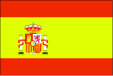
| Capital: Madrid Official Language: Spanish Religion: Roman Catholic Currency: Euro Population: 40,280,780 (July 2004) Total Area: 504,782 square miles Geographic Coordinates: 40 N, 4 W |
| *Geography* |
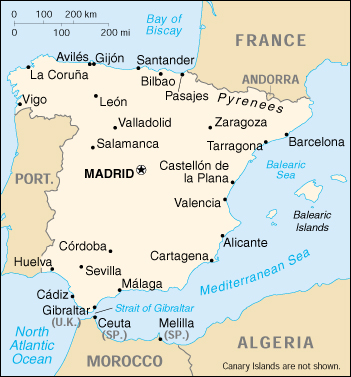
| Spain shares the Iberian peninsula with Portugal and is bounded to the north by the Pyrenees, which seperates Spain from France. The Balearic Islands (Mallorca, Menorca, Ibiza, and Formentera), 193 km (120 miles) southeast of Barcelona, and the Canary Islands off the west coast of Africa are part of Spain, as are the tiny enclaves of Ceuta and Melilla on the north African mainland. With the exception of Switzerland, mainland Spain is the highest and most mountainous country in Europe, with an average height of 610m (2000 ft). The Pyrenees stretch roughly 400m (249 miles) from the Basque Country in the west to the Mediterranean Sea;at times the peaks rise to over 1524m (5000 ft), the highest point being 3404m (11,169 ft). The main physical feature of Spain is the vast central plateau or Meseta, divided by chains of sierras. The higher northern area includes Castille and Leon, the southern section comprises Castile/La Mancha and Extremadura. In the south the plateau drops abruptly at the Sierra Morena, beyond which lies the valley of Guadalquivir. Southeast of Granada us the Sierra Nevada, part of the Betic Cordillera, which runs parallel to the Mediterranean, rising to 3,481m (11,420 ft) and the highest point on the Spanish peninsula (The Pico del Teide on Tenrife in the Canaries is the highest point in Spain.) The Mediterranean coastal area reaches from the French frontier in the northeast down to the Straits of Gibraltar, the narrow strip of water linking the Mediterranean with the Atlantic Ocean and seperating Spain from North Africa. |
| *Environment* |
| The variety of the landscape is reflected in its flora: trees include pines, cork-oak trees, and beech trees; flowering plants include orchids, gentians, lavendar and rosemary. Spain's native animals are relatively small: deer, ibex, tortoises, bats, snakes (including a venemous viper), and other small creatures though a small number of bears, wolfes, and lynxes remain. The native birds are vultures, eagles, kites, bustards, storks, and flamingoes. Many other species stop off on their migration route from Europe to Africa. Like all countries, Spain has environmental problems including deforestation, soil erosion and sea pollution. The huge success of the tourist industry has brought particular difficulties. Five national parks and hundreds of protected areas and reserves have been established over the years. |
| *Architecture* |
| Spain's colonizers have left their architectural mark on the country. The Roman Aqueduct in Segovia is on of the key buildings in Spain's architectural heritage. Moorish architecture can be seen at the Alhambra palace outside Granada. Moorish influence continued, even in religious buildings, for example, in Toledo while the mosque at Cordoba, famous for its red and white Moorish arches became the city's cathedral. Spain has many well preserved examples of religious architecture which are on the World Heritage List: monasteries, churches, and cathedrals. Today modern buildings stand alongside the old. One of the best known examples of early twentieth century Spanish architecture is Antonio Gaudi's Temple de la Segrada Familia in Barcelona. The building is still unfinished, but Barcelona contains many other examples of buildings in his architectural style. |
| *Language* |
| The majority of the people who live there speak Castilian Spanish, about seventeen percent speak Catalan and around seven percent speak Galacian. The Basque population speak their own language, Euskara. Spain's exploration, colonization, and empire are reflected in the number of people in the world who speak Spanish- over eight hundred million worldwide. |
| *Food* |
| Spanish cuisine is full of typically Mediterranean ingediants such as olive oil and tomatoes. Many traditional Spanish dishes are served in tapas bars which are a feature of Spanish life. Traditional dishes include tortillas, (potato omelets), paella, gazpacho (cold soup), sausages, meats such as lamb and pork, cheeses, sardines, octopus, squid, and fruit. The Arab influence can still be seen in the use of fruits and almonds in savoury dishes and in some of the spices and sweet dishes. Wine is plentiful and Spain is known for Sangria. More coffee is drunk than tea. |
| Home |
 |
| Spain Page 2 |
 |