 |
 |
 |

|
| *Geography* |
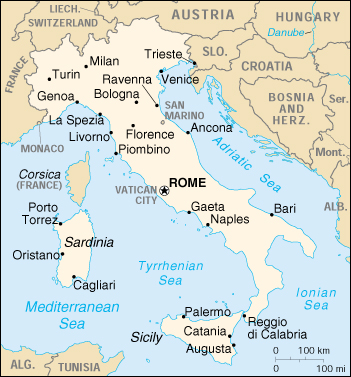
| Italy is divided into 20 regions and 94 provinces. Most of the land is hilly and some of the mountains are volcanic. The Alps stretch along the north and on the east they become known as the Dolomites. The Apennines run down the middle of the country and are known as the "backbone" of Italy. The highest mountain in Europe in found in Italy. It's called Mont Blanc, in the Alps on the border of Italy and France. It's 15,770 feet tall. There are also several tall volcanoes in Italy. Mount Etna is found in Sicily and is 10,902 feet tall. The major rivers in Italy are the Po River (which flows from the Alps near the French border, through Turin, and eastward into the Adriatic Sea), the Arno River (which flows from the north-central Apennines, through Florence, and into the Tyrrhenian Sea), and the Tiber River (which flows from north-central Apennines, south through Rome, and into the Tyrrhenian Sea). Italy is bordered by five countries in all. Monaco, France, Switzerland, Austria, and Slovenia all border Italy's northern border. San Marino is located within Italy near the eastern coast. The independent Vatican City, home to the Pope, is located within Italy's capital, Rome. The four major bodies of water that surround Italy are the Adriatic Sea, the Ionian Sea, the Tyrrhenian Sea, and the Mediterranean Sea. The Adriatic sea is located on the east coast and the Ionian Sea is located on the southeastern coast. The Tyrrhenian Sea is located on the west coast. Last but not least, the Mediterranean Sea is located on the southwest coast of Italy. |
| *Main Italy Facts* |
| Capital: Rome Official Language: Italian Religion: Roman Catholic Currency: Euro Population: 58,057,477 (July 2004) Total Area: 301,230 square kilometers Geographic Coordinates: 42 50 N, 12 50 E |
| *History* |
| Nobody is sure where the Etrusans came from, but between 900 and 500 B.C., they ruled in Tuscany, north of the Po Valley, and south toward Naples. Their society was highly organized and evidence can be seen of their tombs, gold and metal ornaments, buildings, roads, canals,and sewers. The Etrusans were influenced by the Greeks who, arriving in the eighth century B.C., set up colonies in Sicily, Naples, Paestrum, and Taranto. According to legend, Rome was founded by Romulus in 753 B.C. Romulus and his twin brother Remus were abandoned by their mother and was taken in by a she-wolf. This is Rome's symbol. Rome broke free from Etrusan rule in 509 B.C. and established a republic that lasted five centuries. Julius Caesar ended the Republic by becoming a dictator. He was assasinated on the Ides of March ( which is on March 15) 44 B.C. His adopted son, Augustus, established the Roman empire in 30 B.C. The invasion by Attila the Hun and the sacking of Rome by the Goths and Vandals brought an end to the Roman Empire in Italy. In A.D. 800, Charlemagne had conquered Italy and was now crowned by the Pope as emporer of Rome. The rise of cities and a merchant class ended in the Renaissance of the 15th century. Painters, architects, poets, sculptors, and philosophers produced unsurpassed works of genius, despite the turmoil of intercity warfare and invasion by countries to the north. First Spain and then Austria controlled the peninsula during the following centuries, followed briefly by Napoleon's imperial flourish. The post-Napoleon shake-up led directly to the drive for unification of the 19th century, led by Giuseppe Garibaldi, Count Camillo di Cavour, and Giuseppe Mazzini. The Kingdom of Italy was declared in 1861, although Venice was not taken away from Austria until 1866 and papal claims remained an issue until 1870, when Rome officially joined the young nation. No label of unity, however, could hide the huge cultural and social differences that split the industrialized north from the poverty-stricken south. Economic crisis and unreliable politics clogged the new nation in the following decades, as Italy muddled through WWI and became riddled with industrial unrest in the early 1920's. In a memorably unwise employment decision, the king asked Benito Mussolini to take the reins of government under the auspices of his Fascist Party. Il Duce soon became head of state, outlawed the opposition, controlled the press and trade unions and cut franchise by two thirds. His relationship with Adolf Hitler soured after a series of military disasters and an Allied invasion. He was executed, along with his mistress, Clara Petacci, in April 1945. |
| *Government* |
| Italy is a parliamentary republic. The country is divided into twenty regions, which are similar to the states in the United States except that they have less control over their own affairs. The national government is made up of three branches: the legislative, executive, and judicial. The legislative, or law-making branch, is the parliament. It is made up of two houses: the Chamber of Deputies, which has 630 members, and the Senate, which has 315 members. Both senators and deputies serve five years. In the executive branch, the president is head of state and is elected for seven-year term by parliament and members of regional councils. The president does not actually run the government. The prime minister, with his cabinet of ministers, is in charge of running the government. The prime minister is chosen by the president and is the leader of the party that has the largest representation in the Chamber of Deputies. In the judicial branch, there are two main courts. The Supreme Court is the highest court of appeal in all cases except those concerning the Constitution. The Constitutional Court is similar to the Supreme Court of the United States and decides cases concerned with the Constitution. It is made up of fifteen justices. Citizens must be twenty-five years old to vote for senators; the voting age for all other elected officials is eighteen. |
| Italy Page 2 |
| Home |
 |
 |