 |
 |
 |

|
| *Main Greece Facts* |
| Capital: Athens Official Language: Greek Religion:Greek Orthodox Currency: Euro Population: 10,647,529 (July 2004) Total Area: 131,940 square miles Geographic Coordinates: 39 N, 22 E |
| *Food* |
| Greek food is traditionally Mediterranean with tomatoes, olives, olive oil and grilled meat. Middle eastern influences can be seen in foods such as kebabs, and pita bread and in pastries like baklava and kataifi. The long coastline and many islands mean that fish is important to the Greek cuisine. Squids and octopus are popular, as is taramasalata, a dish of salted roe. Moussaka, a dish of minced meat and aubergines, covered with bechamel sauce and feta, a salty sheep's milk are Greek specialties. Fruits such as figs and watermelon are popular. Special foods are prepared for many of the feast days of the Greek Orthodox religious celebrations. Greek wines are best known for the sweet dessert wines of Samos and Mavrodaphne and for retsina (wine with added pine resin). Ouzo, an aniseed-flavored spirit is usually drunk with water. |
| *Geography* |
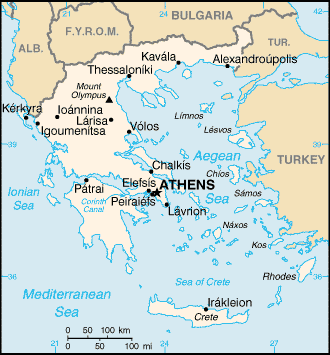
| Greece, officially named called the Hellenic Republic, is located in the south of Europe on the Mediterranean and bordered by Albania, the former Yukoslav Republic of Macedonia, Bulgaria and Turkey. Greece is bordered by four bodies of water. The Ionian Sea which borders Greece to the west, the Crete Sea which borders Greece to the southeast, the Mediterranean Sea which borders Greece to the southwest and the Aegean Sea which borders Greece to the east. Greece's territory includes hundreds of small and inhabited islands; the main group of islands are the Ionian, the Northeast Aegean, the Cyclades, and the Dodecanese. Crete is the largest island. Greece is mountainous and hilly with a rocky terrain and a long coastline. The climate is Mediterranean: hot summers with mild winters. |
| For more information on Greece, go to the link below. |
| *History* |
| The earliest human remains found in Greece are those of the Neanderthal man. At around 6000 B.C. there were communities of Neolithic farmers. By around 2000 B.C. Crete, benefiting from its position on maritime trade routes, was the dominant power.The palaces at Knossos and other Minoan (King Midas) sites were elegant, properly plumbered buildingswith beautiful wall paintings. Minoan rule collapsed around 1400 B.C., perhaps triggered by earthquakes, and the great explosion of Santorini. Mycenae in the Peloponnese became the next dominant power. The period is said to be that of the Trojan War in which Agamemnon of Mycenae and Menalaus of Sparta led the greek armies to besiege, and destroy, the city of Troy in Asia Minor. The fall of Mycenae and other kingdoms caem with the arrival of the Dorians from the north. By around 800 B.C. Greecehad settled into a patchwork of states based on major cities; Athens, Sparta, Thebes, and Corinth among them.Emigration, caused by rising populations and lack of resources, led to the establishment of Greek cities along the coast of Asia, in Sicily and Italy and as far away as Spain. The Asian cities had fallen under the control of the Persian Empire, but rebelled in 499. To punish the mainland Greeks the Persians invaded in 490 but were defeated by the Athenians at Marathon (the marathon race recalls the distance run from the battle to Athens with news of the victory). In 480 the Persians returned but were beaten again, though Athens was burned. From 431-404 Athens and Sparta fought for supremacy (Peloponnesian War). Weakened by the war the city stateswere unable to resist Phillip of Macedon who defeated the Greek armies in 338. under Phillip's son, Alexander, the Greeks invaded and conquered Persia, taking Egypt and marching as far as India before Alexander's death in 323. Rome, the next great power, in the Mediterranean eventually conquered Greece in 146 B.C. In 330 A.D. the Roman empire Constantine moved his capital to Byzantium- a Greek city. The Eastern Empire remained in place despite the fall of Rome and Greece remained a Byzantine possession (though parts were conquered by the Normans). Byzantium fell to the Turks in 1485 and Greece came under Ottoman rule. As the Turkish empire weakened in the nineteenth century the Greeks began to fight for their independence, supported by many Europeans, among them Lord Byron. In 1830 independence was declared. The Balkan Wars (1912-13) finally drove the Turks from Europe. Greece fought on the side of the Allies in World War I and was allocated a large portion of western Asia Minor in the division of the Turkish Empire. But a revived Turkish army, under Mustafa Kemal (later Ataturk) defeated the Greeks in 1922 and drove them out. On October 28, 1940 Mussolini, the Italian leader, who had invaded Albania, demanded passage through Greece. The Greeks replied "No". No Day is now a national holiday. The Italians were driven back through Albania, but in 1941 the Germans invaded and the country was occupied. Guerilla forces fought the occupying forces and when the war ended a Civil War began, lasting until 1950. Political unrest continued through the fifties and sixties. In 1967,a group of Colonels seized power remaining in control until 1975. Their attempt to unite Cyprus with Greece provoked a Turkish invasion of the island. The army then mutinied, desposing the Junta and Greece and returned to civilian rule. A referendum was held to decide the future of the monarchy a majority voted for its abolition. |
| Greece Page 2 |
| Home |
 |
 |