 |

|
 |
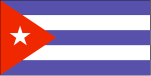
| Capital: Havana Official Language: Spanish Religion: Roman Catholic Currency: Cuban Peso Population: 11, 308, 764 (July 2004) Total Area: 110,860 square kilometers Geographic Coordinates: 21 30 N, 80 00 W |
| *Main Cuba Facts* |
| *Geography* |
| Home |
 |
| Cuba is the largest of the Caribbean islands. It lies between the Bahamas and Jamaica, ninety miles from Key West, Florida. The Republic includes the Isla de La Juventud (Island of Youth) and many smaller islands. Around a quarter of the country is mountainous, with three major mountain regions. The remainder of the country is mostly flat. Cuba has hundreds of rivers, most of them relatively shallow. The climate is tropical. The wet season runs from May to November, when the rainfall is heavy. The dry season runs from December to April. The island is regularly struck by hurricanes. |
 |
| *Environment* |
| Twenty-five percent of Cuba is forested. Trees include cedar, ebony, kapok trees, giant figs, mahoganys, oaks, pines, royal palms (the national tree), and mangroves along the shoreline. The national flower is the mariposa, a species of jasemine; other flowering plants include begonias, bourgainvilleas, bromeliads, hibiscus, jacaranda, orchids, oleanders, and poinsettias. Cuba has no large mammals; the most common mammals on the island are bats. There are a number of species of reptiles such as crocodiles ( the Cuban crocodile is an endangered species), chameleons, iguanas, and lizards. Over three hundred species of birds are to be found in Cuba. As well as the bee hummingbird (the world's smallest bird), green parrots, woodpeckers, and the tocororo (the national bird), there are many water birds living in the mangrove swamps including pelicans, cranes, herons, and flamingoes. The island is an important resting place for many migratory species. Cuba is also home to hundreds of species of butterflies. Big game fish such as marlin are found in the surrounding sea. Other inhabitants of the waters off the Cuban coast are the sailfish, which have been known to swim up to 100 kph, the whale shark, the world's largest fish, and the marine turtle. Deforestation began with the Spanish occupation and many hectares of forest were cleared for sugar plantations and cattle ranches. In 1978, Cuba set up the National Committee for the Protection and Conservation of National Resources and the Environment. Alternate methods of pest control are being used and a reforestation program has been implemented. |
| *Food* |
| Many Cuban foods are spicy.Everyday food eaten in Cuba includes rice and beans, fried plantain, stew, pork, and chicken. One popular dish is picadillo, which is usually ground beef, but it can also be veal or pork, mixed with onions, tomatoes, garlic, and other ingrediants. Although Cuba is an island, fish is not plentiful (fishing boats need a licsence provided by the State.). Much of Cuba's fruit crops are exported. Ice cream is popular and other sweet foods include cakes, doughnuts, biscuits, and coconut flavored desserts. Rum is the best known Cuban drink and the "Cuba Libre" is one of the most famous rum cocktails. Coffee is also widely drunk. Many types of food are scarce in Cuba. As a result, the government has organized a rationing system for the distribution of food. This system is designed to provide all households with minimum quantities of rice, beans, meats, chicken, eggs, sugar, milk, and coffee. |
| *Sports* |
| Cuba is one of the most successful sporting nations, despite its small size. Its boxer have been particularly successful. Basketball is popular in Cuba and is similar to a game played by the early inhabitants of the islands, the Taino Indians. Other major sports include baseball, the World Series Champions of 2003's catcher Ivan, "Pudge" Rodriguez is Cuban, and volleyball. Soccer is becoming more popular. |
| *Holidays* |
| Cuba celebrates Rebellion Day and Liberation Day. Jose Marti's birthday, Labor Day, and the Bay of Pigs Victory Day are among the national holidays. There are a number of celebrations including a Jazz Festival in February and carnivals in the summer lasting between one to two weeks. |
| Cuba Page 2 |
 |