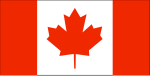
 |
 |
 |
| Main Canada Facts |
| Capital: Ottawa Official Languages: English and French Religion: Roman Catholic Population: 32,507,874 (July 2004) Total Area: 9,984,670 square miles Geographic Coordinates: 60 N, 95 W |

|
| Geography |
| Canada is situated in northern North America. Its land border is with the United States of America and is bounded by the Pacific Ocean to the west, the Atlantic Ocean to the east, and the Arctic Ocean to the north. Islands include Bank Island, Victoria Island, Baffin Island, and and Ellesmere Island. Ottowa is the capital. Other important cities include Calgary, Montreal, Edmonton, Toronto, Vancouver, and Winnipeg. Canada is divided into ten provinces and three territories: Alberta, British Columbia, Manitoba, New Brunswick, the Northwest Territories, Nova Scotia, Nunavut Territory, Ontario, Prince Edward Island, Quebec, Saskatchewan and the Yukon Territory. The landscape consists of plains with mountains in the west and lowlands in the southeast. Canada has a number of lakes, for example, parts of the Great Lakes (Huron, Ontario, Erie, and Superior),the Great Bear, the Great Slave Lake, Lake Athabasca, and Lake Winnipeg. Rivers include the St. Lawrence, and Canada's longest river, the MacKenzie. The climate varies from temperate in the south to subarctic in the north. The weather for the larger part of the country tends to be warm in the summer and cold in the winter. |
| Home |
 |
| *Environment* |
| Canada is home to one tenth of the world's forests; tress include balsam, cedars, spruce, fir, and pine. The Canadian National Parks, such as Aulavik, Banff, and Nahinni National Park conserve Canada's natural heritage: its lakes, rivers, mountains, and a variety of ecosystems. Canadian wildlife found in the parks are musk oxen, bison, caribou, bear, beaver, mink, geese, and a number of bird species. Like all industrialized countries, Canada has to pay the price of damage to its environment by agriculture, forestry, mining, and industrial activities. |
| *Food* |
| Canadian food reflects the variety of ethnic groups living in Canada, for example, Scottish Bannock, Pate Aux Poireaux, Pasta and Windsor Canadian goose. Fish, seafood, beef, lamb, and poultry are popular ingrediants for main dishes. Desserts include Maple Mousse and Maple Syrup Pie. |
| *History* |
| During the last Ice Age it is thought that migrants from Siberia traveled across a land bridge to Alaska and into Canada. Among the early peoples inhabiting Canada were those known as the Dorset, the Thule, the Inuit, the Dene and the indigenous peoples of the Yukon. The Vikings were early seafarers who visited Canada wintering in longhouses. Remains of these buildings have been found in L'Anse aux Meadows, Newfoundland. When John Cabot (who was in the service of Henry VII of England) reached Newfoundland in 1497, Canada was occupied by the Inuit (Eskimo) people and Indians such as the Algokians and Huron-Iroquois. In 1534, the Frenchman, Jacques Cartier, claimed an area of the St. Lawrence River for France. However, colonists did not arrive until much later. Samuel de Champlain founded the first French colony in Quebec. The early settlers were interested in the fur trade; these were followed by other traders and missionaries (Jesuits). In 1670 a group of London merchants formed the Hudson Bay's Company extending British and French rivalry to Canada. During the Seven Years' War, in 1756, the English general, Wolfe, defeated the French general, Montcalm. Canada was ceded to Britain but the French-speaking colonists kept their language and way of life: the Quebec Act (1774) protected the use of the French language, educational rights, and civil law. More migrants moved to Canada including those who had fought for Britain in the American War of Independence (1775-1783);immigrants came from the UK, Ireland, and other European countries. The black population of Canada grew as English slave-owning settlers arrived. (In 1793, the governor of Upper Canada, John G. Simcoe, passed the Abolition Act making it illegal to bring in new slaves, and freeing all slaves over 25 years.) Slavery was abolished throughout the British empire in 1834. The discovery of gold in the Fraser River and in 1896 in the Klondike attracted many prospectors. In the same way as the Gold Rush in American had led to the movement of many people in the rush to find gold, similar events took place in Canada. In 1867 the confederation of Quebec, Ontario, Nova Scotia, and New Brunswick formed a constitutional monarchy under the British Crown. Manitoba joined the Canadian federation in 1870, followed by British Columbia in 1871, Prince Edward Island in 1872, Alberta and Saskatchewan in 1905, and Newfoundland in 1949. Canada's ties with Britain were strong and during the First World War (1914-18) Canadian troops supported the British. Canada also fought with the Allies during the Second World War (1939-45) when Germany led by Hitler attacked Poland, and Britain and France declared war upon Germany followed by Canada and Australia. Canada became an independent country in 1931 but remained a constitutional monarchy with the British monarch as the head of state. Constitutional reforms took place in 1982. (Constitution Act) |
| Canada Page 2 |
 |
 |
 |