HOME

[Click on image for larger version]
 For Athens some things never change.
|
Greek customs
(More material soon...)
|Christmas| - |Easter|
Christmas
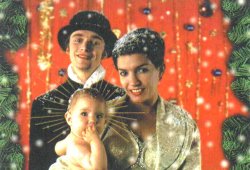 The Christmas season in Greece begins December 6th, St. Nicolas day, and ends in January 6th, Epiphany. In Greece Christmas is not such a pronounced holiday as in most of the Western countries since for the Greeks the most important religious holiday is Easter. During the festive period shops decorate their windows and most mayors decorate the streets of their towns but in general such decorations are modest and most Greeks consider them "kitsch". House yards and trees are rarely decorated and all these very typical colourful lights and other Christmas decorations are not very popular in Greece. The general climate in the country is not so commercialised as elsewhere and Christmas is a rather solemn, religious holiday, even though more and more foreign customs "invade" the Greek culture as the years go by. "Merry Christmas" in Greek is "Kala Hristouyenna".
Inside houses the classic Christmas tree is present throughout Christmas season but this too is a relatevely recent custom introduced from abroad. The Greek equivalent of the Christmas tree is a "Christmas ship", a ship model decorated with colourful lights. Some say that this custom originates from the islands where fir-trees and snow do not exist.
 In general in most areas of Greece the Christmas season unfortunately goes by without the slightest flake of snow.
Probably the most typical image of Christmas in Greece is children singing the "Kalanda", traditional Christmas carols sang the Christmas morning and the morning of the New Year. Groups of children knock on people's doors and shout "Na ta poume?" meaning "Should we sing?" holding "trigona", metallic triangles that produce the rhythm of Kalanda.
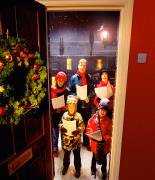 Their reward is money and Christmas cookies, such as "Melomacarona" (honey cookies), "Kourabiedes" (almond crescents) and "Diples". Greek households should prepare LOTS of such cookies since these two mornings each house might get visited even 20 times (or more if it is in the province) by children singing the Kalanda. The Kalanda are as old as Greece and originally were hymns acompanied by floute in honour of God Dionysos. Ancient Greek children used to sing these hymns holding a model ship as a symbol of Dionysos' return. This custom is considered to be the origin of the Greek Christmas ship. Another typical kind of Christmas food in Greece is the "Christopsomo", "Christ's bread", a home-made sweet bread decorated with religious and other symbols made from dough. St. Basil's day people "renew the waters" of the house by emptying all pots and refilling them with fresh water. In many cases water offerings are given to "naiads", small female mythological creatures resempling fairies responsible for water, and other beneficial and kind mythological creatures.
One more peculiarity of Greek Christmas is Santa Claus himself. He was introduced to Greece only the last few decades for commercial reasons. The Greeks do not refer to Santa Claus but to St. Basil instead, who nowadays has come not only to look exactly like Santa Claus but to be associated with him as well.
 St. Basil aka Santa Claus does bring the presents through the chimneys dressed in red and in general acts in the same way as in the rest of the world but he has a religious background as well (mentioned in the next paragraph) responsible for another Greek custom, the "Basilopitta", St. Basil's cake. This cake is prepared for the New Year's Eve dinner, which could include stuffed turkey even though it is not very popular among Greeks. Inside the dough of the cake people hide a decorative coin (in the past it used to be a golden or silver coin of great value!). When the New Year's Eve dinner is over Basilopitta is presented as dessert and the head of the house (who can be an elder grandmother or another highly respected family member) will form the sign of the cross on top of it with the knife. Then the cake is cut in pieces each of which is dedicated to a religious person such as Christ or Virgin Mary or even the house or the country. Then the pieces are offered to the guests and the person that happens to have the piece with the coin is considered to be blessed and lucky for the rest of the year.
The peculiarities of Santa Claus in Greece do not end here though. In Greece he is real and his name is Nicolas! In 300 AD in a city in Minor Asia called Myra lived a young man from a noble rich family named Nicolaos. He soon became a priest and he was very sensitive to poor and oppressed people. He gave all of his fortune to relief them and he would give money to unmarried poor girls as a dowry. The legend goes that he used to throw bags of gold coins through the chimney and loved children, a precursor of modern Santa's actions!
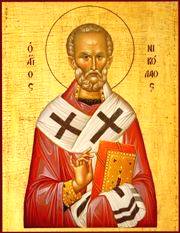 Nicolaos, after many years of persecution and imprisonment became eventually a bishop. Bishops have to wear red robes and Christian Orthodox priests have to wear long beards! (Does that begin to look familiar?). Another legend associated with his life is the story in which people of Myra one day gathered all of their valuable belongings in order to offer them to Nicolaos as a sign of graditute. Nicolaos was unable to accept them and he attempted to return them back to their owners but then it was too late since people could not decide what belonged to whom. Nicolaos then thought of something else to solve the problem. He ordered numerous little cakes to be baked which then he distributed to the people after hiding a piece of jewellery or coin inside each of them. From this story originated the custom of Basilopitta. After his death he became the patron saint of Russia that introduced his image to the Arctic circle. (we get closer to Santa's territory now!) The Dutch would call St. Nicolas, with the name Sinterklaas, from which came the name Santa Claus! In 1822, Clement C. Moore composed his famous poem, "A Visit from St. Nick," which was later published as "The Night Before Christmas." Moore is credited with creating the modern image of Santa Claus. So, it seems that in Greece St. Nicolas/St. Basil/Santa Claus was reintroduced after making a whole circle in Europe! St. Nicolas Name Day, December 6th, the anniversary of his death, is the beginning of the Christmas season.
Another very characteristic legend of Greek Christmas is that of "Kallikantzari". Kallikantzari are small mischievous creatures (something like goblins) that appear on St. Nicolas Day from the center of the earth with one thing in their minds: how to cause as much trouble as possible to humans. They are not so much dangerous as annoying as they tend to cause many things to brake or food to spoil or any other kind of unconviniency taking place. In general all accidents or unpleasant events happening during the Christmas season are attributed to them. During day they hide in dark places and they come out at night until the third call of the rouster.
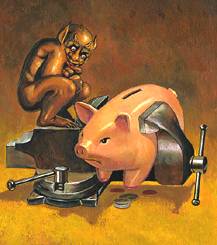 Their real purpose though is not only that. According to legend there is underground a single tree whose roots keep the earth in place, the Tree of Life! Throughout the year Kallikantzari try to cut it down but when Christmas come and while they are about to finish they surface from earth to cause trouble to humans or enter a house from the chimney and eat the stored food or the Christmas cookies or spoil the wine. People in order to protect themselves keep the fireplace lit constantly throughout the Christmas season (exactly the opposite of what people do in other countries for Santa Claus!), hang a piece of meat outside of the house as a bait (and not milk and cookies!), they avoid to walk alone at night and they even avoid to bath after midnight! Kallikantzari eventually are forced to leave the surface of the earth in Epiphany when people sprinkle their houses with holy water. While underground they realise that the Tree has grow back and for the rest of the year until the next St. Nicolas Day they try all over again to cut it down! Children born at Christmas day thought to have some of Kallikantzari features in character and/or form. In some areas of Greece people celebrate Chrismas with something like a carnaval. They dress in animal skins and wear masks trying to resemple as much as possible to kalikantzari. Then they dance in the streets in the music of drums and "clarino" in a wild paganistic way. This custom, as the carnaval itself, originates from feasts dedicated to God Dionysos, a wild dranken God prone to excess and carnal pleasures!
Other Christmas customs are "the feeding of the spring" and "the braking of the pomegranade". The Christmas or New Year's early hours (or midnight) in some villages young unmarried girls leave their houses to take the "silent water". It is called like that because thei are supposed to stay silent at all times. When they reach the water spring they offer all sorts of delicacies such as butter, cheese, bread, jam, etc. near the spring and while they fill their pots with water they say "May my life flow as your waters". Then they throw inside a leaf of basil and three pebbles and they return home. They remain silent until all family members drink from the "silent water" and then they scatter the pebbles around the house. The custom of the pomegranade is more common. When people return from the Christmas mass they brake a pomgranate at the main entrance of the house wishing each other "Kali hronia" that is, "Happy new year".
 The scattered seeds symbolise wealth and fortune. In the Ionian islands in new year's Eve people go out in the streets and sprinkle each other with perfume exchanging seasonal greetings.
The Epiphany is a very important day for the Greeks as well. It is the official end of the Christmas season and the last chance to take off all decorations! That day takes place the "Blessing of the Waters", a ceremony performed everywhere in Greece by a priest. The priest accompanied by lots of spectators gives a short mass next to some body of water. It could be the sea next to the port, or a river, a lake, etc. Then he blesses the waters praying for sailors, fishermen and other people working in the water and he throws a valuable cross inside the waters. At that moment lots of male spectators of various ages who are waiting for this very moment are diving inside the freezing waters to retrieve the cross. The competition is strong and the winner who will offer the cross back to the priest receives his blessing and he is considered to be under a special favour for the rest of the year. In small societies it is considered a great honour to be the one that finds the cross. Then people take holy water from the church and sprinkle their houses with it to drive away the "pagana" as they call them, the Kallikantzari and other evil creatures and spirits. The day of Epiphany is a day of renovation and rebirth.
|


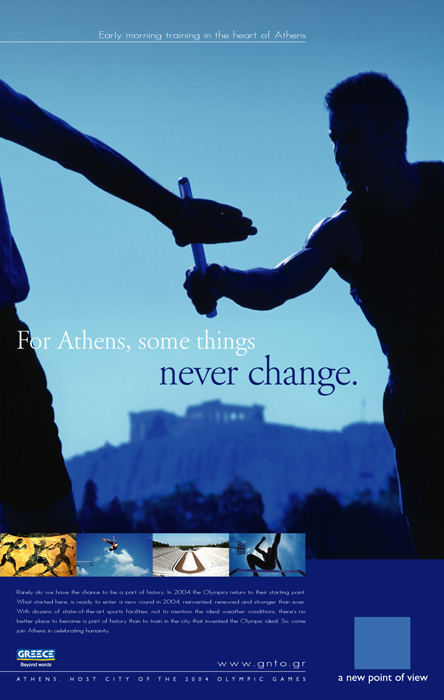 For Athens some things never change.
