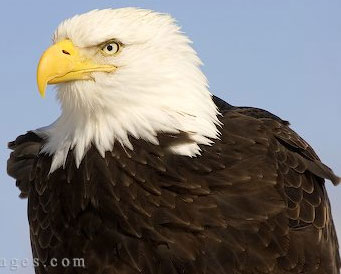
| The plumage of an adult Bald Eagle is evenly brown with a white head and tail. The tail is moderately long and slightly wedge-shaped. Males and females are identical in plumage coloration, but females are 25% larger than males, displaying sexual dimorphism. The beak, feet, and irises are bright yellow. The legs are unfeathered, and the toes are short and powerful with long talons. The highly developed talon of the hind toe is used to pierce the vital areas of prey while it is held immobile by the front toes. The beak is large and hooked, with a yellow ere. The plumage of the immature Bald Eagle is brown, speckled with white until the fourth year, when it reaches sexual maturity. This species is distinguishable from the Golden Eagle in that the latter has feathers which extend down the legs. Also, the immature Bald Eagle has more light feathers in the upper arm area, especially around the armpit.Body length ranges from 27 to 40 inches. Adult females have an average wingspan of about 7 feet; adult males have a wingspan of 6 ft 6 in. Adult females weigh approximately 12.8 lb, males weigh 9 lb. In the wild, Bald Eagles typically live about 20-30 years, but can realize a life span of approximately 50 years. They generally live longer in captivity, up to 60 years.
|
 |
| The Bald Eagle prefers habitats near seacoasts, rivers, large lakes, and other large bodies of open water with an abundance of warm-water fishes.
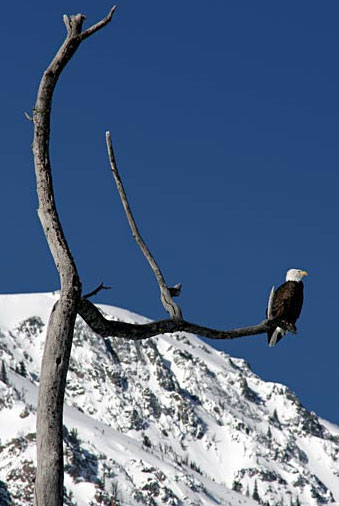
The Bald Eagle requires old-growth and mature stands of coniferous or hardwood trees for perching, roosting, and nesting. Selected trees must have good visibility, an open structure, and proximity to prey.
The Bald Eagle is extremely sensitive to human activity, and occurs most commonly in areas free of human disturbance.
The Bald Eagle's natural range covers most of North America, including most of Canada , all of the continental United States, and northern Mexico.
Bald Eagles will also congregate in certain locations in winter. From November until February, between one and two thousand birds winter in Squeamish, British Columbia , about halfway between Vancouver and Whistler. |
 |
| The Bald Eagle's diet is opportunistic and varied, but most eagles live mostly off of fish . In the Pacific Northwest, spawning trout and salmon provide most of the Bald Eagles' diet. Locally, eagles may rely largely on carrion, especially in winter.
They also may sometimes feed on subsistence scavenged or stolen from campsites and picnics, as well as garbage dumps. Mammalian prey includes rabbits, hares, raccoons, muskrats and deer fawns. Preferred avian prey includes grebes, alcids, ducks, gulls, coots, egrets and geese. Most live prey are quite a bit smaller than the eagle. Reptiles, amphibians and crustaceans (especially crabs) are preyed on when available.
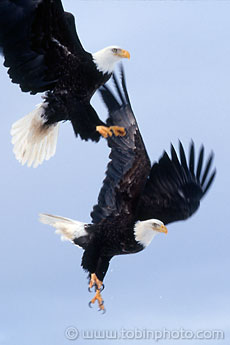
To hunt fish, easily their most important live prey, the eagle swoops down over the water and snatches the fish out of the water with its talons. They eat by holding the fish in one claw and tearing the flesh with the other.
Sometimes, if the fish is too heavy to lift, the eagle will be dragged into the water. It may swim to safety, but some eagles drown or succumb to hypothermia. |
 |
| The Bald Eagle was severely affected in the mid-twentieth century by a variety of factors, among them thinning of egg shells, attributed to the use of the pesticide DDT. While DDT itself was not lethal to the bird, it made an eagle either sterile or unable to lay healthy eggs: the eagle would ingest the chemical through its food and then lay eggs that were too brittle to withstand the weight of a brooding adult. By the 1950s there were only 412 nesting pairs in the 48 contiguous states of the USA. A 1984 National Wildlife Federation publication listed hunting, power line electrocution, collisions in flight and poisoning from eating ducks containing lead shot as the leading causes of eagle deaths. Other potential causes of Bald Eagle populations reductions include oil, lead, mercury, stress from noise, disease and human and predator intrusion. Though its population has declined within the last half century. The 1940 Bald Eagle Protection Act in the U.S., which protected the Bald Eagle and the Golden Eagle, prohibited commercial trapping and killing of the birds. The Bald Eagle was declared an endangered species in the U.S. in 1967. Permits are required to keep this species in captivity. Currently, the Bald Eagle population is slowly but steadily recovering. The U.S. state with the largest resident population is Alaska with half of the estimated 70,000 Bald Eagles on Earth . |
 |
| The Eagle became the National emblem in 1782 when the great seal of the United States was adopted. The Great Seal shows a wide-spread eagle, faced front, having on his breast a shield with thirteen perpendicular red and white stripes, surmounted by a blue field with the same number of stars. In his right talon the eagle holds an olive branch, in his left a bundle of thirteen arrows, and in his beak he carries a scroll inscribed with the motto: "E Pluribus Unum." The Eagle appears in the Seals of many of our States, on most of our gold and silver coinage, and is used a great deal for decorative patriotic purposes.
The image of the Bald Eagle has become commonplace. It is stamped on our quarters, half-dollars, dollar bills, and postage stamps. The Bald Eagle is mounted on homes, storm doors, mailboxes, mud flaps, faux license plates, police badges, and public buildings. It perches atop flagpoles, weather vanes, trophies and monumental pedestals. |
 |