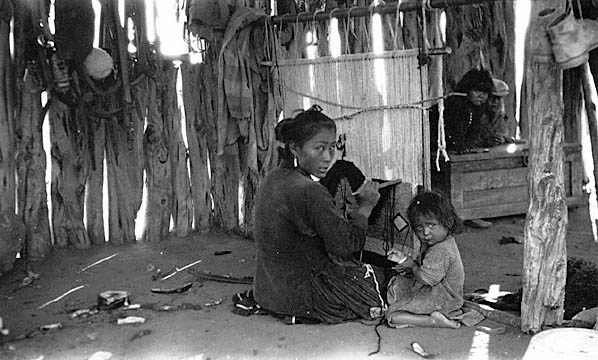
a few words onPrimitive Techniques...& primitive technicians.30+ years ago, It became apparent to me the old style, or primitive' techniques of weaving done by the Dineh (navajo) of yesteryear, were now a thing of the past, as concerned those rare old blankets. Gone as well, were most all weavers of the ceremonial dresses and sash makers of the Hopi nation. So I set about learning what was needed in order to continue this truly primitive weave, as a true form of art. While Hopi have always done in the ways that concern Hopi matters, so some few male weavers will remain to pass along knowledge in the special art needed to assemble a ceremonial sash, belt or skirt for a sacred dance. My attention was turned instead to that lost primitive blanket from a time before white intrusion into the art form. The textile I refer to now is that fine, tightly woven blanket of intricate or simple pattern, that was said to be of such tight weave that a bucket of water poured into its center could be carried two miles across the desert before the first drop would penetrate to fall to the sand. These textiles were almost 'cardboard-like' when first removed from the loom. Due to a combination of being woven from a fine, tightly spun churro cord, still retaining some lanolin content. But chiefly because of the weavers habit of severely beating each and every pass of the weft down into the warps with the use of as large a batten-stick, or shed-stick as the shed opening would allow. Wefts were additionally packed down tightly with the use of a wooden batten fork or comb. These were 'bound-weaves' in the truest use of the word. Not only were they bound at all ends and selvages with a double or triple 'twill cord', but also and mainly because the entire warp was one cord without knot or join throughout the piece. Laid out initially into a figure eight configuration, in order to create the two sheds that would be maintained throughout the weaving of the blanket. It is still one of the true marks of recognition of this type of weave; to find a knot at each corner containing five cords in each knot. These were where the two twisted selvage cords and the end three twill cords that bound the four edges join at each corner. Additionally, when the pattern is duplicated from one side to the other, you will know you are witnessing a true primitive bound weave. The use of pattern had advanced from simple stripes toward more intricate zig-zags and vertical and diagonal effects, to create interlocking keyed effects and many complex variations of design by the time the white trader came on the scene and influenced the demise of this type of weave. These weavings had long been traded and coveted for wear within the trade routs of the Dineh, with other nations. So much so that they became known much later, as 'Chief Blankets. But when trade with the new white people started to become established, it spelled the end of the 'Old style' blanket, in favor of the more loosely woven and much thicker Navajo Rug. Later, when their value increased to remove them from the floor and onto the wall, the new style Navajo blanket weave was born. It does not come close to approximating the weave I am speaking of. Only few examples of those 'old-style' blankets that were from the period shortly before the demise of the art form are left in existence. Most all housed in museums and a very few private collections. Nothing except for a few scraps are remaining from those earliest works. After I had around six years invested in just learning the processes involved in the manufacture of this textile, to a point where I was proficient enough to duplicate it in a crude example from start to finish, I spent many more years in learning some lessons I had started without being aware of as existing. These I like to call the clandestine lessons of the primitive loom. They are in a table of contents under the broader heading of, "Patience." Lessons in patience that will change many facets of your life forever, once learned. So much so in fact that any cloth you may assemble, no matter its intricacy or beauty, will become a by-product of the true value of that endeavor. When you are privileged to hold frayed remnants of those 'old-style' primitive blankets in your hands, to examine and fondle in the harsh glare of museum fluorescent, while knowing exactly what was put forth, in order to patiently assemble them. Then think of that primitive weaver, sitting on a sheep skin in the sands of the desert, as part of a primitive tribe. Knowing all the while that the very best minds of today's weaving technology is not capable of manufacturing any machine with an ability to duplicate that primitive weave. Knowing it can scarcely be duplicated with those exact same primitive methods used in its original manufacture. It cast the word, "Primitive" into a new light. It shows it to mean someone with the skill and vast amount of patience needed to learn how to take the barest of fugal materials and turn them into not only a utilitarian product of need, but also a high representation of intricate art in its purest form of beauty. Two Horns Chu'a -walk in beauty- |
|
Page views: | |||
|
NEXT PAGE
| |||
|
Index to LOOM ppgs |
Index to Main ppgs. |
("Simple Coverings") | |