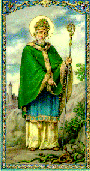
About St. Patrick
The person who was to become St. Patrick, the patron
saint of Ireland, was born in Wales about AD 385.
His given name was Maewyn.
When he was 16, he was sold into slavery to Ireland
where he was a shepherd for 6 years.
While in captivity he studied and turned to religion.
He escaped slavery and later returned to Ireland as a
missionary, determined to convert Ireland to Christianity.
He used the shamrock to explain the Holy Trinity.
Patrick was quite successful at winning converts.
And this fact upset the Celtic Druids. Patrick was arrested
several times, but escaped each time.
He traveled throughout Ireland, establishing monasteries
across the country. He also set up schools and churches
which would aid him in his conversion of the
Irish country to Christianity.
His mission in Ireland lasted for thirty years.
After that time, Patrick retired to County Down.
He died on March 17 in AD 461. That day has been
commemorated as St. Patrick's Day ever since.
Much Irish folklore surrounds St. Patrick's Day.
Not much of it is actually substantiated.
Some of this lore includes the belief that Patrick raised
people from the dead. He also is said to have given
a sermon from a hilltop that drove all the snakes from Ireland.
Though originally a Catholic holy day,
St. Patrick's Day has evolved into more of a secular holiday.
One traditional symbol of the day is the shamrock.
And this stems from a more bona fide Irish tale that tells
how Patrick used the three-leafed shamrock to explain the Trinity.
He used it in his sermons to represent how the Father,
the Son, and the Holy Spirit could all exist as separate
elements of the same entity. His followers adopted the
custom of wearing a shamrock on his feast day.
The holiday, March 17th, is marked by parades in
cities across the United States. The largest of these,
held since 1762, is in New York City, and draws more than
one million spectators each year.
In Ireland, it is a religious holiday similar to Christmas and Easter.
Symbols of Saint Patrick's Day
The color green - because it is the color of spring,
Ireland, and the shamrock.
Leprechaun - Irish fairy. The name leprechaun is
derived from the old Irish word luchorpan which
means "little body." A leprechaun is a fairy taking the
appearance of a miniature old man.
Leprechauns are solitary creatures and spend their time
making shoes and brogues. If you hear the sound
of his hammer when he is at work you know you have found him.
If caught, he can be forced to reveal the whereabouts
of his treasure, but the captor must keep their eyes on him
every second. If the captor's eyes leave the leprechaun,
just for a moment, he will vanish.
The Blarney Stone - is a stone set in the wall of the
Blarney Castle tower in the Irish village of Blarney.
Kissing the stone is supposed to bring the kisser the gift of
persuasive eloquence (blarney).
The origins of the Blarney Stone's magical properties
aren't clear, but one legend says that an old woman cast a
spell on the stone to reward a king who had saved her from drowning.
Kissing the stone while under the spell gave the king
the ability to speak sweetly and convincingly.
Shamrock - a member of the clover family, was used by
Patrick to explain the mystery of the Trinity.
The three leaves of the shamrock representing the
Trinity (the Father, the Son and the Holy Spirit).
According to Irish legend, Ireland's patron saint chose
the shamrock as a symbol of the Trinity of the Christian church.
To this day the shamrock remains the national emblem of
Ireland and is worn proudly by Irish people the world over
on St. Patrick's Day (March 17).