 |
|
|
|
|
|
|
|
|
|
|
|
|
|
|
|
|
|
|
|
|
|
|
|
|
|
|
|
|
|
|
|
|
|
|
|
|
|
|
|
|
|
|
|
|
|
|
|
|
|
|
|
|
|
|
|
|
|
|
|
|
|
|
|
|
|
|
|
|
|
|
|
|
|
|
|
|
|
|
 |
|
|
INTERVIEW WITH THE AUTHOR |
|
|
|
|
|
By Fret Frenulum |
|
|
|
|
|
Matthew Craig has been described as gregarious, articulate, intelligent, lecherous, and an IC-1 male between the ages of 25 to 30 in a state of advanced undress. He has worked as a barman, a musician, a car park attendant and a molecular biologist. Recently, however, he has channeled his energies into more creative work, writing essays for the Internet and creating short comic strips under the nom de publisher "WaterCooler Comix." His first extended project is a biographical comic called "Hondle:" the life story of his dear, departed dog. |
|
|
|
|
|
I caught up with Matthew Craig in a mobile cafeteria, somewhere outside Pwhelli, North Wales. |
|
|
|
|
|
FRET FRENULUM: So, Matthew, tell me a little about "Hondle." |
|
|
|
MATTHEW CRAIG: Hondle is a sixteen-page black-and-white minicomic, telling a few short stories (and some tall tales) about my late pet dog. |
|
|
|
FF: Where did the idea come from for this comic? |
|
|
|
MC: I'd been drawing short strips for some time. I started about this time last year, in fact, while I was working on my PhD. Then, after I left university, I decided that I wanted to do more comics. Well, actually, I wanted to write a children's book. That was originally what this comic was going to be. |
|
|
|
FF: What made you change your mind? |
|
|
|
MC The realisation that nobody was going to be interested in publishing a book about a dog eating his own shit. |
|
|
|
FF: You mentioned that you had been drawing comic strips. Did these feature Hondle? |
|
|
|
MC: Yes. They were single-page strips, and really weren't very good. I scanned them and published them on my website, Written Words. I've since taken them down, as part of a refit of the site. |
|
|
|
FF: But you've been doing other comics work as well, right? |
|
|
|
MC: Sure. I've been putting out short strips on the WaterCooler Comix website for the last few months. However, I wanted to take some time off from that, in order to get this comic done. |
|
|
|
FF: What made this comic so urgent? |
|
|
|
MC: Well, I've been wanting to try my hand at writing for a while, and I figured that I would have a better chance of getting work looked at if I had a bigger portfolio of my own stuff. That, and the Dole have been on at me to prove that I've been looking for work, or at the very least, training for something new. |
|
|
|
FF: Can you take me through the creative process for Hondle? |
|
|
|
MC: Well, I had a fairly strong idea of the story that I wanted to tell: how we got Hondle, the sorts of memories I had of him, how he died and so on. The first thing I did was write a script. This consisted of the text you see in the comic, plus a few artists notes. |
|
|
|
The next stage was to rough out the artwork, one story at a time, until I had a better idea of how long the final comic was going to be. |
|
|
|
FF: Why was that important? |
|
|
|
MC: Well, originally I was going to have a printed version of Hondle, to send out to whoever wanted it. That kind of fell by the wayside, because of the pig-ignorance of certain members of the reprographic community. |
|
|
|
FF: Meaning? |
|
|
|
MC: Some people can't work a photocopier. Anyway, once the rough artwork was finished, and I knew how each page was going to look, I worked out how I wanted to place the text on each page. Then, I sat down and started to draw the comic. |
|
|
|
FF: What sort of art supplies did you use? |
|
|
|
MC: Printer paper and a worn-down HB pencil. And a rubber. |
|
|
|
 |
|
|
FF: You mean an eraser. |
|
|
|
|
|
MC: Quiet, you. So, what I did was copy the roughs in my sketchbook to the printer paper, revising the art where necessary. Then, once the pencil work was finished, I "inked" the art. |
|
|
|
|
|
FF: "Inked." |
|
|
|
|
|
MC: Yeah. In "real" comics, inks are applied to the pencils in order to add definition and depth to the artwork; to make shadows and large areas of black stand out more, and so on. |
|
|
|
|
|
FF: There's not an awful lot of shading in Hondle, though, is there? |
|
|
|
|
|
MC: Ha ha ha, no. Really, all I did was trace oer the pencil art with a black biro, so that the art would scan better. |
|
|
|
FF: The pencils wouldn't scan? |
|
|
|
|
|
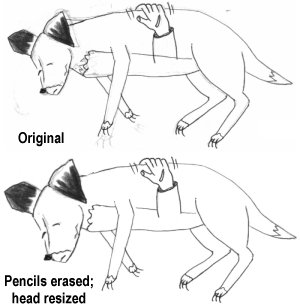
MC: Not on my scanner. Well, not so you could see all the artwork, anyway. Once I had scanned the inked art into my PC, I was able to manipulate it: correct errors, resize panels and drawings here and there. I removed most of the pencil work that had carried over into the scan. And, of course, I was able to add in all the text. |
|
|
|
|
|
Some drawings were manipulated to compensate for errors in the original art. |
|
|
|
|
|
FF: Why did you decide to use such plain lettering in Hondle? Why, for instance,did you select these fonts over more traditional "comic book-y" fonts? |
|
|
|
MC: Because Hondle isn't the Legion of Superheroes. |
|
|
|
FF: That's not much of an answer. |
|
|
|
MC: It's not much of a question. I just chose the font that would be easiest to read, without being too stylised. |
|
|
|
FF: So, what did you do next? |
|
|
|
MC: The rest of the process is remarkably easy. I uploaded the comic pages to some free webspace, and wrote the individual webpages in a basic HTML-writer. |
|
|
|
FF: It's that easy to put a comic on the web, then? |
|
|
|
MC: Sure. I mean, I could have done the comic without even touching a pen and paper, if I'd had the patience. In fact, one of the early Hondle strips was done entirely on the PC. |
|
|
|
FF: With a lightpen? |
|
|
|
MC: Nope. Just me, the mouse, and the Undo key. |
|
|
|
FF: It must be a very pleasant feeling, having your own comic out there for the world to see. |
|
|
|
MC: It is. I've a strong sense of pride in this work. It's a very personal story. I suspect that those are the best ones to tell, because the extra emotional investment makes for better work. There's a few things that I wish I'd done differently, of course. |
|
|
|
FF: Such as? |
|
|
|
MC: Well, some of the art is a little rough. I mean, I'm not an artist by any stretch of the imagination, but I can see where I've gone beyond even my meagre ability, in some places. Some of the dialogue is a bit clunky, too. |
|
|
|
FF: It's only your first full comic, though, isn't it? Surely you can allow yourself some mistakes here and there? |
|
|
|
MC: You'd think so, huh? |
|
|
|
FF: Anything else you would have like to have done differently? |
|
|
|
MC: Well, I would have liked to have had a proper printed version in my hands. But that'll be a couple of days in coming, I think. |
|
|
|
FF: So what's next? What can we expect from WaterCooler Comix in the near future? |
|
|
|
MC: Well, I want to do more comics. I have a Big Idea for a comic called Ripcord Messiah. |
|
|
|
FF: Ripcord Messiah? What does that mean? |
|
|
|
 |
|
|
|
|
MC: When I work that out, I'll let you know. |
|
|
|
|
|
FF: Can you tell me a bit about the story? |
|
|
|
|
|
|
 |
|
|
|
|
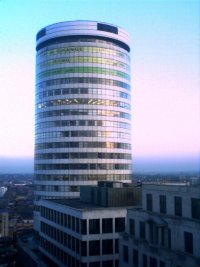
MC: Well, it's about a group of superheroes based in the Rotunda, which is the big round skyscraper building in Birmingham. |
|
|
|
|
|
FF: The one that overlooks the Bull Ring? |
|
|
|
|
|
MC: That's it. Anyway, it's not really a superhero adventure as much as it is a straight drama. It's really just about six people working closely together. There's lots of little bits of friction between two or more members of the team, lots of dramatic triangles, which comes out of the fact that they're all really quite different people. |
|
|
|
|
|
Then, there are added complications: one member of the team is getting married, while two more are on the brink of divorce. Another member is thirty-five and living with his mother, and is desperate to move out. |
|
|
|
|
|
Another member is dealing with being quite a devout Christian in a team of more-or-less atheists, who take the piss out of him an awful lot. And the final member, who I've kind of cast in a leadership role, has to try to keep these people together, because he doesn't want them falling apart as a group when they might be needed to save the world from a six-titted alien cyborg, or something. |
|
|
|
|
|
|
The Rotunda, located in the heart of Birmingham. |
|
|
|
|
|
FF: So, there's a bit more action in this comic than in, say, Hondle? |
|
|
|
MC: I haven't started writing the story properly, yet, but I don't think it's going to be a Big Action Comic. I don't think it's going to need it, necessarily, with all the interpersonal stuff going on. |
|
|
|
FF: Then why make it a superhero story? |
|
|
|
MC: Because, if I made it a police drama or a hospital drama, I'd have to do a lot more factual research. And I'm a very lazy man. |
|
|
|
FF: So, in conclusion, what do you want people to take away from Hondle? |
|
|
|
 |
|
|
|
|
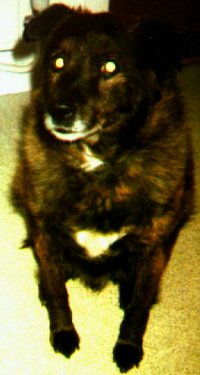
MC: Look. This story isn't subtle. There's no allegory here, no hidden meaning. The big message of Hondle is this: I loved my dog, and I miss him. I hope that people enjoy the story, but I didn't write it for them. |
|
|
|
|
|
I wrote it for him. |
|
|
|
|
|
And for me. |
|
|
|
|
|
The subject. |
|
|
|
 |
|
|
|
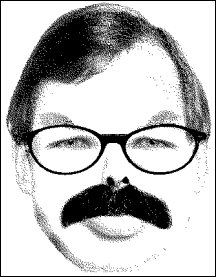
Fret Frenulum is a highly respected columnist for the Manchester Morning Star, a cultural pundit for shows such as "Snoop Cock" and "Nodding and Going Mm," and a figment of the author's diseased imagination, although you would be forgiven for believing otherwise. You big mentalist. |
|
|
|
|
|
 |
|
|
|