By Steve Farrell
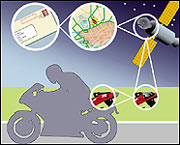 At the moment, insurance firms use data such as the type of bike you ride and the number of claims you've made to determine how much you pay for your policy. But Progressive has developed a system which enables it to take into account how many miles you travel, too. The firm claims it could lop 25 per cent off the cost of an average policy - as long as you keep your mileage to a minimum and avoid speeding. The system uses a global positioning system (GPS) to determine your riding habits. A transmitter the size of a video cassette is fitted to your bike and records information about its movements, constantly transmitting it to the insurance firm via a satellite. That enables the company to find out how many miles you cover and charge you accordingly. Instead of paying a fixed amount when the policy is renewed, you receive a monthly bill based on how far you have travelled. That could be good news if you restrict your riding to sunny afternoon blasts. But if you do a lot of touring or cover hundreds of miles a week on your commute to work, it could mean you end up paying more for your insurance than you do already. But the really bad news is that the system can also tell the insurer if you regularly break the speed limit, enabling the firm to classify you as a bad risk and bump up your premium as a result. Each tracker would cost several hundred pounds, but the cost of buying and installing it would probably be borne by the insurers. The rider would sign a consent form allowing the insurer to access the data, but the company would have to agree not to pass the information to anyone else. So far, the system has only been tested on cars, but Progressive has confirmed that it could easily be modified for bikes. However, it is unlikely to appear for a few years. Dominic Birch, motor insurance manager for Direct Line, said: "Anything which saves money is good, but there are a number of issues which would have to be looked at first, including civil liberties. The European Convention on Human Rights has very tight rules on monitoring movements, which could create problems. We would also need to look at whether it really has saved customers 25 per cent." If it is successful, many insurance firms could find it appealing, as it would enable them to control the amount they charge much more precisely. Richard Alger, of Norwich Union, Britain's largest bike insurer, said: "I think the idea has some merit and we'll certainly keep an open mind on it. But any developments are some way down the line." If the thought of a Big Brother watching your every move isn't enough to annoy you, insurers have another trick up their sleeve. Riders could soon find theft claims rejected if their bikes aren't secured with a Sold Secure-approved lock. Broker Choice Quote has revealed that one of the insurance firms for which it sells policies already refuses to pay up if a bike is stolen without an additional lock fitted. A rider would have to sign a declaration saying a lock was fitted. According to Chris Pracey, the firm's motorcycle insurance manager, most other insurers of superbikes will be doing the same within a year. Pracey refused to name the firm which already operates in this way, but said it accounted for around three per cent of all policies issued by Choice Quote. He said: "The bike actually has to be locked to something, such as a ground anchor, but there also has to be some kind of additional lock on it, such as a disc lock. It applies whenever the bike is left anywhere except in a garage. "I believe that within 12 months most superbike riders will find their insurance companies insisting on the same thing, and refusing to pay out if the requirements aren't met." |

 |
 |
 |
 |
 |
 |
 |
 |
 |

speed is just another way to say CBR 929 RR




About Us

Picture of the month will be posted here |





BEST PRICES

Trick Products