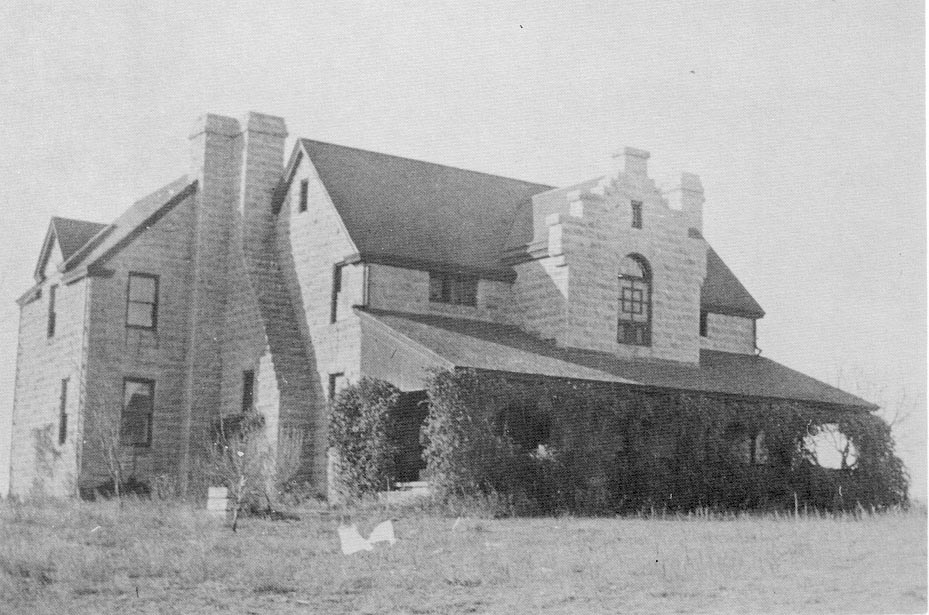
For 67 year it baffled Texans. Is this, at last, the solution of....
by Oren Arnold
Reprinted from the December, 1956 issue of Coronet Magazine
NOTE: Welton Ostrander was the stepbrother of John and Chester Loomis, and son of Lucy Elizabeth Hicks (Ostrander) Loomis from her first marriage. Welton Ostrander and John Loomis were partners in the Ostrander and Loomis Land and Livestock Company in Concho County, Texas. This is one story of his family's strange disappearance from the area of Texas known as Paint Rock (so named for the Native American rock paintings there.) According to John Loomis, the reason they disappeared was that Welton's wife was bored with western life and insisted they move back to the east. You choose the version you like!
Demps Tucker reined in his tired horse before the castle-like stone house on the lonely hilltop. Its massive chimneys and casements of quarried gray stone suggested England rather than the west Texas wilderness of 1889.
Tucker called a "halloo" from the saddle. It was shortly after noon, the cowboy hungry and, according to the law of rangeland hospitality, he was entitled to a meal. He felt uneasy about stopping here but no other house was closer than ten miles.
"Halloo!" he called again.
Still there was no answer. A strange silence brooded over the great stone house. None of the Ostranders was in sight, no ranch hands, nor any livestock. Even if Old Man Ostrander was away, his wife or their two pretty daughters ought to be somewhere about.
Demps tied his horse and went to the door. It was unlocked. He walked inside.
Everything was in order. In the dining room the table was set for noon dinner with silver, fine china, and food untouched. Demps waited a bit, then sat down, ate, wrote a note of thanks, and rode away toward the Concho River.
Ten days later, Demps stopped again. As before, nobody was in sight. Slowly he dismounted, knocked, then went inside. table was as he had left it. His note had not been touched. Demps galloped away to spread the alarm.
By next morning a score of ranch folk had gathered. Nobody knew what to think. No known trouble or danger had threatened W. B. Ostrander or his family, though they were a haughty, aloof clan. Search of the house showed everything in good order, even to clothing hanging neatly in closets.
Miles way on the range Mr. Ostrander's Mexican vaqueros were found at work with his cattle They were mystified by the news. They seldom came to the big house because they weren't welcome there, they said.
Posse men rode in a widening circle, searching. They found no trail or trace.
A week later, on a Sunday morning, a crowd of neighbor folk gathered at the house. A deputy sheriff went through what papers could be found. But they revealed no known relatives, no motive, nothing. Unaccountably, the Ostranders had apparently vanished from the face of the earth.
As they were standing around the yard talking, a woman burst from the house, a look of horror on her face. "Up in the attic--" she cried. "Blood! Under a rope hanging from a rafter. They must have been murdered!"
That set everyone looking for bodies or graves until John Loomis, a rancher, rode up and explained, "Ostrander always hung his beef in his attic. Had a fresh kill not long ago. That's just steer blood."
But the exciting words "blood...rope...attic...murder" had spread and interest in the mystery grew.
An imaginative cowboy, new to the region, soon gave it another startling twist. While hunting stray cattle in a thicket along the nearby Concho, he found a "record of the killing." On a cliff 30 feet above the stream bed was a painting of a white woman being scalped.
Had a roaming band of Comanches wreaked one last bit of vengeance? To many it seemed logical. But the rock painting turned out to be merely a routine Indian pictograph many years old.
Nevertheless, the legend of the vanished Ostranders now acquired a name--The Paint Rock Mystery--and became a main topic of conjecture around campfires and corral fences, in saloons and at church meetings. Songs of mournful lamentation and speculation were composed about them.
"They were rich dudes from Syracuse, New York," a neighboring rancher testified, and correctly. "Some English investors had put up a lot of money in Texas land, and they hired Ostrander to come out and set up a ranch on it. He knowed nothing about cattle, or about people. Him and his family acted like they was above everybody; lived mostly to theirselves.
"Everybody knowed Ostrander was afraid of something, but never knowed what. He made more enemies out here than friends."
Had some enemy lured the missing family away from their stone house and killed them? The superstitious decided so, and endowed the deserted mansion with chain-clanking ghosts.
For year nobody would even venture in to steal the silver or the clothing. Then souvenir hunters began to make raids. Eventually, the law took over and the ranch acquired new owners. Still there was no trace o the Ostranders. But "clues" kept popping up to reactivate the legend.
T.K. Bearden hired cowhands to bury a fine horse accidentally killed near the stone house. Two feet down they unearthed a human skull. "It's Ostrander's," they agreed, and spread the news.
Somebody stole the skull from Mr. Bearden's camp. It turned up in Mexico, teamed with three others and was exhibited as the remains of the four Ostranders.
Finally a doctor examined the first one and said it was most likely a woman's. That became "proof" of Mrs. Ostrander's murder. The skull is probably still kicking around the border country.
Around 1905, a former buffalo hunter and Indian fighter camped for a few nights in the deserted house. The flickering light of his lantern was seen and seven brave young Mexicans rode over at dawn to investigate.
The old man saw them coming and was afraid, but he had an old frontier trick up his sleeve. With a gimlet, he bored a hole angling through a .50 caliber bullet that fitted his buffalo gun. When the horsemen were about 200 yards away, he fired.
"Sreee-e-e-eEEE-e-e-e-e-e!"
The bullet screamed like a wounded mountain lion--or an angry ghost! It was a trick used by pioneers to frighten Indians. It sent the horsemen galloping away to spread the word that the old house was ghost-ridden indeed.
The more superstitious had long ago decided that "Satan just came up out of the earth, grabbed the haughty Ostranders and took them down below." This of course was ridiculous--or was it?
One evening in 1949, Hosea Morgan stretched a trotline across Kickapoo Creek near the Ostrander house, hoping to catch a few catfish. The creek had been 50 yards wide and four to six feet deep there for longer than men could remember. But at daybreak, Hosea returned to find his trotline swinging in the air, and not a drop of water in the Kickapoo!
Even more astounding--for a stretch of 300 yards an upthrust of the stone creek bed was now visible. It looked as if some gigantic mole had crawled under the solid rock of the bed, lifting millions of tons of it, cracking and tossing huge flat boulders aside, and letting the water disappear. Yet there was no other sign of earthquake, no evidence of explosion, nothing else disturbed anywhere about.
The phenomenon has confounded scientists, who still come to study it. But not those Texans who hold to the Satan theory. "It was the spirits of the Ostranders trying to escape," they said.
Everybody has a theory as to what happened to the Ostranders and many are even more fantastic. Actually, there are probably only two people in Texas today who really know. One is a very elderly woman who visited the Ostrander home as a little girl; the other a distinguished ex-judge whose whole life has been linked with the region. From their knowledge we can re-enact that lost day back in 1889.
It must have been 11 A.M. when dinner was placed on the table. Ranch folk often ate early. Ostrander was probably waiting the call to table when the man on horseback came galloping up in a swirl of dust.
"Mr. Ostrander, like you said to, I come in a hurry," he cried. "They're gonna do it--the State Legislature's about to pass the Alien Land Law. Rangers'll be a-coming. They're bound to. Likely this very day!"
Passage of the Alien Land Law meant that no "foreigner" could own Texas land. Because of alleged exploitation practices, the English investors were already in bad repute. There had been repeated threats of violence against them and their hirelings. Now they would be legally stripped of power, and Ostrander, as an exceedingly unpopular one of their managers, would lose prestige and possibly face actual danger.
Moreover, Ostrander had too hurriedly left Syracuse, New York, in the first place; allegedly he was wanted by the police back there for some difficulties with the law. And so now if the Texas Rangers were coming---
Ostrander panicked. Fearfully, he ran to the barns, hitched up a surrey, let out the livestock, quickly gathered his family, and fled.
Several years later he came back for a few days, the old people say. He came very quietly, to see if anything could be salvaged. But it was too late. Texas law had long since run its course.
A lonely, broken man, his family scattered, Ostrander asked that no mention be made of his return. So few ever knew that he had been back at all.
They say he took one last look at the old stone mansion on the hilltop, then quietly disappeared again.
back to homesickcure