He Went Away...
And His Bride Had Only Her Pen to Span the Miles, Ease the Longing
From the Sunday Standard Times, New Bedford, Massachusetts, February 13, 1983
Brad Hathaway, Features Editor
DARTMOUTH--For Sylvia Leonard, the longing stretched into months, and the months into years. Still, she clung to hopes and prayers that someday, she and her husband would be reunited.
The story of her undying love mostly was a private affair, contained in letters to her husband that have survived more than 125 years. Many are tattered and stained, preserved by succeeding generations until they were sold to a collector of historical papers a few months ago.
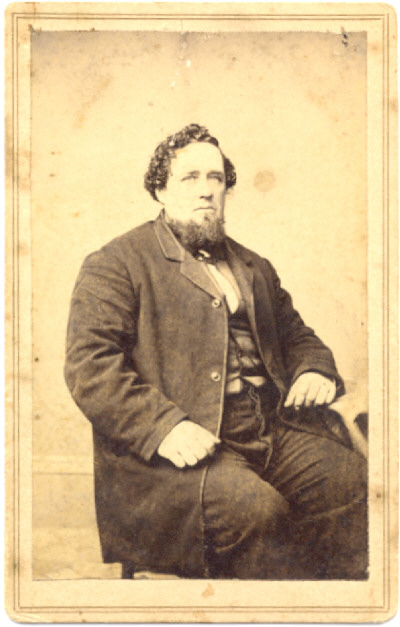
John W. Leonard returned home as mate on the New Bedford whaleship Hillman in 1854. A little more than two months later, his brief courtship with Sylvia Tucker ended in an exchange of Quaker wedding vows. The date was May 28, 1854.
By October, he would sail again, this time as master of the Fairhaven whaleship Lydia for a voyage to the Pacific.
A child--conceived during the wedding trip to New York in those fleeting days when the young lovers knew tomorrow would bring separation--would be born. And the family would be linked by letters traveling halfway around the world.
"Four weeks ago Saturday you went away," she wrote from New Bedford on November 13, 1854, "and it seems almost like four years. But, alas, a long time will have to pass, at best, before I can see you. It is hard work to give up to it, but it must be so."
She told her husband that his brother, George, aboard the whaler Phillipe Delanoye, was reported as having caught seven whales that season. "They think he is on his way home before long. Ah, would that it were you, but such is not the case and will not be for a long time. What joy will be mine to know you are on you way home. My dear husband, be careful for my sake, for you are dearer to me than all the world. I take good care of myself, I feel exactly as if I had two to please, and so, indeed, I have. Don't you remember when I used to cry nights at the thought of your going?"
The lengthy letters were more than expressions of love and loneliness. They served as newspapers of the day, filled with the daily events of family and community life. "The other night we had quite a fire here and burned down Liberty Hall, the whole of it to the ground."
February 21, 1855: "Henry and James each have a son. Whether John's will be a son or not is not decided, but probably will be ere you receive this letter."
"Last Friday, I received your letter and you don't know how pleased I was. It was a long time coming but joy came with it finding you were well and getting along nicely. All you have now you say to regret is that you did not take me with you. I suppose I am better off at home, although it is hard work to think so sometimes."
She told of staying with Capt. Leonard's parents and with his brothers and sisters while he has been away.
"They have had three letters within a short time," she wrote. "George, he has left the ship and gone to the Ochotsk Sea in the Cicero. The Phillipe Delanoye is going another year sperm whaling. I guess he and the Captain did not get along very well."
"Oh, what a fellow (Nat) is. The last letter I wrote you, he says you had better take a copy of the letters you write me now and write them over again bye and bye. He seemed to intimate that love, as it grows older, grows colder. I don't know but it does in some cases, but I know it will not in our case. Separation from you will never change my affection for you. I can truly say that you are all the one I really loved."
Four days later, one cold and blustery Sunday evening, she wrote, "I wish I were with you in warm weather. How pleasant it would be, I think, when we get rich and go south and live. It is so much pleasanter winters there."
Sylvia's handwriting ends halfway down the page. How hurriedly her husband must have glanced through the beginning of the next part, written by her sister, who has been asked to complete the letter to tell him he is "father to a noble little boy on Thursday, the 2nd of March... About 1:00 O'clock in the morning he came to town and was wrapped up in his great-great-grandmother's blanket. He is a real cunning baby...And John, your dear wife is very comfortable indeed and told me to write you. I hope you will not feel too much disappointed for its being a boy. And to name it for you she instantly decided upon."
And so the birth of a son forged a link in the family chain, and from Sylvia's later letters, the growth of the baby is the most important news she can convey. But there remains the heartache brought about by the long separation.
"Oh. John, I miss you more first days [Sundays] than any other time," she wrote. "I have always been so lonesome first days. I miss you now as it is coming warm weather, about the time we were married last year."
"Everything reminds me of you. I look at your miniature often but I need no face to look upon to remind me of you. Your looks are stamped upon my memory."
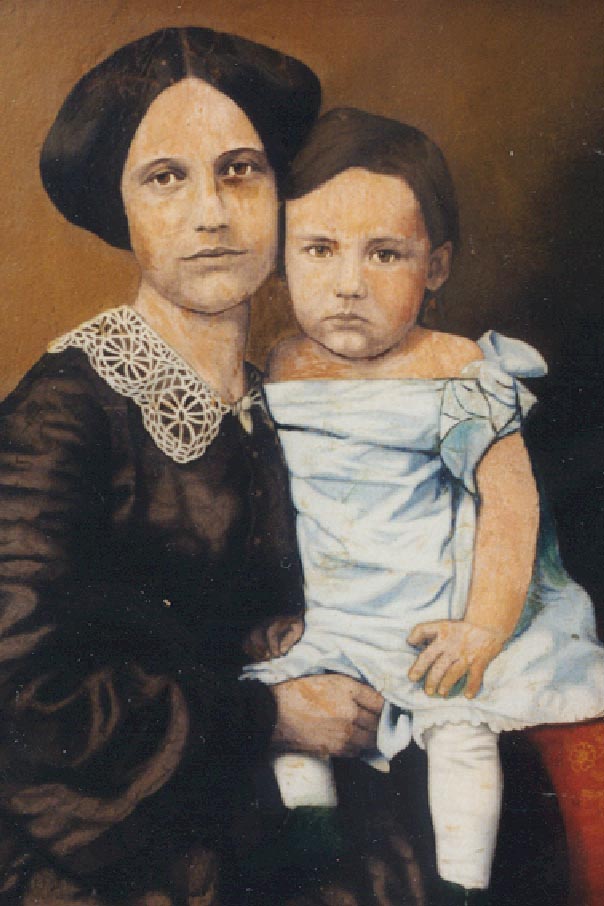
"In August I shall, if nothing happens, have Johnnie's miniature taken and sent to you. Darling child, he won't see his father until he is quite a boy. If they should both live, I dare not think of the time when that happy meeting shall come."
On June 9, 1855, the letter continued, "I received three letters from my own dear husband. Sadness and joy was mingled together. Sorry you were unfortunate as not to have taken that whale, but so glad to hear you were well."
In late July, she wrote of their son. Next month, I am going to put short clothes and little shoes and stockings on him. Won't he look cunning? He has got a little hat. He is a great fat baby, makes me ache by the time it is night these hot days. I tell everybody that by the time he is three years old he will go to the masthead."
September 30, 1855: "Yesterday, the Phillipe Delanoye came in. Your father says Capt. Pierce...he said he saved George's life--a very narrow escape. What a thought! It makes me shudder to think how many hair breadth escapes a sailor's life is heir to."
"One year has nearly expired since your departure, they say the next one will seem shorter. I hope that it may. Don't you remember when you used to tell me it will be so nice when you have a little baby to write about? In this letter I send a little shoe, that you may have as a little memento of your darling boy, if they don't think it too much and take it out in the post office."
Fall faded into winter and as spring approached in 1856, she wrote, "Johnnie is as darling as ever. He walks now as well as I do and can go upstairs, can say "bye-bye," has six teeth and I am going to wean him this month for it takes my strength and flesh. Oh, I think one year from now, if you are prosperous, I shall be straining my eyes for the expected sail, much as I watched it lessen from sight. What grief none can tell but those who experience what it is to part with their friends. May we never know what separation is again."
A few days later she wrote: "It seems now that I never can have you go again and leave me at home. May my home ever be with you whether on the blue lone sea or wherever, it matters not. My fate and yours shall be the same."
April 13, 1856: "It is a beautiful, pleasant day. The sun shines and the grass is coming up all around. It reminds me so much of two years ago. These were the days of happiness, though I hardly realized it. I had no Johnnie then, though I had a dear husband in prospect. And now, little Johnnie is by my side trying to talk and eating gingerbread."
"I dare hardly think of expecting you next spring for fear I shall be disappointed but I will hope for the best. I can never think of being separated from you again. Nothing but your permission will ever keep me from going on another voyage."
"It is now night and I have rocked my baby to sleep. It is a dark, lonesome night and the wind blows high. How often I think, when I lay my head down at night to sleep quietly and sweetly on my bed, would that I might know that your head was pillowed as easy as mine instead of on the rolling billow with the moan of the wind around your bark to lull you to sleep. Oh, that my arms might encircle you as they do Johnnie every night. What happiness would be mine."
May 16, 1856: "And now about our darling boy, Johnnie, if you could only see him. Today I took him to walk in the orchard for the first time. He was so delighted he would stoop over to pick up a dandelion and away he would go headlong. He is so short and thick that he cannot stoop very well. He tries very hard to talk and will, I think before long."
"I am looking daily for letters from you. It seems a long time that they have been coming. Ere this, I suppose you are on the whaling ground anxious for the future which will tell the story whether you come home next spring or not. I cannot bear to think of it, but I will try to put best foot forward and wait the appointed time."
July 3, 1856: "As yet I have received no letters from you this spring or summer. I have looked and looked until my heart is faint, yet I try to keep up my courage and hope everything is all right. Ah, John, are you thinking of two years ago when we were so happy together? I often think of these times and say to myself 'well, I did not half realize the comfort we were taking.' May those happy days again be our curse. I often think if you have to go another season how happy I should be could I take my darling child and come out to meet you and what a happy meeting for us both. The time drags heavily along."
September 29, 1856: "It is now rather late in the evening, but I thought I would write to send you by Henry Howland. It is rather uncertain whether it will reach you or not. If it should, I know it would be acceptable. Poor Henry it is not you that is just going away."
"This morning we hear guns firing. Some ship coming, would it were the Lydia, Captain Leonard, what a happy day it would be for me. But it seems a long wait. The longest half is passed. Keep up good courage and never give up."
Another winter passed and it was obvious John Leonard would not be coming home in the spring, for it had been another poor season.
May 17, 1857: "Everyone is wishing you good luck, John. If I could only help you, how willingly I would do it. I dream of you often and think will it ever be that my dear husband will come home to see me. People ask me some time if I know I have a husband and I tell them, I think I have good proof of it, for Johnnie looks very much like you. I have just carried him a tumbler of warm milk. I asked what his name was: He says John W. Leonard, Jr., talks very plain and says his Papa has gone on the waters. I think he will love you dearly."
August 30, 1857: "Yesterday your dear wife was 25 years old and all the birthday present I had was 6 cents. It is now three years lacking six weeks since you went away and it seems to me ten since we parted. I dare say it seems even longer to you."
September 30, 1857: "I am going to fix Johnnie and me up for the winter. After that, I shall begin to do for you what little I can. I should have made you shirts, but I don't dare for fear they wouldn't fit. This will probably be my last letter. I don't think I shall write again."
The reunion of the Leonards took place the following spring, when Captain Leonard returned to New Bedford Harbor on May 21, 1858. He had been away 3 years and 220 days. His son, John Jr., age 3, had never met him.
Records show that Captain Leonard did not return to the sea that separated him from his loved ones. He took his family far from the shores of Buzzards Bay and headed west across the Mississippi into the plains of Kansas.
There John and Sylvia and Johnnie made their home. But they were denied a long and happy marriage. John Leonard died in Kansas in 1866. His widow was only 34.
After his death, his widow Sylvia walked home to Dartmouth, Massachusetts with her 4 small children: Will, Joe, Alice and John Wood Leonard II. Sylvia remarried to Captain Jonathan Hawes, who was affiliated with the Acushnet Saw Mill. His daughter Addie Hawes became the first wife of John Wood Leonard II, and mother of "Uncle John", the first born of the children of John Wood Leonard II.
This page created 7/28/2000. Back to homesickcure