 |
| Home Archived by the National Library of Australia (background) Tom "Diver" Derrick Bridge, Port Adelaide Latest 13 12 11 10 9 8 7 6 5 4 3 2 1 Oldest f |
 |
| Port Adelaide Bridge Gossip
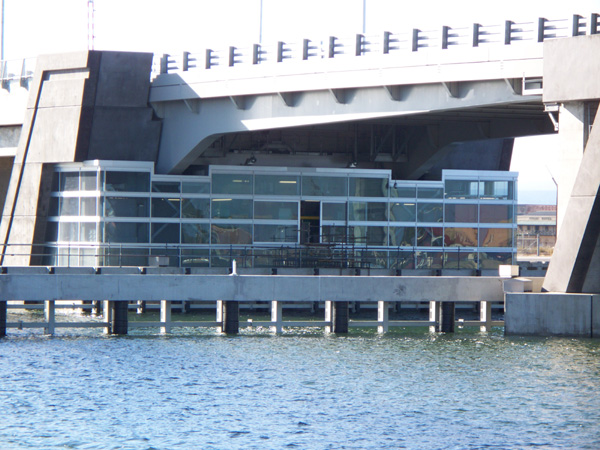
Let's get one thing clear from the start. I know nothing about bridges and even less of engineering. Everything you read below is simply gossip and rumour. The story starts when I recently camped amongst cement encrusted trees between the Adelaide Brighton Cement factory and the new bridges at Port Adelaide. The car and truck bridge is called the Tom "Diver" Derrick Bridge and the train bridge is called the Blessed Mary MacKillop Bridge. (Mary must have been a train buff). The joy of homeless-style camping is that total strangers speak to you of events they wouldn't mention to others. They unload their thoughts onto someone of so little consequence that no one would believe him if these thoughts were repeated. In this case my informers were ABIGROUP contractors and public servants who built the bridges at Port Adelaide. Their chief concern was the predicted century life of the bridges was closer to ten years. One reason was the high-tensile reinforcing mesh left in the rain. It was delivered just on time but due to construction delays got wet and became rusty. This is the thick mesh placed in formwork and onto which concrete is poured. It gives necessary added strength to pylons and the bridge roadway. But this stuff was rusty. If it had been stainless steel mesh there wouldn't have been any problems. When ReadyMix saw the rusty mesh they refused to pour the concrete unless Abigroup released them from their strength guarantee. Abigroup agreed and the concrete was poured. Then came the alleged scaffolding fire. One man told me it was fierce enough to heat the rusty mesh inside the concrete and turn the high-tensile steel into mild iron. By this time the senior engineers put up such a fuss that they left the project. Their professional body, the international society of engineers, then warned their members worldwide to avoid the Abigroup bridge project in Australia. The Abigroup replacement engineers, according to one employee, were hardly out of university and, effectively, apprentices without a master guiding them. The problem originated when the state government chose the wrong contractors, Abigroup, who, according to one informer: "�hadn't built a bridge in the past and won't build another one in the future." The design was also claimed to be problematic: a cheapo French freshwater bridge to be built in the salty Port River. This meant modifications resulting in delays and cost blowouts so the final "bridge cost more than if they'd built a superior, more expensive German-designed saltwater bridge." (Abigroup had tried to get out of the contract when they realised it was the wrong design but by that time they were locked in.) At this time they were in panic mode because their contract included hefty fines by the government for each day the completion date was missed - and the months were being racked up alarmingly fast. They began camouflaging construction problems and the government played ball by not sending its own engineers to sign off on each completed stage: the project had become a political liability and the government wanted it finished. One fundamental problem was when the two sections of the bridge coming from opposite banks didn't meet in the middle. This was despite using the latest GPS and laser technology. The sections were three or four centimetres out of whack. One person said the shifting of pylons in the soft river bed caused the problem. Then the drawbridge wouldn't work properly. It went up but wouldn't come down. They got a huge bulldozer and a steel cable pulling from the opposite side to force it down. The testing was done at night to reduce public ridicule. Another example was the Bassielle, a necessarily dry area below the water line where the counter weights and drawbridge-raising mechanism reside. It leaked. Two-hundred litres of saltwater poured in every minute. The panic buttons were hit again and tons of costly adhesive poured into the cracks but, according to one employee, "It's still leaking." The Basielle is supposed to be a dry area, not flooded in saltwater. Evidence of the wrong bridge design is in the construction of the basielle housing just under the roadway. Its aluminium housing would have been okay in freshwater for which it was designed but the saltwater of the tidal Port River corrodes aluminium. A government accountant, after drinking a little too much at the Colac Hotel, let slip that the bridge was $130 million over budget and that much of this would be disguised by attributing the expenses to other projects. And will Abigroup be held responsible for the bridge if it fails? One informant, also a heavy drinker, said the government had signed off on it. This means they've legally accepted the contract as finished satisfactorily. Any problems in the future will be South Australian government problems, not Abigroup's problems. And, anyway, the government wants to forget the whole project, like some bad nightmare. Well, that's the story I heard. Whether it is the truth or not I don't know. Home |