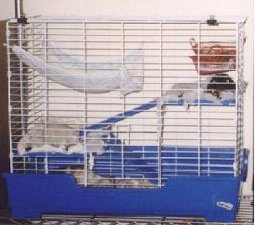
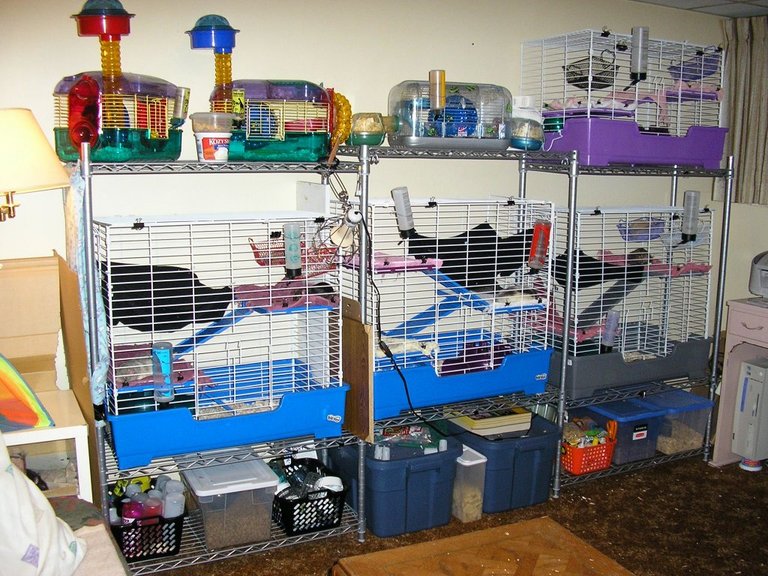
Rat owners have a couple of options for housing their rats. The most important part of housing is that the rats have enough room. Each rat requires a minimum of 1.0 cubic feet within the cage, with 2.0 cubic feet per rat being ideal for an animal their size. If rats feel cramped they will fight and behave aggressively towards one another. Overcrowding makes for unhappy rats. There are cage calculators available to test to see how many rats are able to fit inside your cage. The calculators can be found here:
Although others have found glass or plastic aquariums acceptable, it is not the most common choice. Aquariums work very well in areas that are drafty, or for sick or nursing rats. Aquariums keep in heat efficiently, and provide a safe environment for rats small enough to fit through cage bars. Aquariums should also not be kept in an area where the rats are in direct sunlight.
Aquariums are also very inexpensive. Rat owners can find second hand glass aquariums sometimes very cheaply due to the fact that they no longer are able to hold water.
Aquariums, especially glass, are very heavy. They need to be cleaned out completely every couple of days because the ammonia from the rat urine builds up quickly and causes the rat respiratory distress. It is very challenging to find items that can go into the aquarium that need to be elevated as well.
Metal Cages
Cages are looked upon as the better option for rats for several reasons. Cages provide constant air exchange that does not allow the ammonia to build up within. They are easier to clean in that they can be wiped down much of the time with a non-toxic, animal friendly product instead of being completely submersed in water. Attaching water bottles and hammocks are easy with a metal cage. When chosing a metal cage, it is better to go with powdercoated as opposed to galvanized. Powdercoated are much easier to clean, and do not smell as the galvanized tend to do with time.
Most metal cages come with plastic, or metal bottoms. Both are fine as they are covered with shavings or cloth for the comfort of the rats. The bottom of the cage must never be wire, always a solid bottom. A rats foot can easily be damaged between the wire bars along the bottom of the cage.
The most common problem with metal cages are that they are expensive for rats due to their size requirements. Many use cages designed for ferrets because they will house multiple rats in one cage. They can also be awkward to clean when the shelving inside cannot be removed.
Where cages are kept is also important. They should not be in a drafty area, or in direct sunlight.
Different types of metal cages can be found here: