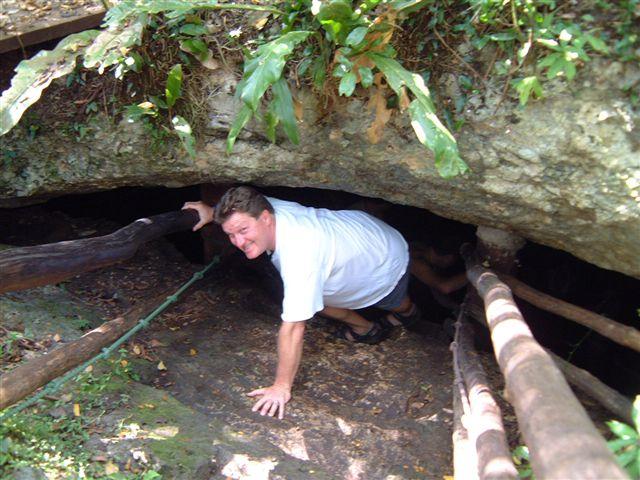
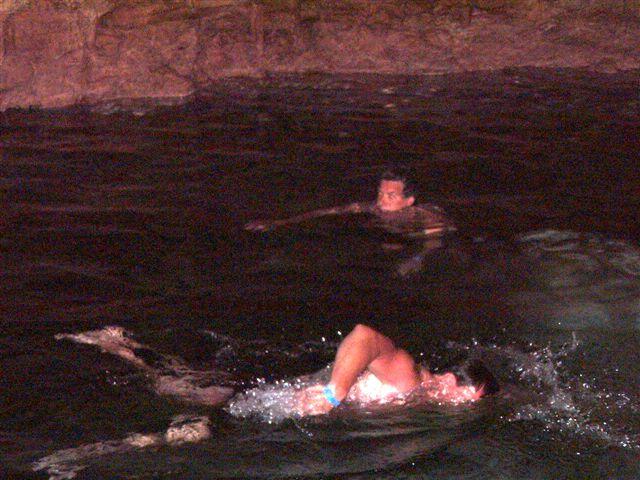
What an amazing experience!
CENOTES The natural wonders of the state of Yucatan are innumerable and some of the most important and unusual are the cenotes (say-NOH-tays) or sink holes. In the Yucatan there are over 3000 cenotes, with only 1400 actually studied and registered. There are four different types of cenotes - those that are completely underground, those that are semi-underground, those that are at land level like a lake or pond, like the one at Dzibilchaltun and those that are open wells, like the one in Chichen Itza. Some of them are accessible for swimming and cave diving, but this is a sport that should ONLY be practiced with a professional guide.
SWIMMING IN THE CENOTES
ENTERING THE CENOTES
INSIDE THE CENOTES
The Maya took advantage of the cenotes and caves, naturally formed wonders created by the filtration of water through the limestone surface. The first explorers who arrived in Yucatan were amazed to find an extraordinary culture focused around water, in a place with no rivers or lakes and with a lengthy dry season. For this reason, most of the beliefs and customs of the area's prehispanic inhabitants were concerned with rain as the basis of survival. Therefore, it was the water god who was most frequently found represented on the temples and ancient buildings. The cenotes, or underground rivers, are sources of plentiful crystalline water which have fulfilled men's needs throughout the centuries and can be found only in Florida, the Yucatan Peninsula and the island of Cuba.