

|
Vishwakarma Institute of Management |
|
S.No.3/4, Laxminagar, Kondhwa (Bk), Pune (India) 411 048 Phone: 020- 26932800 Fax: 020- 26932700 |

|
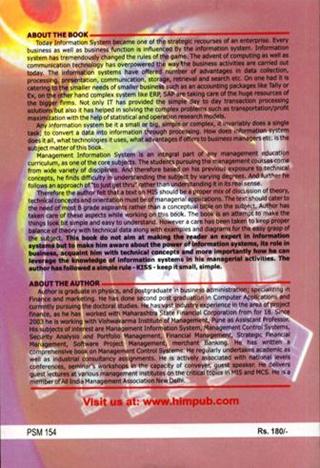
A better option for aspiring management graduates-MBA/PGDBM/DBM/MCA Management Information System Himalaya Publishing House; First Edition 2007 Reviewed & Foreword by — Shri. Deepak Shikarpur; Director & CEO, Auto Line Dimensions Engineering Services Pvt. Ltd.; Chairman, Board of Studies – Computer Management, University of Pune; Chairman, IT Sub Committee – MCCIA, Pune; Chairman, IT Applications, Computer Society of India Preface by — Dr. Sharad Joshi, MBA(IIMA), Director Vishwakarma Institute of Management - Would you like to know Contents please click here |


|
Review and Preface by Dr. Sharad Joshi ……………….
Management Information Systems as a subject in management curriculum has changed significantly over the last decade. An obvious reason is rapid strides in the use of computer and communication technology during this period. Internet has made it possible to decentralize work, which until recently had to be carried out under one roof. Share Trading, Travel Ticket Reservation, Printing and Publishing, Investment Consultancy are examples of some of the businesses which can be conducted with minimum office facilities, almost from home. Several other businesses have acquired a digital dimension. The letter ‘e’ is a familiar prefix for several activities, commonly grouped under the title e-commerce, which were earlier carried out manually,.
The approach to Management Information Systems has been changing as a result of these developments. Business Management is an empirical field which needs to reflect the current state-of-the-art. The study of MIS in the prevailing circumstances requires reference to new technologies which are now in use, introduction to the latest hardware devices and most importantly case studies / examples on innovative use of the information technology and the way it is being deployed by businesses to solve their problems. Considering the need for understanding of many of these ideas in the shortest possible time, the learning resources made available to the students are also undergoing a change. Much of the informational content is now being offered digitally, sometimes on a web-site, which the students are encouraged to access. The world is going paperless in a true sense.
To write a book on MIS is therefore a challenge. The task becomes even more complicated because the author needs to address a more mundane consideration - that of assisting the students, as probably the largest single group of readers, to clear their examination. The book must conform to the syllabi of one or more examining bodies. The content should be relevant, comprehensive and lucid.
To write a book in view of the multiple constraints stated above is not an easy task. Prof. Mahesh Halale must therefore be congratulated for having met almost all the objectives stated above quite competently. The book covers concepts in management, decision making, information technology, DBMS, Software Engineering, Advanced Techniques for Design and use of the Information Systems and Managerial Issues of a Digital Firm. It includes a fine collection of cases, from both manufacturing and service sectors. I particularly compliment the author for an excellent selection of topics and the subject matter. There is so much material available on each of the topics mentioned above that it is not easy to be selective. As a result, the book has come out to be an extremely useful compendium on currently important topics in MIS. It will be useful not only to the students but to the practitioners as well. I have no doubt that the book will contribute significantly to the literature on the subject and will be enthusiastically received by the user community.
Dr. Sharad Joshi Director, Vishwakarma Institute of Management, Pune |


|
Foreword by Shri. Deepak Shikarpur….. Within a decade most literate human beings on this planet will be impacted by the power of Information Technology and Management Information Systems. Adoption of IT and MIS is happening much faster than any other technology - TV, Radio, Cars or mobile Phones and will soon change the way we live and work on this planet. The biggest advantage of the e-Lifestyle is that it will end Q-Life Style. Q-Life style means standing in queue for a service. The decade ahead will bring in sweeping changes through the convergence of Information, Entertainment and Communications technologies and the interfacing of devices (such as telephone, fax, TV, pagers, computers, ovens, clocks etc). Natural Language interfaces and Speech Recognition technologies will change the way we interact. Computers will be a sweeping yet invisible part of our everyday lives. The awareness of these changes and the potential of IT is a must for the common man. I congratulate Mahesh Halale for writing a comprehensive book on MIS and its impact on Business for all. I am sure the book will bring the much needed awareness about IT in rural India particularly among marathi speaking students.
I wish Mahesh all the best for this noble Endeavour.
|