|
Vishwakarma Institute of Management |
|
S.No.3/4, Laxminagar, Kondhwa (Bk), Pune (India) 411 048 Phone: 020- 26932800 Fax: 020- 26932700 |

|
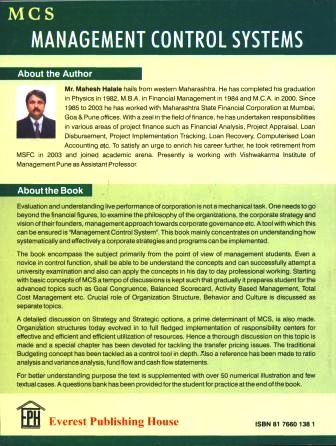
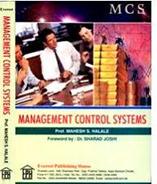
Management Control Systems First Edition 2005-06 Reviewed & Foreword by Dr. Sharad Joshi, MBA(IIMA), Director Vishwakarma Institute of Management Everest Publication, Pune A must for all management graduates/aspirants. Best for MBA/PGDBM/DBM/MCA etc - Would you like to know Contents please click here |


|
Foreword by Dr. Sharad Joshi
Management control system is one of the most important, yet less understood topic, both in academic field as well as in practice. The reasons are not difficult to see. Much of the management control presupposes delegation of authority. There is no question of controlling an activity, unless the manager in charge is empowered to run it with some degree of independence. Several small and medium size organizations are so tightly controlled by the professional or owner managers that the need for a control system is not appreciated. It is also felt that unless an organization has reached a minimum stage of sophistication in terms of systems, performance evaluation, accounting standards and organizational development, implementing control system will not be easy. The need for management control systems arises as soon as an organization evolves for itself a strategy. It may be easier said than done. There are innumerable number of organizations with all sizes with no strategic intent whatsoever; strategy if any is mere happenstance. Barring this group, howsoever large in size, management control system is a must. There is no way except a carefully planned control system whereby the organizational strategy can be implemented. Put it differently, without management control systems, strategy formulation could just be empty words. Robert Anthony’s definition therefore is very apt. Management control is the process through which managers ensure that resources are obtained and used, effectively and efficiently, in the accomplishment of organization’s objectives. A book on such an important topic is always needed. Management control systems are usually required by larger, more professionally managed organizations. A typical text book on management, even management accounting is unlikely to cover themes forming a part of management control systems. The number of foreign titles on this subject are also very limited. The subject is however expanding and new books are required all the time. My colleague, Prof. Mahesh Halale has done a yeoman service to the academic community and even the practicing manager by writing a comprehensive textbook on this subject. A quick review of the index would reveal that all important themes required by a student are covered in this book. I would especially recommend chapters 15 onwards. Performance Evaluation, Budgeting, Balanced Scorecard, Interactive Control Systems, MCS in Service Organizations, Total cost management are all modern themes. Prof. Mahesh deserves to be complimented for covering these in this textbook. The book contains more than 50 illustrations and many Indian cases. The style used by the author is direct, simple and student-friendly. The fact that the students need to use a textbook of this nature to attempt a university examination has never been lost sight of. I congratulate Prof. Mahesh for completing a worthy task. I am sure the students would welcome this book very enthusiastically and use it – both for their MBA curriculum and for practicing management control in their professional career.
Dr. Sharad Joshi Director, Vishwakarma Institute of Management, Pune |