| HOLE LOAD OF TROUBLE JOHN FOWLER |
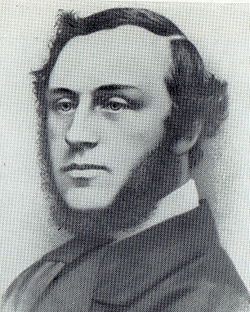
| John Fowler (11 July 1826 � 4 December 1864) was an English agricultural engineer who was a pioneer in the use of steam engines for ploughing and digging drainage channels. His inventions vastly reduced the cost of ploughing farmland, and also enabled the drainage of previously uncultivated land in many parts of the world. This introduction to John Fowler is based upon the man as oppossed to his inventions and contributions to the world of steam deveopment. Further articles on Fowlers products, ideas and innovations can be found elsewhere on this website. EARLY LIFE. Fowler was born in Melksham, Wiltshire, the third of five brothers. His father, John Fowler senior was a wealthy Quaker merchant, who had married Rebecca Hull. As well as five sons, they also had three daughters. When he left school Fowler followed his father�s wishes and began working for a local corn merchant, but when he came of age in 1847 he turned his back on the corn business and joined the engineering firm of Gilkes, Wilson and Co. of Middlesbrough. Amongst other things, the company was involved in building steam locomotives and colliery winding engines. The company built a number of locomotives for the Stockton and Darlington Railway. Change of career Fowler might have remained with the Middlesbrough firm and made his reputation there, had it not been for a chance visit to Ireland in 1849, probably on business. This was at the time of the Irish potato famine, and Irish agriculture depended on the potato crop whilst much of the land was uncultivated due to poor drainage. This affected Fowler and he was convinced that there must be a way of bringing more land into production. The normal way to drain agricultural land was to use a mole plough to dig a subterranean drainage channel. The mole plough has a vertical blade with a cylindrical �mole� attached to the bottom. The mole is pointed at the front end, and as it moves through the soil, it leaves a horizontal channel into which porous drainage pipes can be laid. However this required considerable tractive power, so that the size of the plough was limited by the strength of the teams of horses that pulled it. Fowler returned to England and developed a horse-powered ploughing engine that would dig drainage channels. HIS WIFE. On 30 July 1857 Fowler married Elizabeth Lucy (1833�1881), ninth child of Joseph Pease, MP for South Durham. Joseph Pease was a wealthy Quaker from Darlington who had initiated the idea for the Stockton and Darlington Railway. Fowler had become acquainted with the Pease family when he was working at Middlesbrough. Fowler and his wife settled at Havering in Essex and eventually had a son, who died young, and two daughters. LATER CAREER Between 1850 and 1864 Fowler took out in his own name and in partnership with other persons thirty-two patents for ploughs and ploughing apparatus, reaping machines, seed drills, traction engines, slide valves, the laying of electric telegraph cables, and the making of bricks and tiles. By 1858 Fowler had forty sets of ploughing tackle in use, and by 1861 he had one hundred sets working. From 1860 the manufacture of the ploughing machinery was carried out by the firm of Kitson and Hewitson of Leeds. JOHN FOWLER & COMPANY In 1862 Fowler formed a partnership with William Watson Hewitson of the above firm and founded Hewitson and Fowler based at Hunslet. A year later Hewitson died and the firm became John Fowler and Company. Fowler�s ploughing sets were sold all over the world and were responsible for bringing land into production that was previously unable to be cultivated. RETIREMENT Fowler had worked so hard in developing his ideas that he had undermined his health. He was advised to take more rest and so he retired to Ackworth in Yorkshire, to recuperate. He was persuaded to take up hunting as a way of getting exercise and whilst out with the hunt he had a fall and sustained a compound fracture of his arm. Whilst recovering from this mishap, he developed tetanus and died on 4th December 1864, at his home in Ackworth. He died only months after his great triumph at the Newcastle ploughing trial, at the age of only thirty-eight. His brothers Robert, William and Barnard had joined him in the business he had founded and they continued to run the firm after his death. Fowler�s method of ploughing continued to be used until well into the twentieth century when the internal combustion engine allowed the development of light but powerful tractors that could draw a plough behind them |
 |
| Text taken from : Wikedpedia Page Updated : 29/06/08 - 19:04 |