| HOLE LOAD OF TROUBLE ANDREW MEIKLE |
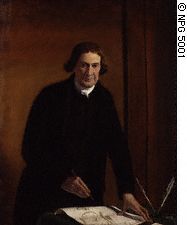
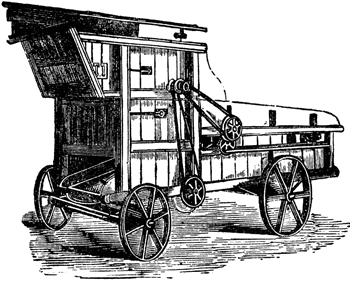
| Andrew Meikle (1719 � 27 November 1811) was an early mechanical engineer credited with, in about 1786, inventing (though some say he only improved on an earlier design) the threshing machine (used for removing the outer husks from grains of wheat, etc; occasionally also known as a 'thrashing machine'), regarded as one of the key developments of the British Agricultural Revolution in the late 18th century. The 1881 Household Cyclopedia said of Meikle's machine: "Since the invention of this machine, Mr. Meikle and others have progressively introduced a variety of improvements, all tending to simplify the labor, and to augment the quantity of the work performed. When first erected, though the grain was equally well separated from the straw, yet as the whole of the straw, chaff, and grain, was indiscriminately thrown into a confused heap, the work could only with propriety be considered as half executed. By the addition of rakes, or shakers, and two pairs of fanners, all driven by the same machinery, the different processes of thrashing, shaking, and winnowing are now all at once performed, and the grain immediately prepared for the public market. When it is added, that the quantity of grain gained from the superior powers of the machine is fully equal to a twentieth part of the crop, and that, in some cases, the expense of thrashing and cleaning the grain is considerably less than what was formerly paid for cleaning it alone, the immense saving arising from the invention will at once be seen. "The expense of horse labor, from the increased value of the animal and the charge of his keeping, being an object of great importance, it is recommended that, upon all sizable farms, that is to say, where two hundred acres [800,000 m�], or upwards, of grain are sown, the machine should be worked by wind, unless where local circumstances afford the conveniency of water. Where coals are plenty and cheap, steam may be advantageously used for working the machine." Earlier (c.1772), he also invented windmill 'spring sails', which replaced the simple canvas designs previously used with sails made from a series of shutters that could be operated by levers, allowing windmill sails to be quickly and safely controlled in the event of a storm. Meikle worked as a millwright at Houston Mill in East Linton, East Lothian, and inspired John Rennie to become a noted civil engineer. He died at Houston Mill and is buried in East Linton's Prestonkirk kirkyard (close to Rennie's father, George, who farmed the nearby Phantassie estate). |
| Text taken from : Wikipedia Page Updated : 29/05/08 - 09:16 |
 |
| . |
 |