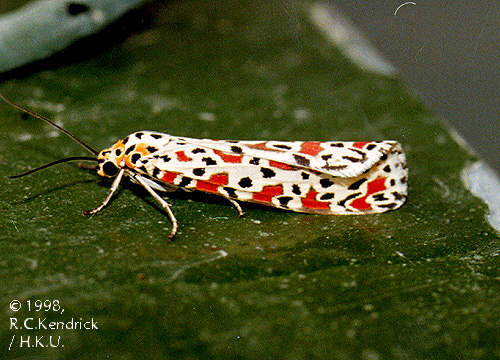
Utetheisa lotrix (Cramer, 1779)
[Arctiidae, Arctiinae]
originally described as Geometra lotrix Cramer, 1779, Uitl. Kapellen 2: 20-21, 149, pl. 109, figs E. F.
|
 |
Geographical Range
Old World tropics (Holloway, 1988). Within
China, known from Fujian, Guangdong, Sichuan, Yunnan provinces & Taiwan
(Wang et al, 1982a).
In Hong Kong
Distribution: widespread.
Status: rare.
Recorded larval hostplant: Crotalaria juncea L. (Papilionaceae)
Sun Hemp (Lee & Winney, 1982).
Adult Phenology: too few records to ascertain.
Notes: of the two recent H.K. records of imagines, one was by day and one was at a light trap.
|
Identification Note
This species is very similar to
Utetheisa pulchelloides Hampson,
1907, which also occurs in Hong Kong (and the Indo-Australian and Pacific tropics
and Indian Ocean islands, also as a migrant to New Zealand, New Caledonia, Norfolk
Island and Vanuatu (Holloway, 1988)). The only difference in the forewing markings
that seems to be consistent (as noted by Holloway, 1988 and from personal observation
in Hong Kong) is the presence in
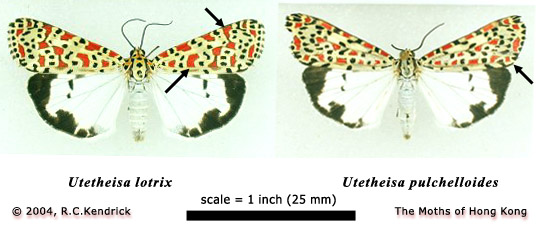
U. pulchelloides of a red patch
at the tornus (the bottom corner at the end of the wing). It also appears that the forewing markings on the costal edge extend over the subcostal vein to the radial vein in
U. lotrix, whereas in
U. pulchelloides the costal markings stop at the subcostal vein, giving the appearance of a larger space between the markings in the upper third of the forewing. Additionally, although variable in size, the red blotches appear generally larger in
U. lotrix, with the two arrowed on the figure below generally as single blotches, rather than as pairs of blotches as on
U. pulchelloides.
Also very similar
is
U. pulchella (Linnaeus) from Africa and southern Europe (
Pinhey,
1975 - who possibly incorrectly gives southern Asia and Australia as part
of
U. pulchella's range, as
Nielsen
et al. (1996) do not list this species as Australian), and a very
scarce migrant to the British Isles, where it is known as the
Crimson Speckled
(
Skinner, 1984).