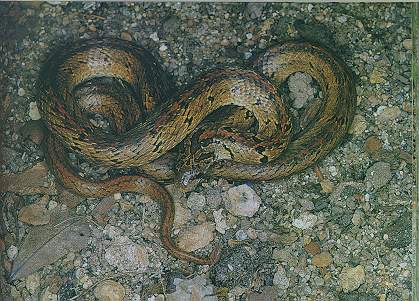
Taiwan Kukri Snake (non-venomous)
Description: A medium-sized snake, averaging 50-70 cm in total length, but occasionally reaching 90 cm. Ground colour greyish or reddish-brown, with thin irregular crossbars. Scales smooth. A dark brown chevron mark extends from neck on to head, with another fragmented chevron in front of it. A brown bar from eye to upper labials. Head short, not distinct from neck. May or may not have an orange or reddish mid-dorsal stripe. Ventrals iridescent, pale pink. Tail short. Young individuals have bright red-coloured ventrals. The colour gradually fades to the more sombre pink of adults. Has two elongated, razor-sharp, curved teeth at rear of mouth resembling the ¡§kukri¡¨ knife of Gurkha troops.
Habits and habitat: Inhabits both dry and moist areas, from grassland and hillside shrubland to dense secondary forest, and grassy edges of ponds and cultivated fields. Sometimes found hiding under objects and inside catchwaters. Usually nocturnal; occasionally active by day. Uses its enlarged teeth to slit open the shell of reptilian and bird¡¦s eggs, important food items. Often bites when captured, causing profuse bleeding.
Diet: Eats eggs of reptiles and birds. Also frogs, lizards and small mice on occasion, especially as juvenile. Captive specimens drink raw chicken egg yolk.
Reproduction: Oviparous. One hatchling measured 13 cm.
Distribution: Not generally common, but widely distributed all over Hong Kong including a few small islands. Especially common on Ping Chau Island in Mirs Bay. Found in southern China including Taiwan, and northern Vietnam.
Diagnostic features: Back reddish-brown; with irregular, black crossbars; brown chevron mark on the head; dark bar from eye to labials.