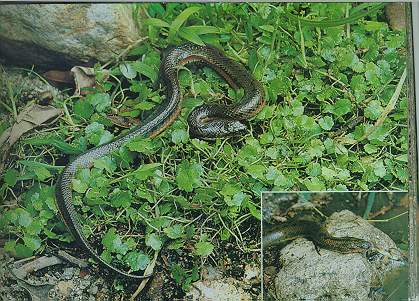
Chinese Water Snake (mildly venomous)
Description: A medium-sized robust snake, with an average total length of 45-60 cm; occasionally 83 cm. Ground colour brown or olive-brown, with small irregularly scattered black spots from neck to tail. A black zig-zag mark extends from centre of head on to neck. A conspicuous, pale orange stripe present on lower flanks along entire body length; is bright orange in young snakes. Head rounded, distinct from neck. Nostrils open on top of head. Labials dirty white, with faint black mottling. Dorsal scales smooth. Ventrals yellowish-white, each scale bordered with brown. Has two short fangs at the back of upper jaw.
Habits and habitat: A lowland species, almost totally aquatic. Can also live in brackish water. Found in cultivated areas, sluggish streams and particularly in fish ponds, where it may occur in large numbers. Often hides under boards or other debris on banks of drying ponds. Primarily nocturnal. Occasionally observed during daylight hours, with only its snout protruding from the water surface to take in air. Feeds well in captivity. Like E. plumbea, wanders overland on rainy nights. When disturbed, flattens the body and bends the neck into a S-shape as a threat display. It may snap viciously. A mildly venomous species. One person bitten by this snake suffered swelling of the bitten area, headache and nausea. The symptoms subsequently disappeared without treatment.
Diet: Feeds almost entirely on fish, but occasionally eats frogs.
Reproduction: Viviparous, bearing up to 13 young. Hatchlings 10-13 cm in total length. Young snakes abundant in August.
Distribution: Widely distributed over northern and central New Territories. Absent from small islands. Because of dietary and habitat preferences, is rarely sympatric with E. plumbea, except at Mui Wo on Lantau Island. Found in central and southern China including Taiwan, and northern Vietnam.
Diagnostic features: Back olive to dark brown; with small black spots over the back and lower flanks; an orange-yellow stripe along lower flanks; tail short; ventrals creamy-white banded with brown.