 |
|
|
|
|
|
|
|
|
|
|
|
|
|
|
|
|
|
|
|
|
|
|
|
|
|
|
|
|
|
|
|
|
|
|
|
|
|
|
|
|
 |
|
|
|
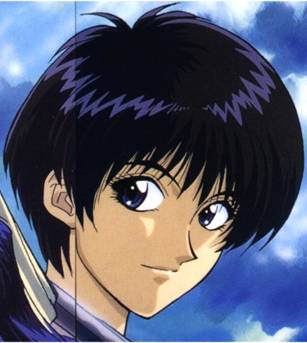
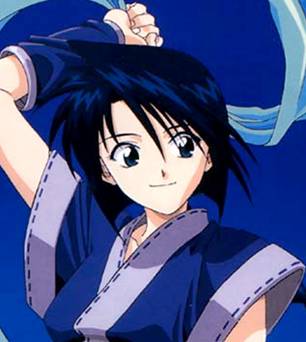
Innocence: Soujirou and Misao |
|
|
|
 |
|
|
 |
|
|
|
Featured in: Shiki (and appearing in Tadagoto, with mentions in Kaihou) |
|
|
| Ever with a smile on their faces -- both embodying innocence, yet neither as innocent as they seem. A girl who longs to be acknowledged as a woman; a not-quite young man whose childhood was shattered. Kunoichi and swordsman. Their paths to the future lie open before them... |
|
|
| -----> go to: MISAO SOUJIROU POST-SERIES REASONS <----- |
|
|
|
Background Information (Pre-series backstory) |
|
|
| As entertaining as I'm sure it would have been, Misao and Soujirou unfortunately never interact directly with each other throughout the course of the series. However, Soujirou is certainly aware of her existence (he was sent by Shishio to recruit Aoshi, after all, and seems to know quite a bit about the Oniwabanshuu), and Misao first "meets" him when she witnesses Kenshin's first fight with him in the village of Shingetsu. Whether or not Soujirou noticed her there or even recognized her is debatable; one popular fan speculation from which several fanfics have sprouted, however, is that Shishio considered having Soujirou kidnap Misao as a backup plan in case Aoshi refused to cooperate. |
|
|
| Misao was born in late 1863, right around the beginning of the most chaotic period of the Bakumatsu. Takasugi Shinsaku of the Choshu clan had just formed the Kiheitai (the militia group Himura Kenshin initally joined after leaving Hiko) a few months earlier in response to the Shimonoseki incident; in little more than seven months after Misao's birth, both the Ikedaya massacre and the bloody rout of Choshu forces before the Hamaguri Gate in what would later be known as the Kinmon no Hen incident occurred in quick succession. |
|
 |
|
| Misao's grandfather was the okashira, or leader, of the Oniwaban group, a clan of ninja who acted traditionally as spies for the shogunate and as hidden guardians of Edo Castle. It is pretty safe to assume that her parents, whom we suppose died when she was young, were both ninjas as well. Although the reasons for their deaths are never specified, it is likely that they were killed within the year amid the violence and bloodshed of Kyoto. |
|
|
|
Chibi Misao... or at least a very young-looking Misao |
|
|
| It is interesting that a ninja child born and orphaned in the midst of all this chaos would grow up relatively innocent and unjaded. The reason for this is perhaps due to the protectiveness of the rest of her ninja "family," who immediately stepped in to raise her. Among the key figures in her childhood was the then eleven year old Shinomori Aoshi, and later, her grandfather's best friend Kashiwazaki Nenji (a.k.a. Okina). Aoshi was her primary caretaker for about four years. |
|
| The position of okashira was likely meant to have been passed on to Misao's father; with his death, however, Misao's grandfather offered the position to Okina. Okina, at the time stationed in Kyoto, in turn recommended Aoshi. Aoshi likely began to be primed for the position around then, in mid to late 1864. In early 1868, Misao's grandfather presumably died, whether by blade or poison, old age, or sickness is unknown, and the position of okashira passed to Aoshi, just turned fifteen. The first option seems unlikely given the precise timing, and seeing as how Okina is still alive and well ten years later, I am inclined to believe it was illness, and that the old okashira held on until Aoshi turned fifteen and thus entered "manhood." |
|
| At around the same time Aoshi became okashira, the Battle of Toba-Fushimi, the first key point of the Boshin War, occurred. A mere four to five months later, Edo Castle was unconditionally surrendered in an agreement with the Ishin government, and Aoshi and the Oniwabanshuu (plus Misao) were turned out to fend for themselves in the new era. |
|
| The series is somewhat contradictory regarding what happened next. Aoshi states that the Oniwabanshuu stayed with him in Edo, later renamed Tokyo, for ten years, until all but four managed to find their ways into new lives. Misao, however, claims that at the start of the Meiji era, Aoshi left her with Okina in Kyoto before setting off to wander the country with the Oniwabanshuu. Still later, we are shown a flashback scene from Aoshi's point of view in which he and the four who remained with him until the end were apparently in Kyoto and about to leave behind both Misao and unspecified "others" who were "good merchants" with Okina (presumably at the Aoiya, which Okina had established years ago to double as a base and an inn). |
|
| Given how young Misao was at the time, we can probably discount her as a reliable source of information -- all we can be certain of from her claim is that she came under Okina's care sometime in 1868 (Meiji year one) or 1869, at around age four or five. Two scenarios then seem possible. One is that after the fall of the castle, Aoshi first went to Kyoto with Misao and a contingent of Oniwaban interested in working with Okina, and stayed there for a few months to see how things worked out, then left with those who could not fit into life at the Aoiya (and joined up again with the others still in Tokyo). This would seem to contradict Aoshi's statement in the flashback, however: "From now on, we five will use our strength as spies of the Oniwabanshuu." |
|
| The other scenario is that all but a handful of Oniwaban found their ways into new lives within the first year or so; Aoshi then took the rest to Kyoto and events fall out as in the previous scenario. This, though, also doesn't seem to jive completely with Aoshi's first statement, which implied that the former onmitsu trickled away from his side over a period of ten years. Still, this second scenario makes more sense overall. |
|
| And so five-year-old Misao is raised in Kyoto by Okina and the rest of the Aoiya Oniwaban, taught the basics of ninja skills but kept shielded from true danger... |
|
|
|
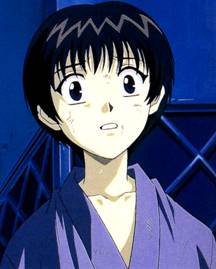
Soujirou had a much harsher childhood. His father was a presumably well to do rice merchant named Seta who managed to keep a much younger mistress on the side, to whom Soujirou was born in early autumn of 1861 in the Kanagawa Prefecture (where the city of Yokohama is located), just south of the Tokyo area. I also suspect that the man was wealthy enough to buy him and his family low-ranking samurai status... although that is pretty much irrelevant to Soujirou's tale, and is just a fun speculation. |
|
 |
|
|
|
Soujirou lived with his mother (likely a prostitute) for an unspecified amount of time until she presumably could no longer take care of him and left him in the care of his half brother (the father having presumably died by this point -- probably of old age, although possibly in the violence of the Bakumatsu -- and the family business having passed down to the legitimate son). Unfortunately, there seems to have been some remaining resentment on the Seta heir's side regarding the choice of his father in keeping a mistress perhaps even younger than himself, and he adopted Soujirou as his own son only for the sake of saving face. |
|
|
|
|
Chibi Soujirou |
|
|
|
|
| The younger Seta already had a family of his own: a wife, a daughter, and two older sons. He and the family viewed Soujirou as an unwanted intrusion, and treated him as no more than a lowly servant. (In essence turning him into sort of a male Cinderella.....) Soujirou was heavily abused and mistreated, and gradually learned to use his smile as an armor against their cruelty, when he found that anger and crying only encouraged them. Eventually it got to the point where he kept a smile plastered on his face at all times. |
|
| When Soujirou was about seven to eight years old, some time after the end of the Boshin War in 1869, Shishio Makoto, former hitokiri (assassin) of the Choshu Ishin Shishi, was running from government forces intent on killing him to preserve the secrets of the new regime. Shishio, an ambitious and dangerous man, had already survived through one attempted assassination in which he was burned alive, and was fighting a policeman in the forested area on or near the Seta property when Soujirou accidentally came upon him slicing the policeman to bits. |
|
| Shishio, noticing this potential witness, was about to kill Soujirou when he noticed something very strange about the boy -- he was smiling, despite his impending death. Intrigued, Shishio sheathed his sword and instead demanded Soujirou to get food and fresh bandages (for his burns). Awed by Shishio's strength, Soujirou did so without question, having obeyed orders unthinkingly for most of his life. Later, after questioning the boy about his constant smiling, Shishio gifted Soujirou with his wakizashi (short sword) as payment for harboring him. Soujirou's attachment to this charismatically strong-willed stranger, the first person to offer him anything other than blows or harsh words in a very long time, began to cement. |
|
| The Seta family soon noticed the missing rice and bandages, however, and having been warned of the presence of a dangerous, escaped rebel in the area, their suspicions were immediately aroused. They summoned Soujirou, with the intention of punishing him for harboring a wanted man and risking government retaliation in form of disgrace, possible arrest and execution, and destruction of the family business. The eldest, hot-tempered Seta son, waving around his sword, proclaimed that he would kill Soujirou. In response, Soujirou screamed and ran off to hide under the porch, where he had secretlly stored the wakizashi. The younger Seta son found Soujirou there, clutching the sheathed blade, and reached out to take it, removing the sheath in the process... |
|
| Shishio's earlier words to him, "In this world, the food of the strong is the flesh of the weak. The strong live; the weak die," running through his mind, Soujirou panicked and sliced off the other boy's head. He then emerged from under the porch with bloody wakizashi in hand and proceeded to slaughter the rest of his family. Shishio walked out calmly from where he had been eating in the barn to find Soujirou standing motionless among the bodies as the rain began to fall. |
|
|
Shishio: Are you crying?
(Soujirou turns towards him, smiling.)
Soujirou: No.
Shishio (as he begins to walk on): Coming with me?
Soujirou: Okay. Hey, Mr. Shishio?
Shishio: Yeah?
Soujirou: Do you think... I could be strong?
Shishio: Sure. You'll be the strongest there is, after me --
(Maigo-chan's Ruroken translations, Volume 16, Chapter 132) |
|
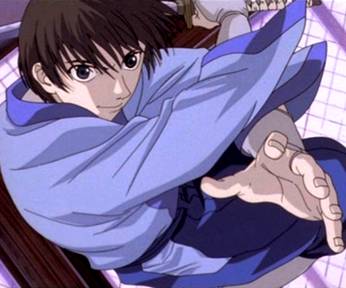
| From that time on, Soujirou trained under Shishio, developing his natural potential as a swordsman, becoming Shishio's protege and right hand man as Shishio disappeared into the Kyoto underground and began to gather people and resources to him as he made plans for taking over the country... |
|
|
|
 |
|
|
 |
|
|
 |
|
 |
|
|
|
|
| Both Misao and Soujirou make their first appearances in the Kyoto arc of the Rurouni Kenshin series, when Shishio finally begins to set his plans in motion. Misao declares herself the new okashira when she faces some harsh truths about the tragedy of the four Oniwaban members who had followed Aoshi for ten years, and discovers that Aoshi has descended so deeply into madness that he is even willing to harm old comrades. Later, Aoshi returns and reforges his old brotherly relationship with her, continuing to guide and protect her in his own way throughout the rest of the manga. Soujirou fights twice with the protagonist Himura Kenshin, and when defeated in their second match, comes to the realization that Shishio's creed may not be the true answer to life, and sets out to find his own answers. The last we see of him, he is heading north towards Aizu... |
|
|
|
Post-series |
|
|
|
 |
 |
|
|
|
|
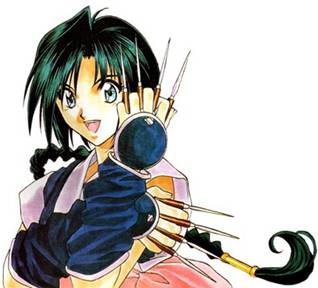
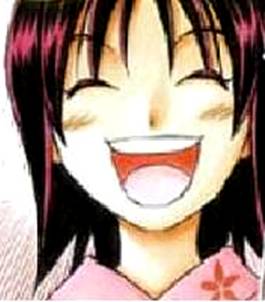
| In the Kenshin Kaden artbook, mangaka Watsuki Nobuhiro adds a special ending to the series, entitled "Cherry Blossoms in the Spring." In this six-page special, the Ruroken characters gather for a picnic reunion in Ueno Park, five years after the last arc in the manga (Meiji 16/1883). Soujirou, presumably still wandering Japan in search of his answers, does not appear. Misao, on the other hand, shows up with Aoshi, still as cheerful as ever but with a few interesting changes. For one, she has cut off her long braid (in a culture where hairstyle can be extremely symbolic this may or may not be significant). She is also wearing a pink kimono/red hakama outfit with boots that is apparently the standard Meiji schoolgirl uniform... which may indicate any amount of interesting things about changes in her character/life. |
|
|
|
Reasons |
|
|
So why pair Soujirou with Misao, when they don't even interact in the series?
I shall, as on the Aoshi/Megumi page, begin with the most shallow reason: aesthetics. Few pairs in this series are drawn to visually complement each other, not counting the twins Sae and Tae: Aoshi/Megumi is one, Hiko/Kenshin is another, Watsuki pretty much outright states in his Character Corner on Yumi that she was drawn to complement Shishio, and Kenshin/Kaoru is the other obvious one. Soujirou and Misao are the odd pair -- the other four have obvious deeper connections in canon that the visuals help emphasize; Sou and Misao seem to have no connection at all, and yet their designs seem to parallel and mirror each other the way the other pairs do.
Take for instance their smile. Both of these characters are always smiling, though for very different reasons. Even their eyes are (in general) drawn somewhat similarly, both wide and sweet, unmasked, though (generally) not quite as soft and expressive as Kaoru's.
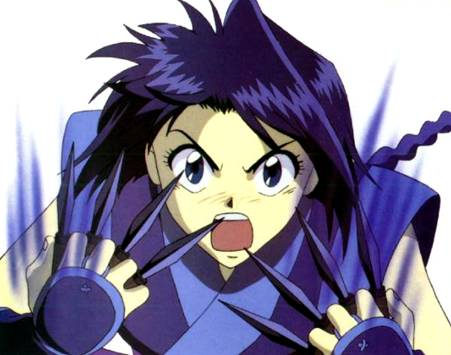
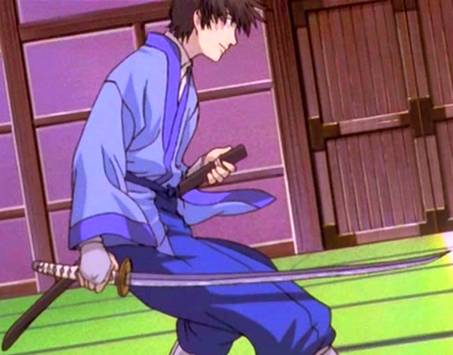
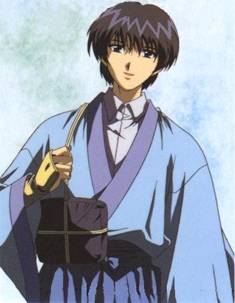
Most interesting, however, are their clothes. Misao wears minimal layers, with very short lengths; Soujirou wears what seems to be a Western style button-up shirt under a standard billowy kimono/hakama outfit. They both wear arm/wrist guards. Their color scheme: always, always blue. Misao wears dark blue, hemmed with a paler blue, though with a long pink sash. (Discounting the trench coat, Aoshi's outfit, on the other hand, is more black and purple.) Only in the Cherry Blossom special do we see an exception to this scheme, when Misao shows up wearing red/pink, the "opposite" of blue, apparently transitioned by aforementioned pink sash. Even her hair is usually drawn with a greenish/bluish tint; only while wearing her red kimono does it gain a reddish tinge. And in Soujirou's outfit, the colors seem to be exactly the same as those of Misao's normal outfit, or at least extremely close, only reversed, with the dark blue hemming the light blue.
Even if these parallels and reflections are unintentional, the possible underlying symbolism is endless. And fascinating.
Now onto actual character analysis.
I explain extensively on the Aoshi/Megumi page why I do not feel Aoshi/Misao is feasible. Looking at the timeline, it seems ridiculous to even think that Misao, who last saw him at age five, has anything more than a girlish crush on Aoshi. And given what we see of Aoshi and schoolgirl!Misao in Cherry Blossoms, I think it is safe to say that five years after the end of the series, there remains no romantic relationship between the two.
A common point Soujirou/Misao fans make is how this pairing parallels Kenshin/Kaoru. I agree that it does, to a certain extent; however, it is also unfair to make them mere clones of Kenshin and Kaoru. Soujirou is in many ways more innocent, or really "simpler," than Kenshin (who at each step of the way was thinking for himself and making his own decisions, working out issues on his own), and his childhood far more tragic and twisted; Misao is more ruthless and more extroverted and short-tempered and overtly willful than Kaoru, though perhaps because of this both more childish and less independent. Both Soujirou and Misao, at any rate, still have much space to grow at the end of the series.
With Aoshi's guiding presence, Misao will almost certainly begin settling down and maturing. Declaring herself as okashira seems to be a fitting start on her way to learning responsibility, both for herself and for others. We know little of how Soujirou's journey will progress, on the other hand. Will he decide that Kenshin was correct? Or that Shishio was right after all? Or will he find an answer that is completely his own, whether for better or for worse? The last seems to be most reasonable, considering what Kenshin tells him at the end of their battle; although given the theme of the series, the first is probably most likely. My preference is the last option, however, which is the most interesting one, in my opinion. Kenshin and Soujirou are different people, after all, so it is natural that they may come to different conclusions.
That being said, it is quite easy to concoct a scenario where Soujirou wanders back to Kyoto and meets with Misao again -- this seems to be the standard for most post-series Sou/Misao fanfic. What I think is really interesting to speculate on is how Soujirou and Misao would play off each other. Soujirou, despite appearing to be empty-headed most of the time, is not actually stupid, and in fact possesses a strange and almost subtle sense of humor at times. (He especially seems to enjoy innocently exaggerating his empty-headedness to drive Yumi, among others, up the wall.) Misao, on the other hand, is as direct and impatient as they come, and doesn't take teasing terribly well (see: Saitou and Megumi)... which would likely amuse Soujirou greatly. At the same time, Misao can be sneaky and perceptive when she wants -- she is a ninja, after all, as little as she acts like one -- and one can picture a more mature Misao becoming fond of Soujirou's quirkiness despite herself.
As well, I feel that their dynamic would be one of mutual growth. Soujirou is not so outrageously hot-headed that he'll get into full-blown bickering with Misao a la Sano or Yahiko; he is likely to get on her nerves in a more subtle manner, forcing her to perhaps learn patience and restraint instead of blowing up at every little incident. Misao's bluntness, too, would force Sou to face himself directly instead of continuing to dodge his issues, and also learn to really start thinking for himself instead of allowing others to think for him. Misao is such an optimistic, confident character; it would do good for Soujirou to have such a positive influence like her in his life, lest the darkness he must now face overwhelms him. Soujirou, on the other hand, would teach Misao to look deeper, for the hidden layers, rather than treating everything as black and white.
They, more than any other couple in the series, would challenge each other and help each other grow, and are ultimately a couple with such a positive theme that one can't help but like them. And so in Shiki I chart the potential development of their relationship, as well as their development and growth as individuals. |
|
|
|
BACK
HOME |
|