Cyrenaica
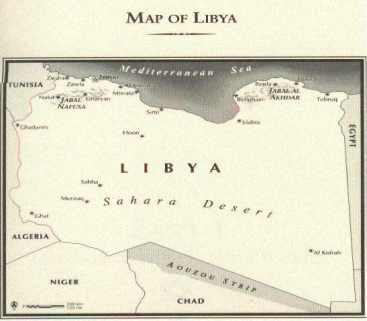
Libya is made of three regions: Cyrenaica
(Arabic pronunciation
BARQAH) to the east,
Tripolitania (Arabic pronunciation TARABLUS)
to the west, and Fezzan (Arabic pronunciation FAZZAN) to
the south. Evans-Pritchard highlights the difference between Tripolitania
where one Muslim faith united the Arab tribes, and Cyrenaica. The Sanusiya
united and organised the Bedouin tribes in Cyrenaica, whereas in Tripolitania
the tribesmen remained weaker and divided. This made the task of administering
Tripolitania far easier for the Turks and later the Italians.
The choice of Cyrenaica was particularly significant.
It had the right ingredients for the birth of nationhood through the growth
of a politco-religious movement. It is cut off, composed of a homogeneous
population, affiliated to a tightly knit tribal system, and ruled by one
dominant religious Order. The leader of this order, Sayyid
Muhammad Idris al-Mahdi al-Sanusi, became prince of this region in
1920.
Cyrenaica was colonised by the Greeks, the Ptolemies
of Egypt, and the Romans. Arab armies under the leadership of 'Amr ibn
al-'As conquered the country in 642. In the Middle Ages, Cyrenaica was
ruled by a succession of Egyptian-based dynasties. The region, along with
most of North Africa eventually came under the direct rule of the Ottoman
Empire.
Back
to Home Page