|
.introduction.
From the beginning of human history, man has always wanted to
communicate with each other from afar. They have used smoke signals, mirrors,
jungle drums, carrier pigeons, and semaphores to get a message from one point
to another (Schuman 1999, 22). But the telephone was something new. It supports
everyday needs, making it easier to communicate with someone across the world
in a matter of seconds. The telephone has a strong presence in homes, businesses,
but most of all, life (TelecomWriting.com's Telephone History Page 3 --1870 to 1876).
But what was communication like before the invention of the telephone? Before
the telephone, communication was difficult. Attempts to make communication
easier resulted in the Morse Telegraph, which is one of the first electrical instruments
for telegraphic transmission, or sound over wires, which was invented by Samuel F.
B. Morse (Encarta Encyclopedia, 2001 ed., s.v. �Morse Telegraph�). This type of
communication consisted of codes in which messages were transmitted by
electric pulses passing over a single wire (Encarta Encyclopedia, 2001 ed., s.v.
�Morse Telegraph�). However, distant communication did not have to remain that
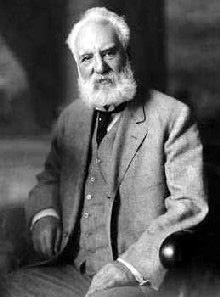
complicated, so luckily, in 1876, Alexander Graham Bell invented the first
telephone, knowing that this invention would make a big impact on the world
even a hundred years from the day he invented it (Pasachoff 1996, 57). The
telephone changed the world, being convenient in the area of communication in
everyday life, making communication with another person across the world
consist of only a matter of a few seconds (Shannon 2000). Bell forever changed the
way of communication in the world. He invented the telephone through his
exploration of the telegraph; indeed he encountered ideas of the Morse
Telegraph, which led to the telephone, and therefore made it easier to exchange
ideas in a matter of seconds, no matter the distance.
| |