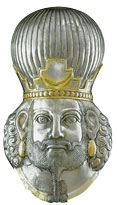
Ardeshir, son of the priest Papak, who claimed descent from the legendary hero Sasan, had become the Parthian governor in the Achaemenid home province of Persis (Fars). In A.D. 224 he overthrew the last Parthian king and established the Sassanid dynasty, which was to last 400 years.
The Sassanids established an empire roughly within the frontiers achieved by the Achaemenids, with the capital at Ctesiphon. The Sassanids consciously sought to resuscitate Iranian traditions and to obliterate Greek cultural influence. Their rule was characterized by considerable centralization, ambitious urban planning, agricultural development, and technological improvements. Sassanid rulers adopted the title of shahanshah (king of kings), as sovereigns over numerous petty rulers, known as shahrdars. Historians believe that society was divided into four classes: the priests, warriors, secretaries, and commoners. The royal princes, petty rulers, great landlords, and priests together constituted a privileged stratum, and the social system appears to have been fairly rigid. Sassanid rule and the system of social stratification were reinforced by Zoroastrianism, which became the state religion. The Zoroastrian priesthood became immensely powerful. The head of the priestly class, the mobadan mobad, along with the military commander, the eran spahbod, and the head of the bureaucracy, were among the great men of the state. Rome, with its capital at Constantinople, had replaced Greece as Iran's principal Western enemy, and hostilities between the two empires were frequent. Shahpur I (241-72), son and successor of Ardeshir, waged successful campaigns against the Romans and in 260 even took the emperor Valerian prisoner.
Chosroes I (531-79), also known as Anushirvan the Just, is the most celebrated of the Sassanid rulers. He reformed the tax system and reorganized the army and the bureaucracy, tying the army more closely to the central government than to local lords. His reign witnessed the rise of the dihqans (literally, village lords), the petty landholding nobility who were the backbone of later Sassanid provincial administration and the tax collection system. Chosroes was a great builder, embellishing his capital, founding new towns, and constructing new buildings. Under his auspices, too, many books were brought from India and translated into Pahlavi. Some of these later found their way into the literature of the Islamic world. The reign of Chosroes II (591-628) was characterized by the wasteful splendor and lavishness of the court.
Toward the end of his reign Chosroes II's power declined. In renewed fighting with the Byzantines, he enjoyed initial successes, captured Damascus, and seized the Holy Cross in Jerusalem. But counterattacks by the Byzantine emperor Heraclius brought enemy forces deep into Sassanid territory.
570 -- The Prophet Mohammad was born.
608-622 -- The long war between the Sasanians and the Byzantines significantly weakened both sides.
622 -- Fearing persecution for his beliefs, the Prophet Mohammad migrated from Mecca to Medina. His migration or Hijra marked the birth of Islamic civilization and the starting point of all Islamic calendars. God conveyed the beliefs of Islam to the Prophet Mohammad through the angel Gabriel in a series of visions and revelations. Muslims consider the Prophet Mohammad as the last prophet in a line of prophets that includes the prophets Moses and Jesus.
629-632 -- Two consecutive female monarchs ruled over the Sasanian Empire, Purandokht and her sister Azarmidokht. Purandokht signed a peace treaty with the Byzantines.
632 -- The Prophet Mohammad died. Subsequently, his revelations were gathered and compiled into the holy book of Islam - The Koran.
While in Iran years of warfare exhausted both the Byzantines and the Iranians. The later Sassanids were further weakened by economic decline, heavy taxation, religious unrest, rigid social stratification, the increasing power of the provincial landholders, and a rapid turnover of rulers. These factors facilitated the Arab invasion in the seventh century.