
ELIZABETH THE FIRST
ELIZABETH'S COURT AND COUNCILLORS
THE ELIZABETHAN COURT
The
'court' referred both to the various royal palaces, mostly in and around London,
and to the body of people who surrounded the monarch. The Elizabethan court was
made up of the collection of privileged people serving the Queen � the members
of the Privy Chamber, Royal Household and the Privy Council. One estimate
suggests that Elizabeth�s court included some 1250 people.
Elizabeth
maintained a splendid court to project an image of power but she did not spend
money on expensive vanity projects, such as the major building works of Henry
VIII. This was left to her courtiers, like Christopher Hatton and William Cecil,
Lord Burghley, who built massive country houses as symbols of status and power.
These private houses were often used as surrogate palaces for the Queen and the
court on their travels around the country, known as 'progresses'.
Once a year the Queen would often go on a progress to the southern counties, but most of the time, she resided in one of the great royal palaces; Whitehall, Hampton Court, Greenwich, Richmond, Westminster, St James, Windsor Castle, and towards the end of her reign, Nonsuch. All these palaces were, in their different ways, magnificent to behold with high fanciful towers and a sea of spiraling chimneys. Whitehall was reputedly the largest palace in Europe, spanning an incredible 23 acres, and it was this palace that Elizabeth resided in more than any other.
It was important that the court moved after a few weeks as the palaces needed to be "aired and sweetened". Sewerage facilities were primitive and unless the palaces were cleaned after several weeks, it would become an unhygienic and unpleasant place to be. When the court was not in residence, the Palace would be cared for by a Keeper and resident staff and they were expected to have things ready so that the Queen and her court could arrive at a moments notice. Windsor Castle, for example, was the strongest and best placed strategically to offer the best defense should enemy forces invade the country, and thus it was imperative that the Queen and court could resort there immediately should an invasion occur.
Over
a thousand people attended court and the larger the palace, the easier it was to
accommodate this number of people. But no matter which palace the Queen was
staying in, it was still not possible to house everyone and many courtiers,
ambassadors, or other people who wished to attend court had to lodge nearby. All
these palaces were in or near London so finding suitable lodgings was not
difficult. London was one of the greatest cities in Europe with a population of
200,000 and growing, and offered everything that a visitor could want from
traveling inns to shops to entertainment. However, being lodged at court was an
honor and the Spanish Ambassador, Count de Feria, was not at all pleased that he
had to lodge in city dwellings rather than at the court as he had done in Mary's
reign.
Everyone
who was permitted to court had access to the Presence Chamber. This was a great
hall in which the monarch would give audience and where all entertaining and
general socializing took place. Access to other parts of the palace, depended on
status and relationship to the Queen. Security was necessarily tight as with so
many people daily visiting court there was always the danger that an assassin
could target the Queen. Elizabeth was thus well guarded and access to her privy
chambers was strictly controlled by her Gentleman Usher. The Queen had two
private rooms, the Privy Chamber and the Bedchamber, although she was rarely, if
ever, alone in either. Not only were her six maids of honour often present, but
there were also ladies of the bedchamber, ladies and grooms of the Privy
Chamber, as well as the Gentleman Usher. The Queen would also entertain
government officials or Ambassadors here.
The
court revolved around elaborate ceremony and ritual, which reinforced
Elizabeth's position as head of state and provided opportunities for courtiers
to catch the Queen's eye. While Elizabeth relied on the devotion of her
courtiers for advice and protection, they relied on her continued favour for
their positions and promotions. Her favourites were often in direct competition
with each other for her affection and support, and the wooing of her favour and
patronage literally adopted the forms of a courtship ritual. In the centre of
this extraordinary cult of love was Elizabeth, who managed to induce her
favourites to command and combine the affection of a subject for their sovereign
with that of a man for his lover.
Elizabeth
had pet names for many of her favourites and they showered her with extravagant
compliments, gifts and letters using the language of love. Hatton, one of the
Queen's most trusted courtiers, whom she called 'Lids' and her 'sheep', is a
case in point. He built an immense house at Holdenby, the largest in England at
the time, in honour of the Queen and wrote to her in language more befitting a
lovesick suitor than a government official:
Would
God I were with you but for one hour. My wits are overwrought with thoughts. I
find myself amazed. Bear with me, my most dear sweet Lady, Passion overcometh
me. I can write no more. Love me, for I love you.
Hatton
knew that his powerful position was a result of their special relationship. He
never married, so as not to incur the wrath of his beloved Queen, and to keep
the courtship ritual alive. Many of Elizabeth's courtiers who did marry, such as
Dudley and Raliegh, did so secretly and, when it was discovered, often found
themselves out of favour.
Entertainment
at court included such pastimes as jousting, dancing, poetry reading, dramatic
performances, hunting, riding, banqueting and concerts. Elizabeth was a skilled
hunter, rider, dancer, poet and musician and admired proficiency in these areas
in her courtiers. In addition to pleasure and recreation, court entertainments
thus provided a means to interact with the Queen and to come to her attention.
They also partly explain why the Elizabethan age was such a notable one for
poetry, drama and music.
These entertainments also allowed Elizabeth to see and be seen. One of her first public appearances after her coronation took place at Greenwich in July 1559, with courtiers and citizens in attendance. An elaborate entertainment was held over a few days that included a staged military skirmish, a tilt (a form of jousting), a masque, a banquet and fireworks. A good time was had by all and Elizabeth's behaviour � dignified, confident, gracious and obviously enjoying herself � reassured those present that she was fitted for the role of appealing to and ruling over both court and commoners.
Tilts,
in particular, were rituals designed to impress, allowing Elizabeth's favourites
to show off their athletic prowess. Henry Lee, one of Elizabeth's favourites,
became her first Champion, representing the Queen in tournaments until his
retirement in 1590. He was responsible for initiating her Accession Day
celebrations, one the grandest events of each year.
There was a lot of ceremony surrounding the Queen. For example, as she moved around the palace, guards would line her route and a fanfare would announce her arrival. The Queen's head was always theoretically meant to be higher than everyone else�s, although in practice this may have been hard to observe without all the tall men of her court permanently kneeling. No one was supposed to turn their back on the monarch, which often meant walking backwards if leaving the Queen's presence. All courtiers were also expected to present the Queen with a New Year's gift, and in return the Queen would present them with a gilt plate to the value of their status. Later, it became customary to present her with a gift on her birthday and accession day also.
Much was expected of a male courtier. He was expected to be graceful and courteous in manner and discourse; well educated in classical works of literature, history, geography, mathematics, languages; athletic, industrious, generous, and witty.
While
all the men who frequented the court were technically a courtier, the role of
the traditional courtier was very different to the role of the councillor or the
politician.
Therefore Elizabeth expected different things from various of her men. Of traditional Courtiers like Robert Dudley, she expected a certain flamboyance of dress and manner. She expected to be courted very much in the courtly love tradition. She was the available but ultimately unobtainable lady that they were trying to woo. She expected flattery, gifts, expected to be courted by music, by dancing, and by words of love and devotion. It was all part of the courtly ideal and a perfect solution to the problem of how a man should behave towards a female monarch, more over a single female monarch. It was in many ways frivolous fun and married men as well as single men played this game with the Queen. It was not meant to be taken from the courtly to the personal level or to result in an actual relationship or personal romance with the Queen. Hostile outsiders sometimes misconstrued the innocent flirtations for serious romantic intentions and this was partly responsible for Elizabeth's erroneous lascivious reputation.
Of her political advisors, Elizabeth expected a degree of sobriety, and her relationship with these men was rarely tinged with the romanticism of her relationships with the traditional courtier. One of the strengths of her rule was that she had the ability to judge men well and in choosing courtiers as opposed to politicians she chose men of very different characters. Both William Cecil and Francis Walsingham were piously religious, family men, and incredible hard workers. More often than not they dressed in black and were the models of sobriety. Her courtiers like Robert Dudley and later Robert Devereux were flamboyant men with an eye for the spectacular, outgoing men with great wit and charm, and handsome and athletic men who excelled at courtly events such as jousts.
Despite many of his efforts, Robert Dudley never really managed to successfully
place a foot in both camps. He was ambitious for a political career, but the
unkind truth is that he was a much better courtier than he was a politician. If
personal circumstances had been more favorable towards him, his courtly virtues
meant that he would have made a good Prince consort. It was only one man,
Christopher Hatton, who was successful in bridging the gap between both worlds.
He was a both a handsome, athletic, courtier, and also a successful politician,
rising to become Lord Chancellor of England. Like his step father, Robert
Devereux also tried to become a courtier and a politician, but his attempts only
ended in personal and political disaster.
As
well as ambitious courtiers, politicians, bishops and servants, Elizabeth's
court also housed its share of spies. These spies belonged to various foreign
powers who planted them in the Royal household to find out secrets and to
generally provide them with information. The Queen had her own spies in royal
residences in other countries.
The
Queen held supreme power according to law, heredity and the doctrine of divine
right; she was the primary source of patronage and had the last word on all
state policy. Government was viewed as the monarch's private business and its
success therefore depended greatly upon the ruler's strength of character and
political acumen.
Elizabeth
was particularly successful because she valued the goodwill of her subjects
above all; the abuse of royal prerogative under James and Charles I provoked
much resentment and led to increasing limitations upon royal power.
2.
The Privy Council
The
Privy Council constituted the governing executive and chief advisors of the
monarch; Privy Councillors were all chosen personally by the Queen, to whom they
swore an oath of personal loyalty.
Under
Elizabeth there were about 18 members, drawn from the nobility and gentry, but
most business was handled by a minority of leading officials.
The
most important and active members of the Council were usually the Lord
Treasurer, Lord Chancellor, Lord Privy Seal and, most influential of all, the
Secretary.
Here is the text of the oath given
to every Privy Councillor on his appointment to that office. He swears, his
hand upon the Bible.
You shall swear to be a true and
faithful councillor to the Queen's Majesty as one of her Highness's Privy
Council.
You shall not know or understand any
manner of thing to be attempted, done, or spoken against her Majesty's person,
honour, crown, or dignity royal but you shall let and withstand the same to
the utmost of your power, and either do or cause it to be forthwith revealed
either to her Majesty's self or to the rest of her Privy Council.
You shall keep secret all matters
committed and revealed to you as her Majesty's councillor, or that shall be
treated of secretly in council.
And if any of the same treaties or
counsels shall touch any of the other councillors, you shall not reveal the
same to him, but shall keep the same until such time as by consent of her
Majesty, or the rest of the Council, publication shall be made thereof.
You shall not let to give true,
plain, and faithful counsel at all times, without respect either of the cause
or of the person, laying apart all favour, meed [reward], affection, and
partiality.
And you shall to your uttermost bear faith and true allegiance to the Queen's
Majesty, her heirs and lawful successors, and shalll assist and defend all
jurisdictions, preeminences, and authorities granted to her Majesty and
annexed to her Crown against all foreign princes, persons, prelates, or
potentates, whether by act of Parliament or otherwise.
And generally in all things you shall do as a faithful and true councillor
ought to do to her Majesty.
So help you God and the holy contents of this book.
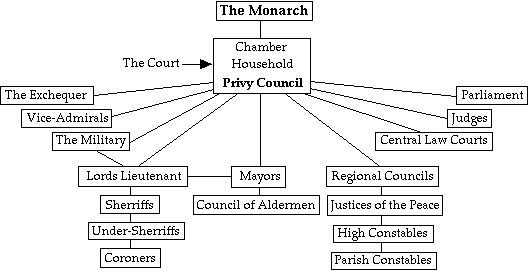
The
domestic servants of the monarch, living in close quarters with the Queen (or
King) at Court. The 40 messengers of the Chamber were also used by the Privy
Council to make arrests.
Servants
of the monarch who attended to the public face of Court administration; the
Court merged with central government since servants of the Household and Chamber
often held offices in the Privy Council and state bureaucracy.
Overseers
of coastal counties or of seaboard areas within a county. Though appointed by
the Admiralty they were instructed by the Privy Council as were the Lords
Lieutenant and Judges.
The
centre of Crown finance; the Lord Treasurer, a leading member of the Privy
Council, appointed officials to collect revenues from the counties. The revenue
was then passed up through the various levels of administration from the Parish
Constables.
Fraud
and tax evasion inevitably diverted much government revenue, and no effective
method was devised to resolve the problem largely because officials were
insufficiently paid; even the scrupulous Lord Burghley was guilty of tax evasion
while acting as Lord Treasurer.
About
thirty peers and privy councillors were appointed by the monarch to oversee the
local administration of counties, usually in areas where they had estates or
business interests of their own. They acted as a liaison between the military
and local branches of government and were responsible for the division of the
country into its administrative regions. they supervised the muster roll and
summoning of soldiers, the provision of military supplies and storehouses, and
the provision of local tax money to provide for the equipment and transportation
of military troops. These officials were instructed by royal messengers and by
visits to Court.
Deputy
Lieutenants were assistants to the Lords Lieutenant. They were drawn from gentry
and also appointed by the Crown; there were at least two deputies in each
county.
Though
beneath the Lords Lieutenant, the Sheriffs remained the most direct
representative of the Crown in the counties. They were appointed annually from
among leading men of the counties, chosen by the monarch from a list of nominees
compiled by privy councillors and judges. Among their duties were the collection
of fines, keeping of the jails, some law enforcement, and the arranging of
elections to Parliament (they ordered gentry or town burgesses under their
jurisdiction to elect two representatives to the Commons--and often influenced
the final choice).
They
appointed their own deputies, or Under-Sheriffs.
The coroner (or "crowner") was elected from gentry below the rank of knight. There were from 1-6 per county, and they assisted with law enforcement and the assembling of juries. Their main responsibility (as today) was to determine the cause of death where circumstances were suspicious.
NOTE:
(a)
Know who attended the Queen
(b)
Court ceremony
(c)
The key areas � Household, Privy Council, Chamber
(d)
Why being at Court was
important
(e)
Role of Privy Council � how it also controlled the regions through
appointments, and its links with Parliament
(f)
Idea of faction at Court
(g)
Disputes between Elizabeth and Councillors
(h)
Importance of key councillors � Cecil, Dudley, Walsingham, Hatton,
Essex
Yet,
in contrast to works that were issued in 1958 to mark the quatercentenary of her
accession, the picture recent works have painted of Elizabeth, particularly in
academic circles, has been darker than that portrayed by Sir John Neale, Sir Roy
Strong and others.3
Whereas, for Neale and Strong, Elizabeth was a genuine champion of
Protestantism, who ruled effectively over an increasingly prosperous and
politically and culturally significant realm, adored and celebrated by her
subjects, for more recent historians Elizabeth's reign was troubled and its
legacy more so. Though Geoffrey Elton attacked Neale's interpretation of
Elizabethan parliaments, the first significant assault on Elizabeth's queenship
was Chris Haigh's Elizabeth I, which argued that Elizabeth was, if an
astute politician able to manipulate council, court and subjects through courtly
love, emotional blackmail and propaganda, also an indecisive and vain monarch.
She was both a bully and weak, who created many of her own problems, whether
this was by conciliating conservative religious opinion too much at the
beginning of her reign or allowing both council and court to become a
dangerously narrow clique in her final years. This negative picture has been
developed further, increasingly highlighting the political and religious
fissures between Elizabeth and her leading subjects. John Guy has pointed to the
significant differences in political beliefs between Elizabeth and many of her
councillors, like Burghley, Leicester and Walsingham. Patrick Collinson and
Stephen Alford have demonstrated that, in conjunction with conflicts over
political issues, these differences created tensions over the issues of marriage
and succession, with councillors willing to invoke quasi-republican ideas to
provide remedies and to force Elizabeth into action. Collinson, Peter Lake,
Brett Usher, Thomas Freeman and others have highlighted the continuing conflict
between Elizabeth and moderate puritans over the perceived failure of the
religious settlement of 1559 to reform the church fully � Conversely, crucial
questions about Elizabeth's queenship, the nature of court politics and
policy-making, the extent to which political issues were discussed outside the
court and how Elizabethans perceived their queen and her governance, remain
disputed or unanswered. John Neale's and Conyers Read's influential readings of
Elizabethan governance � that it was based on social connections and was
divided by factionalism � have been challenged. Simon Adams demonstrated that
the near-contemporary sources on which Neale and Read based their arguments �
Camden's Annals (Books 1�3, 1615; Book 4, 1629) and Sir Robert
Naunton's Fragmenta regalia (1641) � were infused with personal agendas
and modelled on classical styles. He has also shown that factionalism was absent
from the court until the disruptive influence of Robert Devereux, second earl of
Essex, was felt in the 1590s � a position with which many historians agree.
Yet, revisionist history largely failed to deal with the wider questions raised
by Neale and Read: the role of social connections and ideology in politics. With
the exception of Haigh's Elizabeth I � which outlined instances where
Elizabeth took counsel from individuals, including those who were not privy
councillors � Elizabethan politics was increasingly seen in Eltonian,
institutional terms. The privy council was identified as the central advisory
and policy-making body, even when research by David Starkey, George Bernard,
Eric Ives, Cliff Davies, Steve Gunn and Penry Williams re-emphasised the
importance of social connections in early Tudor governance vis-�-vis
Elton's �Tudor revolution in government�. Instances of informal counselling,
highlighted by Haigh and others, were conceived in terms of exceptions to the
rule, often means by which Elizabeth consciously isolated herself from the
council whose opinions conflicted with hers.
Similarly,
though the work of Paula Scalingi and Constance Jordan has shown that
contemporary debate on royal power was dominated by the issue of female monarchy
in the second half of the sixteenth century, there is little consensus about the
role gender played in Elizabeth's queenship. Feminist historians, such as
Allison Heisch, Mary Thomas Crane, Mary Hill Cole and Anne McLaren, have argued
that gender was the defining force in Elizabeth's reign. According to Crane,
Elizabeth played with gender conventions to wrong-foot her counsellors; Heisch,
Cole and McLaren have seen Elizabeth more as a prisoner of her gender. In her
increasingly influential work, McLaren has suggested that Elizabeth's gender
forced her to redefine her queenship in �extraordinary� and providential
terms: as a corporate activity, executed jointly by her and her male counsellors.
In contrast, while acknowledging that gender formed part of the
politico-cultural milieu of the age, Patrick Collinson, John Guy, Stephen Alford
and others have all identified religion as the key factor. Elizabeth
consistently refused to resolve the central problems the regime faced: reforming
the church fully and securing a Protestant succession, to prevent the accession
of Mary Stuart and the reconciliation of England to Rome. Simply, Elizabeth
remained under constant pressure to live up to Protestant expectations that her
accession had inspired.
Gender
has also influenced more recent studies of public discourse on or during
Elizabeth's reign. Carole Levin's �The heart and stomach of a king�
has analysed popular public debate of Elizabeth's queenship, concluding that
ordinary Elizabethans shared the concerns of her most eminent privy councillors:
Elizabeth's failure to follow gender expectations by marrying and having a child
to succeed her. The strengths of Levin's study are that she has sought to
examine popular knowledge and discussion of major political issues and has
implied that such debate was independent of elite discourse in the court and
council. It contrasts with earlier work which has defined public debate as
directed by the council to �bounce� Elizabeth into action, whether this
involved planting speeches in parliament or commissioning pamphlets, such as
John Stubbe's The discouerie of a gaping gulf (1579) against the Anjou
match. However, Levin's study is also problematic because she assumes a
consciousness and deliberate manipulation of gendered imagery by Elizabeth and
her subjects that is disconcertingly and anachronistically modern. It also fails
to distinguish between different types of participants in debate �
ambassadors, Catholic polemicists, puritan clergymen, yeomen and labourers �
and denies that other issues, like religion, had equal or greater importance.
Levin's
work, therefore, leaves important questions about the nature of Elizabethan
public debate unanswered: who participated in debate, why and what did they say?
Moreover, the significance of these questions has grown since the publication of
an English translation of J�rgen Habermas's highly influential work on the
public sphere, Strukturwandel der �ffentlichkeit (The structural
transformation of the public sphere).
Though
Habermas's definition of the public sphere, and his identification of the late
seventeenth century as its birth date, have been widely challenged, there
remains a reluctance to date the emergence of a public sphere in England earlier
than the early or mid-seventeenth century.22
Preliminary research on the existence of public debate in Elizabethan England
points to the need to reconsider these issues fully and in detail.
This
study attempts to answer these questions. It grew out of my doctoral work on
Elizabeth's final marriage negotiations, with Francis, duke of Anjou, brother of
Henry III of France, between 1578 and 1582. In the course of reconstructing the
negotiations and exploring how they could help us define the nature of politics
and political culture in the much-neglected mid-Elizabethan period, two things
struck me. First, an examination of the process of the negotiations in 1579
drawn from memoranda principally in Burghley's archive, suggested that Elizabeth
not only took a more active role in policy-making than some recent studies had
suggested, but that the privy council did not take the leading advisory role.
Rather, Elizabeth appeared to select individual councillors whom she trusted to
discuss the marriage separately from formal conciliar meetings. Moreover,
related issues and incidents, such as attempts to secure the release of the
former Scottish Regent, the earl of Morton, in 1580�1, suggested that
Elizabeth took counsel from those who were not privy councillors, such as her
Scottish agent, Thomas Randolph, often privileging their advice over that given
by councillors.
Second,
my re-evaluation of the circumstances surrounding the publication of John
Stubbe's controversial pamphlet against the marriage, The discouerie of a
gaping gulf (1579), raised questions about the extent to which public
political debate was organised by the regime. It proved difficult to ascertain
close connections between Stubbe and Leicester and Walsingham, often regarded as
the commissioners of the pamphlet. Closer connections existed between Stubbe and
Burghley, through Burghley's secretaries, Vincent Skinner and Michael Hickes,
who were Stubbe's friends and contemporaries at Cambridge and Lincoln's Inn.
These connections appeared to be confirmed not only by the possibility of an
earlier collaboration between Stubbe, Skinner and Hickes on The life off the
70. Archbishopp off Canterbury presentlye sittinge Englished (1574), but by
apparent references in A gaping gulf to memoranda by Burghley and Sussex
now extant in Burghley's archive. Equally, however, a reconstruction of Stubbe's
political assumptions, his education, religious commitment and his earlier
forays in print � including his collaborative work with Skinner and Hickes �
made the likelihood that Stubbe was commissioned to parrot the words of others
less convincing. Rather, it appeared that Stubbe wrote the pamphlet because of
his own concerns about the marriage and his belief that he could counsel the
queen or comment on political issues. It raised the possibility that a forum for
public debate existed in Elizabethan England.
These
two themes form the basis of this study. On the one hand, therefore, I have
sought to explore the nature of Elizabethan court politics � both
policy-making and wider political debate � and of Elizabeth's queenship, to
test the extent to which the methods I found characteristic of the late 1570s
and early 1580s were evident earlier in the reign. On the other, I have
attempted to expand the model of public debate I identified with Stubbe across a
broader social and geographic canvas. Therefore, chapter 2 seeks to answer the
questions posed by Neale and Read about the nature of Elizabethan court
politics; chapter 3 discusses the specific question of whether Elizabeth's
queenship, and court politics, were shaped by her gender or by other factors. In
what often felt like a �book of two halves�, chapter 4 attempts, in part, to
connect the discussion of court politics to the examination of public debate.
Having established in the previous two chapters that the court was the main
forum for policy-making, chapter 4 explores ways in which political issues were
discussed at court aside from direct counselling by Elizabeth's trusted
advisers. Chapter 5 lays the foundation for examining the nature of public
debate by surveying how news circulated in England, Wales and Ireland; the
nature of public debate itself is explored in chapter 6. Though both the issues
of debate, and the factors which may have encouraged participation, are
highlighted in chapters 5 and 6, chapter 7 focuses on how a variety of
Elizabethans understood and perceived Elizabeth's queenship.
In
what appeared to be an increasingly ambitious project, especially concerning the
nature of public debate, a number of points have underpinned my approach. First,
my methodological approach to Elizabethan politics has been to combine study of
real politics with political culture, part of what has been termed �New Tudor
Political History�. Influenced by political theorists and historians, like
Quentin Skinner, John Guy, Patrick Collinson and others, I have increasingly
understood Tudor politics as the interplay between people, institutions and
ideas. Therefore, I have found it necessary to explore the social, educational
and ideological background of political actors in order to understand how they
perceived the Elizabethan regime, the issues facing it and their own responses.
Second, though this study was initially conceived to concentrate on the
mid-Elizabethan period, which has been rather neglected, it grew to consume the
first decade of the reign too. Indeed, it covers what John Guy has identified as
the first of two coherent periods into which Elizabeth's reign can be divided,
1558�1585/7. This was partly born out of the availability of sources: a number
of crucial pieces of evidence on political discourse at court and in the country
dated from the 1560s, while corresponding material for the 1570s could be rare.
My desire to explore the origins of what I perceived to be a more active style
of leadership by Elizabeth was also important. However, whilst not the primary
focus of this study, the result has been to enable me to reconsider Guy's
arguments about the coherence of the so-called �first reign� and pursue
reservations about these arguments which I had experienced during my doctoral
research.
Third,
I have found it more useful to define the court in terms that lie between David
Starkey's very narrow definition and the much wider ones of Perez Zagorin and
Malcolm Smuts. Whilst Starkey's emphasis on the royal household, and in
particular on the monarch's personal body servants in the privy chamber, ignores
the nobility and gentry who were physically attendant at court but lacked
official positions, Zagorin's inclusion of all county officials, and Smuts's of
courtiers' London houses and the Inns of Court, seems too liberal. Though there
were close connections between the court and the counties, on which Tudor
governance relied, a blanket inclusion of all officials conceals the differing
levels of contact individuals had with the queen and her immediate regime. In
turn, this blurs differences in access to, and involvement in, political debate
at court which, as will be shown in later chapters, could be practically and
ideologically distinct from that in the counties. Rather, when I talk of the
court, I refer to the royal household and those aristocrats and gentry, male and
female, who were resident or attendant at the royal palaces for at least part of
the year. This has been estimated to be approximately two-thirds of the nobility
and as many as fifty to sixty gentry families in the early and middle years of
the reign. I see the court as a collection of individuals � some with official
positions, others without � rather than as an institution or a physical space,
circumscribed by the palace walls or dictated by proximity to Elizabeth. Hence,
individuals became courtiers because they were attendant, in one way or another,
on the monarch but did not cease to be courtiers when they returned to their
estates or went abroad on official business. One of the most important, and
interesting, aspects of the court and its relationship with public debate is the
permeable barrier between the two, a permeability created by courtiers who were
able to traverse or occupy the different physical spaces of the royal palaces
and the counties. To explore this more accurately, however, we need to think of
the court as a collection of individuals and to use the term �courtiers�
more readily than �the court�.
Fourth,
perhaps unsurprisingly for a former student of St Andrews, I have also attempted
to take a �British� approach. It has become increasingly clear, thanks to
the work of Jane Dawson and Roger Mason, that leading Elizabethans, like
Burghley, perceived politics in �British� terms, looking at the strategic
and ideological problems and benefits posed by constituent parts of the British
Isles. If their work has informed my understanding of Elizabethan court
politics, then I have also attempted to translate this to my exploration of
public debate. I have consciously tried to explore public debate in England,
Wales and Ireland, even if, because of the imbalance of evidence, England has
assumed the lion's share. Irish debate in particular seems to make important
correctives to our current understanding of early modern discourse and point to
some important avenues of research.
Fifth,
though Peter Lake's and Michael Questier's recent study of the public sphere, The
anti-christ's lewd hat, has demonstrated how much information on the
dissemination and reception of printed texts can be gained from the texts
themselves � something that I had recognised in reading countless pamphlets in
the British Library � I have chosen to try and reconstruct the nature of the
public sphere by identifying real readers and real participants, through book
inventories, booksellers' accounts, cases of seditious and slanderous words etc.
Sixth, having outlined how I use the term �court�, it seems equally
imperative to delineate how I have used a number of different labels for the
public sphere and public debate in the course of the following exploration �
though I discuss explicitly what we should call the Elizabethan public sphere at
the end of chapter 6. I use �public sphere� to denote the concept of the
public sphere and as an initial term to refer to the Elizabethan public sphere
prior to defining exactly what we should call it, or (with the adjective
�Elizabethan�) as a short-hand to signify that I am referring to the concept
of the public sphere in relation to the Elizabethan period. I use �public
discourse� to denote an unsituated discourse, a common theme debated by a
variety of people who were not always aware of each other's existence.
Conversely, I use �public debate� as an umbrella term to refer very
generally to the act of discussing political issues by those who were not
members of the court.
Finally, this study is not concerned with conceiving the public sphere, as Habermas and others have done so, in terms of an essential prerequisite of liberal�democracy and one of its major causes. Thus, it does not seek primarily to respond to some of the most recent research, notably by David Zaret, that traces the origins of public opinion and the development of conscious appeals to it to legitimate political action. Rather, it is born out of the debate on the nature of Tudor political history as articulated by Patrick Collinson in his inaugural lecture as Regius Professor of Modern History at Cambridge in 1989 and uses the notion of the public sphere as a new, and necessary, conceptual framework to examine Elizabethan political discourse. Chapter , therefore, details the historiography of Elizabethan court politics and political debate and discusses the conceptual frameworks needed to resolve some of the unanswered questions it poses. It also lays down some of the problems posed by extant sources and how these shape our pursuit of a better understanding of political awareness and debate under Elizabeth.
ELIZABETH�S
COUNCILLORS
Sir
William Cecil, 1st Baron Burghley
Cecil 1520-1598, was Elizabeth's most trusted and capable advisor. He served in both Edward VI's and Mary I's administrations, and acquired the reputation of a reserved and dedicated servant of the crown. He was probably Elizabeth's most trusted advisor on the Privy Council. He first met Elizabeth in her teenage years, and she recognized his abilities; she appointed him her surveyor 'accountant'. They were close friends, and Cecil, understandably, was often at odds with the queen's favourite courtier, Robert Dudley. Both men viewed the other as their main rival for Elizabeth's affections. Dudley was open in his ambition to marry the queen, and Cecil was just as openly opposed to the idea.
Burghley, also spelled Burghleigh, was known as Sir William Cecil from 1551 to
1571. He was a pillar of state through three reigns and for forty years was the
main architect of the successful policies of the Elizabethan era, earning a
reputation as a master of renaissance statecraft whose talents as a diplomat,
politician and administrator won him high office and a peerage.
Despite Cecil's prodigious administrative gifts, Elizabeth remained the true power in England. She enjoyed occasionally disagreeing with him, and never hesitated to have her own way. But she trusted him unconditionally, and loved him deeply. His death was a devastating blow in the last years of her reign; no other councillor received the same favour and affection.
He continued to sit in Parliament, as a commoner until 1571 and as Lord Burghley thereafter, and was Elizabeth�s chief spokesman there, as well as administrative head of her government. One of his greatest skills was his ability to function as a liaison, representing royal policy to Parliament and keeping Elizabeth in touch with its feelings. His personal religious sympathies were with the Puritans, but politically he considered the interests of the country best served by a middle-of-the-road Anglican church, which he supported against both Protestant and Roman Catholic extremes. He urged Elizabeth to marry and perpetuate a Protestant Tudor house, and he supported the cause of the Scottish Protestants against the Roman Catholic Mary Queen of Scots. He was not able to maintain a policy of moderation, however. A succession of Catholic plots against Elizabeth led to increasing harshness toward Catholics generally and finally the execution of Mary Queen of Scots. In the Privy Council Burghley took a decisive role in the suppression of the Catholic revolts, but he was opposed to the entrance of England into European wars on behalf of the Protestants. This policy was defeated (1585) by the Puritan wing of the council under Robert Dudley, earl of Leicester, and Sir Francis Walsingham. Although Elizabeth�s favourites often opposed Burghley�s influence, his role as chief adviser was never seriously challenged. After Burghley died, his son Robert , who he had hand-picked and trained for the job, took over as Elizabeth's advisor in her later years.
Sir
Robert Dudley, earl of Leicester (c1532-88)
Dudley was Elizabeth's main favourite throughout her reign. Many historians believe Dudley was Elizabeth's true love. Whether Dudley deserved the queen's affections is debatable; he was often ill-tempered and arrogant. But he and Elizabeth remained close until his death, and there is much surviving proof of their emotional connection. In fact, during the early years of her reign, most foreign ambassadors believed Elizabeth and Dudley would marry.
The son of the duke of Northumberland who had engineered Jane Grey's disastrous
nine day reign, Dudley's fortunes were low until he met Elizabeth again in
adulthood, they first met as children. He sought to keep his first marriage
secret, though his wife, Amy Robsart, died in mysterious and scandalous
circumstances in 1560. Later, he made a secret marriage to the queen's cousin,
Lettice Knollys.
When Elizabeth contracted smallpox in 1562, she named him as heir of
England. Elizabeth only titled him earl of Leicester in 1564, and
ostensibly this was to make him a more attractive candidate for marriage to the
queen of Scots. But, as the Scottish ambassador James Melville noted wryly, the
queen openly tickled Dudley's neck as she fastened the mantle around his
shoulders. Still, Elizabeth was always quick to keep Dudley off-balance and
insecure in her favour. As she told him once, 'If you think to rule here, I will
take a course to see you forthcoming. I will have here but one mistress, and no
master.' A privy counsellor, he favours an aggressive foreign policy
and further reform of the Church of England. He is made general of the English
forces in the Netherlands in 1585, but his support of the Dutch rebels against
Spain is ineffectual.
Dudley died on 4 September 1588. Despite her emotional ties to Dudley, Elizabeth had over 20 different "favourites" during the course of her realm.
Sir
Christopher Hatton, 1540-1591
Hatton was one of Elizabeth's most gifted and trusted courtiers. He was very intelligent, though he left Oxford without taking a degree; he went to court instead, and his wit and skills as a dancer impressed the queen. Elizabeth kept him at court for nearly a decade before rewarding him adequately for his services (she was perversely fond of withholding titles and monies from her favourites.) Hatton eventually served ably in several offices, including Captain of the Queen's Bodyguards and as one of her spokesmen in the House of Commons. In 1587, he reached the summit of his career when he was made Lord Chancellor. And, ironically enough, she also made him Chancellor of Oxford University.
CLICK HERE TO RETURN TO MENU
