LOUIS XIV -- RELIGION
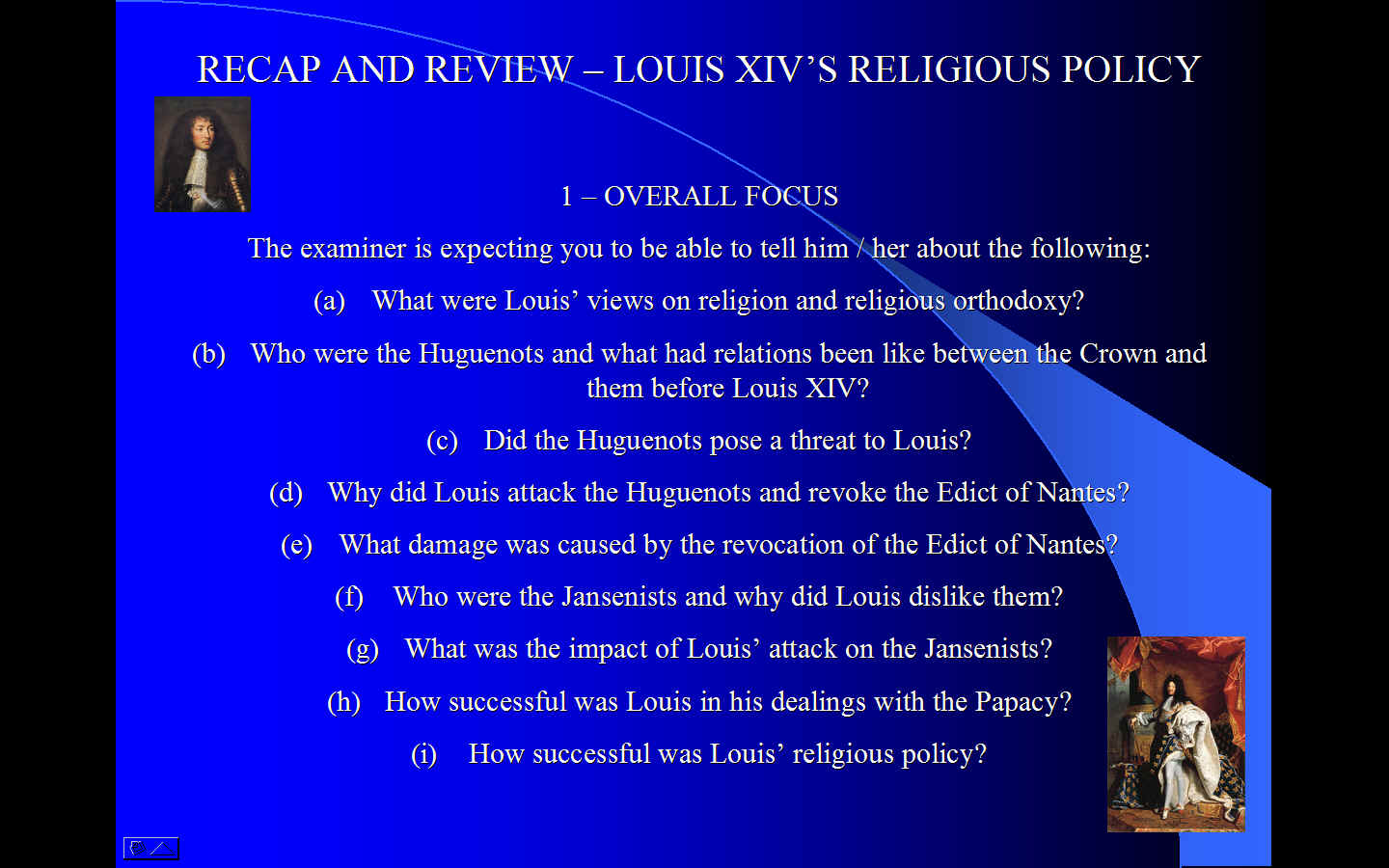
The examiner is looking for evidence that you are aware about Louis' views on religion and orthodoxy; that you understand the reasons for Louis' attacks on Huguenots and Jansenists; that you understand the events leading up to the Edict of Nantes and its repercussions; that you understand the successes and failures of his religious policies.
To help you revise for this topic, you will find below the following sections:
(a) Notes on Louis XIV and his Religious Policy -- these notes are presented in 3 different methods as people learn differently: there are traditional notes that you can print out, there is a powerpoint presentation of the notes and there is a video version of the notes. Select whichever option you prefer
(b) Essays on Louis and Foreign Policy
(c) Extended reading on Louis and Foreign Policy
SECTION (a) NOTES
TRADITIONAL NOTES THAT YOU CAN PRINT OUT
LOUIS AND THE PAPACY
THE HUGUENOTS
JANSENISM
POWERPOINT PRESENTATION -- Click on the picture below for the Powerpoint presentation
VIDEO PRESENTATION -- Click on image below for the video presentation
......... SECTION (b) -- ESSAYS Why did Louis XIV revoke the Edict Of Nantes and how damaging was the measure? Louis XIV understood little about religious doctrine but was guided by an unquenchable belief in the Catholic Church; to him all other religious beliefs were an affront to God and to his own royal authority. His views were reinforced by his spiritual advisers, the Jesuits, who continually warned the king that his soul was in danger as long as he tolerated such heresy within his kingdom. The Edict of Nantes had been passed by his grandfather Henri IV as a temporary measure to solve the immediate problem of religious tension. The fact that the decree was signed with yellow wax rather than the green wax of permanent royal decrees demonstrates that it was not meant to be a permanent measure, for Henri IV, also believed that the state would only be strengthened if religious orthodoxy could be assured. Even before Louis became king the edict had been weakened by Richelieu, who in 1629 had negotiated the Grace of Alais, removing the political and military clauses of the Edict. Even before Louis assumed control of France he showed his hostility towards the Huguenots by treating a deputation to extreme aloofness in 1659. The moment he became king he began to put in a series of measures to make life difficult for the Huguenots. Louis gloried in the title of His Most Catholic Majesty and was determined to stamp out any groups that challenged the orthodoxy of religion within his realm. Between 1661 and 1679 measures were introduced to make life unpleasant for Huguenots : restrictions were placed on marriages and funerals, Huguenot schools and churches were closed and Huguenots were bribed to abandon their faith. Louis became convinced that only through the conversion of the Huguenots could his and their souls be saved. He was determined to convert them into good Catholics. To this end a special government department was set up, knows as the casse des conversions, whose task was to oversee conversions. This policy had a degree of success for it has been estimated that the number of Huguenots in France fell from 2 million to 1.25 million. If this policy had continued and the conversion rate remained steady the Huguenots would have disappeared by 1750. Yet the speed of conversions was not sufficient enough for Louis as he wanted the Huguenot religion eradicated in France during his lifetime. 1679 proved to be the decisive year. This was the year when Louis stood at the height of his power in Europe. He was dominating the Continent and yet was being openly defied by heretics at home. In 1679 Louis adopted a more aggressive policy. He was determined to eradicate heresy and unify the Church. Louis came under the influence of a group of enthusiastic Catholics (known as devots) who maintained that Protestantism could be stamped out with firm action. Louis was convinced by such arguments. He came to accept that stepping up the persecution would deal the death blow to these heretics. Louis therefore launched a series of measures. These included the abolition of the Chambres de l'Edit which had protected Huguenot interests, a decree in June 1680 that stated that all conversions from Catholicism to Protestantism were forbidden, the destruction of Huguenot churches on the flimiest excuse, the banning of Huguenots from public offices and from the medical, legal and publishing professions and the policy of taking from the Huguenots their children at the age of 7 to be educated as Catholics. All these measures were designed to encourage Huguenots to escape such persecution by conversion. Louis spared no method to step up the pressure as all this was accompanied by offensive propaganda and the deliberate billeting of troops on Huguenot families. As a result of this billeting policy men were beaten up, women raped, children terrorised and property destroyed. Yet latter was too much for Louis : he denounced violence and ordered end to it but billeting continued. Economic pressure was also put the on Huguenots : those who converted to Catholicism were exempt from taille, but heretics had to pay four times as much as previously. Such tactics began to work well and saw large numbers convert, but Louis would not be satisfied until all Huguenots had converted and so stepped up pressure : people who denounced Huguenots were rewarded with half their property; Protestants were forbidden to preach or write, were not allowed to employ Catholic servants and were not allowed to emigrate. However to Louis the most shameful stain on France was the existence of a decree that recognised the Protestant faith. At same time the Emperor had just secured a victory against the heretical Turks and was wallowing in the glory of smashing heretics. Catholics in Europe were now looking to the Emperor, rather than Louis, as Europe's foremost Catholic monarch. Louis needed to do something. In 1685 he removed the disgrace to France and to his royal dignity be revoking the Edict of Nantes. To many historians this was merely the logical outcome of his policies since Protestantism had effectively ceased as a force in France. Yet Louis was more motivated by the desire to remove any stain on his dignity and to updo the Emperor. The Revocation included clauses totally banning public Protestant worship, banishing ministers who refused to conform, insisting that children of Protestants should be baptised and educated in Catholic religion and condemning to galleys laymen who tried to emigrate. Louis was determined to deal with the matter once and for all. The immediate results of revocation were tragic : 240,000 fled to other countries taking their skills and hatred of Louis; however 1450 were caught and sent to galleys. 10,000 Huguenots fought for William of Orange against France, including 600 officers. the Huguenots who remained were subjected to forced conversions, forced attendance at mass, and forced protestations of loyalty. After 1685 the persecution escalated : between 1685 and 1762 46 Huguenot ministers were executed and the dead bodies of relapsed heretics were dug up and thrown on rubbish heaps. In longer term campaign against Huguenots failed for in remote areas, like the Midi, Protestant congregations continued to worship, while Huguenots revolted in the Cevannes in 1689 and 1692, at a time when Louis was fighting against powerful enemies, he was forced to send troops to these areas, thereby weakening his army and giving an advantage to his enemies. Protestant worship continued until it was officially recognised by Napoleon. Roland Mousnier has condemned Louis' policy as pointless, ineffectual and tyrannical. Certainly the whole incident has damaged Louis' reputation with most historians regarding it as a blunder. The emigration of so many merchants, bankers and craftsmen hurt France and helped countries like England. in addition it stepped up hostility to Louis among Protestants in other countries like England and The United Provinces. In fact his persecution helped to turn many in England against the pro-French James II and witness his overthrow by Louis' main enemy William of Orange. The policy failed to eradicate the Huguenots, harmed Louis' foreign policy, damaged his reputation and did little to enhance his reputation as Europe's foremost Catholic monarch, for Catholics continued to look to the anti-French pope and the Emperor for their lead. Yet it was not all bad news. The Spanish were impressed by his actions and this played no small part in their decision to offer the throne of Spain to his great-great-grandson in 1701. Why did Louis declare war on Jansenism and how successful was he in his campaign against them? Louis did not really understand Jansenism, but disliked it as his Jesuit advisers told him it was a disruptive influence and Louis was aware that some Jansenists had been involved in the Frondes. As a result Louis became convinced that the Jansenists were a threat to the stability of Church and State and rejected their claims that they had been misrepresented. Jansenism originated from Cornelius Jansen's book Augustine (1640) in which he claimed St Paul and St Augustine had supported doctrine that man was hopelessly sinful and could only be saved by God's grace. There was nothing heretical in such views as their arguments were based on clear Catholic doctrine, but their arguments were hated by the Jesuits who believed in people's freedom of choice and the value in God's sight of their good deeds. the misfortune for the Jansenists was that they encountered a king who never really understood religious doctrine and who based all his decisions on a blind commitment to the Catholic faith. Louis' religious ideas tended to be shaped by his spiritual advisers the Jesuits and this meant disaster for the Jansesnists In reality the Jansenists posed no threat to either Catholic doctrine or the authority of the King. These were the sort of people that Louis should have admired and supported. They lived blameless lives and based all their views on Catholic doctrine. Yet in some ways it was their very success in France that worried Louis. Louis saw himself as the Most Catholic Majesty and wanted religious orthodoxy within his realm. the last thing he wanted were people questioning this orthodoxy. The popularity of the Jansesnists in France threatened this religious orthodoxy as people began to question the church in France and in particular its laxity and corruption. Louis recognised the need to reform religion in France, but this was his job not that of some religious sect. The opposition from the Jesuits, who were very unpopular in France, and their lifestyles, convinced many in France that the Jansenists were a group worth supporting. Louis' approach to Jansenism was two-fold : on the one hand he would take the wind out of their sails by reforming the Church, and on the other he would repress their influence. Under Louis there were improvements in the Church : the training and education of parish priests improved and Louis took trouble over appointments, promoting men on merits as well as birth. Yet the persecution was also part of the picture. In 1661 Louis imposed Jesuit doctrines on Port-Royal and chased out male Jansenist leaders; in 1664 the Archbishop of Paris, Louis' ex tutor, expelled the nuns from Port-Royal. All this was designed to weaken the movement by destroying their headquarters. However despite this Jansenism remained a force in France and Louis found he needed papal support. Jansenism received support from many Catholics in France, but such Catholics took their lead from the Pope. If the Pope condemned Jansenism it would lose respectability in the eyes of Catholics. Louis therefore welcomed an anti-Jansenist bull issued by the Pope in 1665. This he hoped would convince Catholics that this organisation was heretical and should not be supported. Yet the policy proved a disaster for Louis. Unfortunately several French bishops disagreed with the Pope and Louis over the condemnation. Also many French Catholics were influenced by Gallicanism and resented papal interference. The pope's support for Louis had back-fired. As a result between 1668 and 1679 the anti-Jansenist campaign was temporarily replaced by "peace of the church", a period of compromise inspired by a more sensitive and tolerant pope. Yet Louis was furious that the group had survived and in 1679 as part of his religious campaign against the Huguenots, he also stepped up campaign against the Jansenists. The 1680s saw Louis' drive for religious orthodoxy, as witnessed by attack on Huguenots and for Louis made sense to deal with Jansenists at same time. Yet despite pressure the Jansenists continued to thrive. During the end of his reign Louis realised that to destroy Jansenism he needed to rebuild fences with Rome. Therefore in 1693 disowned Gallican Articles. In this way he hoped to win the active support of the pope in his campaign. French pressure in Rome led to pope ending right of Jansenists to remain quiet on sensitive theological issues. In this way he hoped that Jansenists could be questioned over such issues and thereby reveal heretical thoughts. With papal support Louis sent troops to expel the remaining nuns from Port-Royal. In 1711 he ordered buildings to be razed to ground and the bones of dead Jansenists to be reburied in common grave. The climax to Louis' war came in 1713 when Pope issued a bull condemning 101 heretical propositions in Jansenist literature. Louis hoped that this would end French catholic support for the group. Yet the bull provoked sympathy for the Jansenists and the parlement of Paris only registered the bull under protest, while 15 bishops refused to recognise it. In order to restore discipline and ensure acceptance of the bull, Louis proposed summoning a council of the French church, with the king presiding. But he died first, so Jansenism survived. Was all this worth it? In pursuit of religious orthodoxy, Louis had quarreled with Pope, alienated own clergy and clashed with Paris parlement and Jansenism survived. Indeed Jansenists had revenge as they were active in events leading to fall of Louis' great-great-grandson, Louis XVI, in 1789. How successful was Louis' dealings with the Papacy? Louis was a devout Catholic who saw it as his duty to protect and maintain the Catholic faith. His view was based on belief rather than understanding of doctrinal issues. Louis was guided by his confessors, all of whom were Jesuits, committed to the promotion of the Catholic faith. Traditionally the French Crown and the Catholic Church had co-operated to maintain order in state and church, but under Louis this relationship was tense. At the root of the problem was the question of authority over the catholic church in France. Louis was convinced that he had right to supervise French Church despite Pope's claim to be supreme authority. The Church was influential and rich and whoever controlled the pulpit more or less controlled public opinion throughout France. The Pope, on the other hand, claimed authority over all catholic churches throughout Europe. For Louis this was a question of royal authority -- he was to be the only supreme authority in France. Allowing the Pope control of the French Church would weaken his position and authority. There was nothing new in this struggle for religious control. The struggle for the domination of the French Church had always been a three-cornered affair between the Papacy, the Crown and the nobles. A movement called Gallicanism had sprung up in the middle ages to campaign for the freedom of the French Church from papal influence. Yet the Crown had never been enthusiastic about Gallicanism since it was essentially an aristocratic movement aimed at increasing aristocratic control over the church. The Crown had no wish to see an increase in noble power and so was unenthusiastic about the movement and had sided with Pope, but Louis saw Gallicanism as something that could be exploited in his conflicts with the Pope. For him it could be a useful political tool to bribe the Pope into granting his demands. Although Louis gloried in the title His Most Catholic Majesty, he was determined to show his independence from Papacy. When a fracas broke out in 1662 between the Pope's guards and those of the French ambassador in Rome,the king demanded and received an apology. Yet for most of time relations were cordial and in 1665 the Pope issued a bull denouncing the Jansenists against whom Louis was waging a vendetta. Louis was also glad to accept the Pope's lead in patching up compromise with Jansenism in 1669. Yet relations suffered setback in 1673 when king declared he was entitled to the regale throughout France. The regale was an ancient custom by which the king appropriated the revenues of vacant bishoprics; but it had only operated in northern France. Louis was, therefore, seeking to extend the terms of the regale at the expense of the papacy. Two French bishops appealed against the king to the Pope and the Pope threatened to censure Louis. A major crisis began to blow up in relations between the Most Catholic Monarch and the Pope. Louis decided to use Gallicanism against the Pope. In March 1682 the French clergy published the Gallican Articles, with Louis' prompting.. These were anti-papal pronouncements declaring that the king was not subordinate to Rome in non-spiritual matters and that the Pope's decisions could be reversed by the approval of whole church, as such these were deeply offensive to Rome. the crisis looked set to get out of hand when Pope Innocent XI responded by refusing to consecrate any more French bishops, leaving 35 dioceses unfilled. The Pope then went further and in 1687 he cancelled the immunity of the French embassy in Rome from inspection by officials chasing criminals. Louis told his Ambassador to defy the authorities, leading the Pope to excommunicate the Ambassador and threatening to do the same to Louis. Yet Louis came out worse as a result of this conflict as is shown by the Cologne election. The crisis reached its height over the Cologne election (1688). Cologne was strategically important to France and up to 1688 had had a pro-French Archbishop. When he died, it was up to the Pope to select a successor. Louis tried to persuade the Pope to accept a French candidate, but the Pope refused and so Louis threatened to invade Italy. The Pope responded by appointing a different candidate. Louis responded by seizing the papal state of Avignon in southern France. This embarrassed French Catholics and made Louis look the aggressor. Louis had been seriously damaged by the conflict : he had lost control of a strategically important city, which was now controlled by an Archbishop loyal to the Emperor, he had tarnished his reputation and had appalled Catholics by his actions. Louis, late in the day, realised he had more to gain from peace with the papacy. The reconciliation was assisted by the death of Pope Innocent XI in 1689. In 1693 Louis withdrew the Gallican Articles and a compromise was reached over the regale. Louis was especially keen to mend fences with Rome because he needed papal support against the French Jansenists. The Sun King's relations with the Papacy therefore had a bizarre conclusion : he had to agree to the Pope in order to impose his policies on his own people. SECTION (c) -- EXTENDED READING Information to appear here shortly CLICK HERE TO RETURN TO THE MAIN LOUIS XIV MENU
SECTION (b) -- ESSAYS
Louis XIV understood little about religious doctrine but was guided by an unquenchable belief in the Catholic Church; to him all other religious beliefs were an affront to God and to his own royal authority. His views were reinforced by his spiritual advisers, the Jesuits, who continually warned the king that his soul was in danger as long as he tolerated such heresy within his kingdom.
The Edict of Nantes had been passed by his grandfather Henri IV as a temporary measure to solve the immediate problem of religious tension. The fact that the decree was signed with yellow wax rather than the green wax of permanent royal decrees demonstrates that it was not meant to be a permanent measure, for Henri IV, also believed that the state would only be strengthened if religious orthodoxy could be assured. Even before Louis became king the edict had been weakened by Richelieu, who in 1629 had negotiated the Grace of Alais, removing the political and military clauses of the Edict.
Even before Louis assumed control of France he showed his hostility towards the Huguenots by treating a deputation to extreme aloofness in 1659. The moment he became king he began to put in a series of measures to make life difficult for the Huguenots. Louis gloried in the title of His Most Catholic Majesty and was determined to stamp out any groups that challenged the orthodoxy of religion within his realm.
Yet the speed of conversions was not sufficient enough for Louis as he wanted the Huguenot religion eradicated in France during his lifetime. 1679 proved to be the decisive year. This was the year when Louis stood at the height of his power in Europe. He was dominating the Continent and yet was being openly defied by heretics at home. In 1679 Louis adopted a more aggressive policy. He was determined to eradicate heresy and unify the Church. Louis came under the influence of a group of enthusiastic Catholics (known as devots) who maintained that Protestantism could be stamped out with firm action. Louis was convinced by such arguments. He came to accept that stepping up the persecution would deal the death blow to these heretics.
Economic pressure was also put the on Huguenots : those who converted to Catholicism were exempt from taille, but heretics had to pay four times as much as previously. Such tactics began to work well and saw large numbers convert, but Louis would not be satisfied until all Huguenots had converted and so stepped up pressure : people who denounced Huguenots were rewarded with half their property; Protestants were forbidden to preach or write, were not allowed to employ Catholic servants and were not allowed to emigrate.
However to Louis the most shameful stain on France was the existence of a decree that recognised the Protestant faith. At same time the Emperor had just secured a victory against the heretical Turks and was wallowing in the glory of smashing heretics. Catholics in Europe were now looking to the Emperor, rather than Louis, as Europe's foremost Catholic monarch. Louis needed to do something.
In 1685 he removed the disgrace to France and to his royal dignity be revoking the Edict of Nantes. To many historians this was merely the logical outcome of his policies since Protestantism had effectively ceased as a force in France. Yet Louis was more motivated by the desire to remove any stain on his dignity and to updo the Emperor.
The immediate results of revocation were tragic : 240,000 fled to other countries taking their skills and hatred of Louis; however 1450 were caught and sent to galleys. 10,000 Huguenots fought for William of Orange against France, including 600 officers. the Huguenots who remained were subjected to forced conversions, forced attendance at mass, and forced protestations of loyalty. After 1685 the persecution escalated : between 1685 and 1762 46 Huguenot ministers were executed and the dead bodies of relapsed heretics were dug up and thrown on rubbish heaps.
In longer term campaign against Huguenots failed for in remote areas, like the Midi, Protestant congregations continued to worship, while Huguenots revolted in the Cevannes in 1689 and 1692, at a time when Louis was fighting against powerful enemies, he was forced to send troops to these areas, thereby weakening his army and giving an advantage to his enemies. Protestant worship continued until it was officially recognised by Napoleon. Roland Mousnier has condemned Louis' policy as pointless, ineffectual and tyrannical.
Certainly the whole incident has damaged Louis' reputation with most historians regarding it as a blunder. The emigration of so many merchants, bankers and craftsmen hurt France and helped countries like England. in addition it stepped up hostility to Louis among Protestants in other countries like England and The United Provinces. In fact his persecution helped to turn many in England against the pro-French James II and witness his overthrow by Louis' main enemy William of Orange.
The policy failed to eradicate the Huguenots, harmed Louis' foreign policy, damaged his reputation and did little to enhance his reputation as Europe's foremost Catholic monarch, for Catholics continued to look to the anti-French pope and the Emperor for their lead. Yet it was not all bad news. The Spanish were impressed by his actions and this played no small part in their decision to offer the throne of Spain to his great-great-grandson in 1701.
Why did Louis declare war on Jansenism and how successful was he in his campaign against them?
Louis did not really understand Jansenism, but disliked it as his Jesuit advisers told him it was a disruptive influence and Louis was aware that some Jansenists had been involved in the Frondes. As a result Louis became convinced that the Jansenists were a threat to the stability of Church and State and rejected their claims that they had been misrepresented. Jansenism originated from Cornelius Jansen's book Augustine (1640) in which he claimed St Paul and St Augustine had supported doctrine that man was hopelessly sinful and could only be saved by God's grace.
There was nothing heretical in such views as their arguments were based on clear Catholic doctrine, but their arguments were hated by the Jesuits who believed in people's freedom of choice and the value in God's sight of their good deeds. the misfortune for the Jansenists was that they encountered a king who never really understood religious doctrine and who based all his decisions on a blind commitment to the Catholic faith. Louis' religious ideas tended to be shaped by his spiritual advisers the Jesuits and this meant disaster for the Jansesnists In reality the Jansenists posed no threat to either Catholic doctrine or the authority of the King.
These were the sort of people that Louis should have admired and supported. They lived blameless lives and based all their views on Catholic doctrine. Yet in some ways it was their very success in France that worried Louis. Louis saw himself as the Most Catholic Majesty and wanted religious orthodoxy within his realm. the last thing he wanted were people questioning this orthodoxy. The popularity of the Jansesnists in France threatened this religious orthodoxy as people began to question the church in France and in particular its laxity and corruption. Louis recognised the need to reform religion in France, but this was his job not that of some religious sect. The opposition from the Jesuits, who were very unpopular in France, and their lifestyles, convinced many in France that the Jansenists were a group worth supporting.
Louis' approach to Jansenism was two-fold : on the one hand he would take the wind out of their sails by reforming the Church, and on the other he would repress their influence. Under Louis there were improvements in the Church : the training and education of parish priests improved and Louis took trouble over appointments, promoting men on merits as well as birth. Yet the persecution was also part of the picture.
Jansenism received support from many Catholics in France, but such Catholics took their lead from the Pope. If the Pope condemned Jansenism it would lose respectability in the eyes of Catholics. Louis therefore welcomed an anti-Jansenist bull issued by the Pope in 1665. This he hoped would convince Catholics that this organisation was heretical and should not be supported.
Yet the policy proved a disaster for Louis. Unfortunately several French bishops disagreed with the Pope and Louis over the condemnation. Also many French Catholics were influenced by Gallicanism and resented papal interference. The pope's support for Louis had back-fired. As a result between 1668 and 1679 the anti-Jansenist campaign was temporarily replaced by "peace of the church", a period of compromise inspired by a more sensitive and tolerant pope.
Yet Louis was furious that the group had survived and in 1679 as part of his religious campaign against the Huguenots, he also stepped up campaign against the Jansenists. The 1680s saw Louis' drive for religious orthodoxy, as witnessed by attack on Huguenots and for Louis made sense to deal with Jansenists at same time.
Yet despite pressure the Jansenists continued to thrive. During the end of his reign Louis realised that to destroy Jansenism he needed to rebuild fences with Rome. Therefore in 1693 disowned Gallican Articles. In this way he hoped to win the active support of the pope in his campaign. French pressure in Rome led to pope ending right of Jansenists to remain quiet on sensitive theological issues. In this way he hoped that Jansenists could be questioned over such issues and thereby reveal heretical thoughts. With papal support Louis sent troops to expel the remaining nuns from Port-Royal. In 1711 he ordered buildings to be razed to ground and the bones of dead Jansenists to be reburied in common grave.
The climax to Louis' war came in 1713 when Pope issued a bull condemning 101 heretical propositions in Jansenist literature. Louis hoped that this would end French catholic support for the group. Yet the bull provoked sympathy for the Jansenists and the parlement of Paris only registered the bull under protest, while 15 bishops refused to recognise it. In order to restore discipline and ensure acceptance of the bull, Louis proposed summoning a council of the French church, with the king presiding. But he died first, so Jansenism survived.
Was all this worth it? In pursuit of religious orthodoxy, Louis had quarreled with Pope, alienated own clergy and clashed with Paris parlement and Jansenism survived. Indeed Jansenists had revenge as they were active in events leading to fall of Louis' great-great-grandson, Louis XVI, in 1789.
How successful was Louis' dealings with the Papacy?
At the root of the problem was the question of authority over the catholic church in France. Louis was convinced that he had right to supervise French Church despite Pope's claim to be supreme authority. The Church was influential and rich and whoever controlled the pulpit more or less controlled public opinion throughout France. The Pope, on the other hand, claimed authority over all catholic churches throughout Europe. For Louis this was a question of royal authority -- he was to be the only supreme authority in France. Allowing the Pope control of the French Church would weaken his position and authority.
There was nothing new in this struggle for religious control. The struggle for the domination of the French Church had always been a three-cornered affair between the Papacy, the Crown and the nobles. A movement called Gallicanism had sprung up in the middle ages to campaign for the freedom of the French Church from papal influence.
Yet the Crown had never been enthusiastic about Gallicanism since it was essentially an aristocratic movement aimed at increasing aristocratic control over the church. The Crown had no wish to see an increase in noble power and so was unenthusiastic about the movement and had sided with Pope, but Louis saw Gallicanism as something that could be exploited in his conflicts with the Pope. For him it could be a useful political tool to bribe the Pope into granting his demands.
Yet relations suffered setback in 1673 when king declared he was entitled to the regale throughout France. The regale was an ancient custom by which the king appropriated the revenues of vacant bishoprics; but it had only operated in northern France. Louis was, therefore, seeking to extend the terms of the regale at the expense of the papacy. Two French bishops appealed against the king to the Pope and the Pope threatened to censure Louis.
A major crisis began to blow up in relations between the Most Catholic Monarch and the Pope. Louis decided to use Gallicanism against the Pope. In March 1682 the French clergy published the Gallican Articles, with Louis' prompting.. These were anti-papal pronouncements declaring that the king was not subordinate to Rome in non-spiritual matters and that the Pope's decisions could be reversed by the approval of whole church, as such these were deeply offensive to Rome. the crisis looked set to get out of hand when Pope Innocent XI responded by refusing to consecrate any more French bishops, leaving 35 dioceses unfilled. The Pope then went further and in 1687 he cancelled the immunity of the French embassy in Rome from inspection by officials chasing criminals. Louis told his Ambassador to defy the authorities, leading the Pope to excommunicate the Ambassador and threatening to do the same to Louis.
Yet Louis came out worse as a result of this conflict as is shown by the Cologne election. The crisis reached its height over the Cologne election (1688). Cologne was strategically important to France and up to 1688 had had a pro-French Archbishop. When he died, it was up to the Pope to select a successor. Louis tried to persuade the Pope to accept a French candidate, but the Pope refused and so Louis threatened to invade Italy. The Pope responded by appointing a different candidate. Louis responded by seizing the papal state of Avignon in southern France. This embarrassed French Catholics and made Louis look the aggressor. Louis had been seriously damaged by the conflict : he had lost control of a strategically important city, which was now controlled by an Archbishop loyal to the Emperor, he had tarnished his reputation and had appalled Catholics by his actions.
SECTION (c) -- EXTENDED READING
Information to appear here shortly
CLICK HERE TO RETURN TO THE MAIN LOUIS XIV MENU