LOUIS XIV -- FOREIGN POLICY
The examiner will be looking for evidence that you can talk about what Louis' aims were in 1661; what the problems were facing him in 1661; why he got involved in each of his wars -- and what happened and what were the results; how successful his foreign policy was up to 1688 and how far this success declined after 1688
This page has three sections:
(a) Notes on Louis XIV and his Foreign Policy -- these notes are presented in three ways = traditional notes that you can print off; powerpoint presentation; video versions of the powerpoint presentation that you can watch or download to your ipod
(b) Model essays
(c) Extended reading on this topic
SECTION (a) -- Notes
Traditional notes that you can print
WILL APPEAR HERE SHORTLY
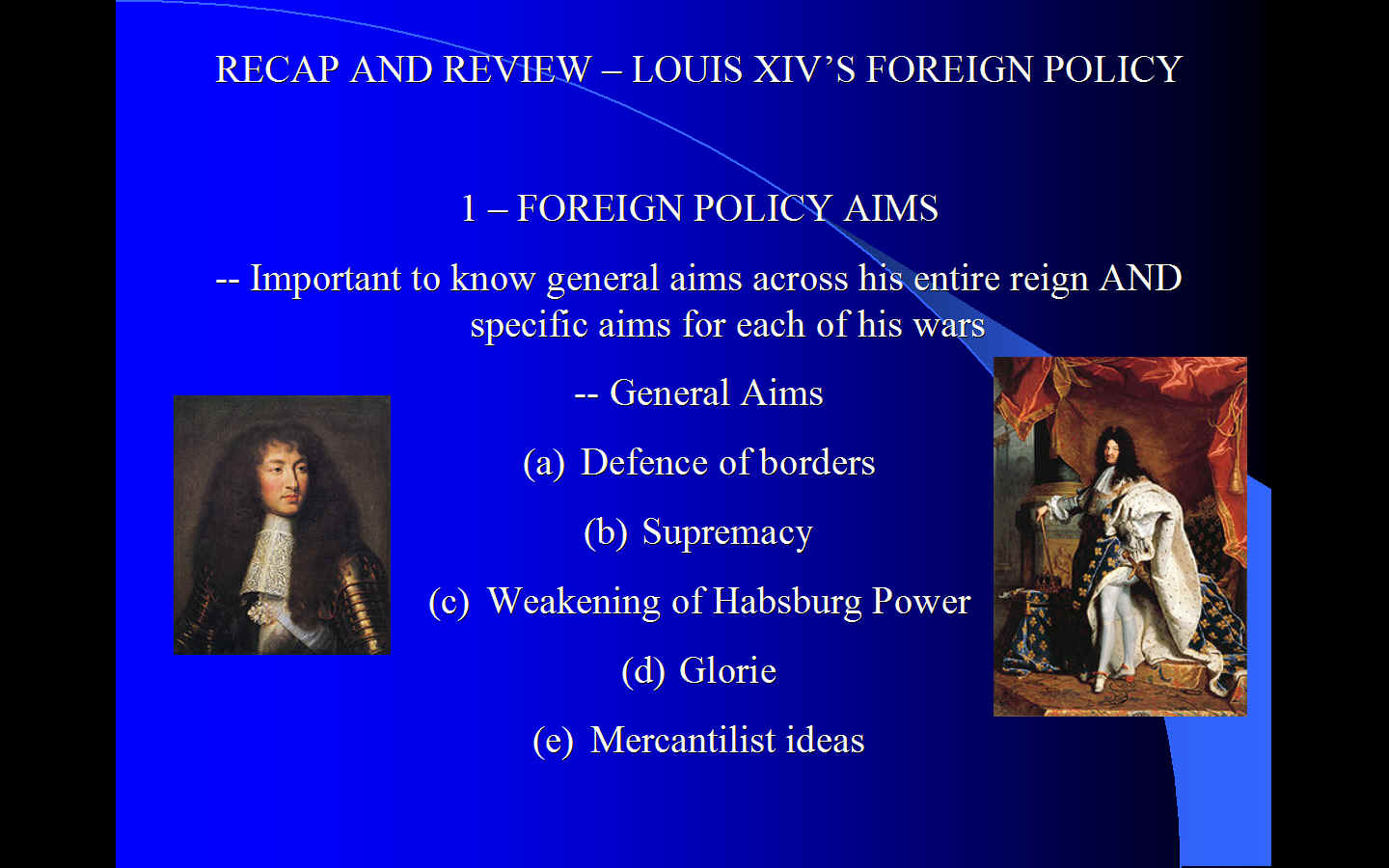
Powerpoint Presentation -- CLICK ON IMAGE
Video presentations -- click on the video links
VIDEOS PRODUCED BY KHS HISTORY DEPARTMENT ON LOUIS XIV'S FOREIGN POLICY
.....<.................... SECTION (b) -- ESSAYS Why did Louis embark on the war of Devolution and how successful was this war for France? Louis grew up in Europe overshadowed by Spain and came to power determined to turn France into the predominant power on the Continent. As a result he was determined to control and shape foreign policy. Louis was convinced that foreign policy was royal preserve and God had equipped him with skills to succeed. One of louis' main concerns was national security. The north-east border was a cause for concern for in 1636 a Spanish army had invaded and got close to Paris and during the Frondes France had been invaded from the same area. Louis was unhappy with the border between France and the Spanish Netherlands. He was determined to eradicate this threat to French security. In 1659 a fifty year war with the Habsburgs came to and end. The war had devastated Europe and left a power vacuum. Spain had been dominant power but had been seriously weakened. Louis, therefore, became king at the time of a power vacuum and France in 1661 was in better position than any other country to exploit this power vacuum. Louis' chance to solve the problem of the Spanish Netherlands came in 1665 when Philip IV of Spain died and was succeeded by his young son Carlos II. Louis saw this as a chance to exploit the weakness of Spain and to strengthen the border with the Spanish Netherlands. Louis decided to exploit his wife's claim to the Spanish inheritance. French lawyers found an ingenious argument for taking part of Spanish Netherlands. They found an ancient Flemish law that said when a man married a second time his property should eventually DEVOLVE upon the children of the first marriage. Maria Theresa was the child of Philip's first wife; Carlos of his second wife. In Louis' eyes, therefore, Maria Theresa was the rightful ruler in those Flemish areas. Louis claimed that he was merely advancing a legal claim, but in reality the claim was weak as only applied to property and so not surprisingly the Spanish Regent rejected the claim. Louis decided to invade to seize the land with an army of 50,000. Most of the Spanish Netherlands was quickly over-run with key fortresses being seized, like Lille. Turenne was in command, with Vauban in charge of sieges. However French successes alarmed other countries -- England and the Dutch (United Provinces) ended their war and joined with Sweden in alliance against France, designed to stop French expansion. Louis retaliated by opening negotiations with Emperor on eventual partition of Spanish Empire. At same time he sent Conde to capture Franche-Comte, which he quickly did. Yet Louis decided to support the doves in his government against the hawks. By the treaty of Aix-la-Chapelle (May 1668) with Spain, Louis kept most of his gains in Spanish Netherlands but returned Franche-Comte. Vauban quickly fortified the new towns in Netherlands -- ironically most of these were not in areas covered by laws on devolution. Louis' war had been relatively uncostly and he was supremely confident, but he was furious with the Dutch since he had protected them in the past and in return they had sided against him. Louis was determined to teach them a lesson. Why did Louis embark on the Dutch war and how successful was he? Although War of Devolution can be justified on the grounds that it improved French security, most historians see the Dutch war as merely a war of spite because of their involvement against France in the War of Devolution. His motive does indeed appear to have been based on vindictiveness and between 1668 and 1672 he prepared for the invasion. Yet some historians have defended Louis. Fracois Bluche called the Dutch War the "inevitable conflict", basing his argument on the irremovable opposition of the Dutch to French expansion in the Spanish Netherlands. Bluche also stresses the economic rivalry between Holland and France as well as the deep-rooted antipathy between Catholic and Protestant. Also Louis despised their republicanism. The Dutch, therefore, were Louis' natural enemies and war was logical rather than vindictive. Louis anticipated a short well-planned and executed campaign to teach the Dutch never to challenge him again in his attempts to absorb the Spanish Netherlands, it is unlikely that his intention was to conquer the area. In addition if their trade could be ruined, this would please Colbert. His first step was to isolate the Dutch. He bribed the Swedes to withdraw from the alliance with the Dutch and reached a deal with Charles II of England in the Treaty of Dover under which in return for cash, Charles would join the war against the Dutch. To prepare for the war, Louis occupied Lorraine in order to limit the potential enemy access to the Low Countries and to protect France's eastern frontier. Louis then mobilised his army. The Dutch were worried and sent envoys to offer concessions, but Louis ignored them. This might suggest that vindictiveness was the key motive. n April 1672 France invaded the United Provinces and by mid-June had seized 40 Dutch towns and the Dutch had been forced to abandon their barrier fortresses. Amsterdam lay for the taking, but Louis listened to his cautious ministers and failed to act. This was a major mistake. At the end of June 1672 the pro-French Dutch leader, Jan de Witt, sent envoys to discuss terms. The Dutch offered to pay an indemnity and to concede to France all Dutch territory south of river Maas. Foolishly Louis rejected the offer since Louvois convinced him that greater concessions could be won. So the war continued. Three things then went against Louis. Firstly the Emperor and the Elector of Brandenburg sent troops to help the Dutch; secondly the Dutch halted the French advance by flooding the countryside; thirdly Jan de Witt was murdered and replaced by William of Orange, who set out to stiffen resistance to Louis. Yet despite the formation of an anti-French alliance in 1673 (Empire, Brandenburg, Spain, Dutch and Lorraine), Louis continued to achieve victories over the next five years. Yet by 1678 it was obvious even to Louis that the war had to end. England had withdrawn in 1674 after Charles' niece had married William of Orange; Sweden, France's ally, had been defeated by Brandenburg in 1675 and the French economy was suffering. Also despite the expansion and professionalism of the French army, it was clear that a stalemate had been reached by 1678. Also Louis had lost his two most competent generals -- Turenne killed in 1675 and Conde who retired in 1675. Peace was reached at Nymegen (1678) under which France retained Franche-Comte and the towns in Flanders like Ypres. Yet Louis handed back to Dutch his most northerly conquests. Yet Louis was far from satisfied with his gains and sacked his foreign minister for not achieving better terms. One of the outcomes of the war was to create an anti-French alliance and to see the coming to power of William of Orange, a man committed to Louis' demise. By 1678 Louis was reviled in the United Provinces, but if he had now acted with restrain he could probably have turned the situation around. Why did Louis' foreign policy after 1678 lead to the formation of the League of Augsburg? Following Nymegen there was a power vacuum that favoured France -- the Emperor was exhausted by war and was focusing on the Turkish threat; Brandenburg had switched sides back to Louis and Charles II was keen to be bribed by Louis once more. Only William of Orange wanted to continue fighting. Whilst other countries reduced their armies, Louis kept his at 140,000. Louis also replaced foreign minister with Colbert de Croissy. This was a significant appointment for Colbert de Croissy was an experienced jurist and had served in various capacities in France's eastern frontiers. Between 1678 and 1684 Louis followed an extremely aggressive foreign policy that alarmed other countries. The first thing Colbert de Croissy did was to establish special courts -- known as Chambres de Reunions -- in Flanders, France-Comte and Alsace. Their purpose was to investigate French claims to ownership of territory that had been "dependent" on towns now occupied by France. Colbert de Croissy discovered several such "dependencies" and submitted them to Chambres de Reunion for judgement. These courts invariably found for Louis and if the areas resisted, force was used to absorb them. This policy -- known as "reunions" -- was doubly significant -- firstly great areas of land was gained; secondly, the countries who lost territory included France's allies, like Sweden. This led to Sweden breaking off diplomatic relations. Yet what really alarmed Europe was Louis' seizure of Strasburg in 1681. This was a free city of the empire to which France had no claim. Louis' aggressive stance continued. Claims were put forward to an area in the Spanish Netherlands, which the Spanish king rejected. In retaliation Louis billeted French army in Spanish Netherlands. At same time the French bombarded Genoa, Spain's ally. In 1683 Carlos II declared war, but Spain was too weak and the Emperor was occupied with the Turks. He won a victory in 1683, but not until 1688 was he in position to intervene in western Europe. Louis exploited the situation to seize Luxembourg in 1684. At the truce of Ratisbon (1684), Spain and the Empire recognised Louis' latest conquests. The reunions were accepted as permanent, while France was to retain Strasbourg and Luxembourg for the next twenty years. Louis' fortification of these areas showed he had no intention of returning them. Louis is said to have reached the height of his power in 1684. People copied French styles and rushed to visit France. Why was Louis so successful between 1661 and 1684? Undoubtedly due to several France's strengths and her enemies' weaknesses. French resources may at times have been strained, but in 1684 showed no sign of collapse. Indeed by 1688 army had expanded to 300,000. Louis also was good at bribing people. Louis' enemies were a motley bunch. Louis was careful not to antagonise Dutch merchants, who prefered trade to war as long as Louis did not go too far. Louis learnt from his mistakes so that in mid-1680s William of Orange failed to galvanise Dutch against Louis because Louis was careful to respect Dutch susceptibilities. The Emperor was preoccupied with the Turks till 1688 and German princes would easily change sides for payment. Yet Louis' successes not as secure as they seemed, for even Louis realised that now the Emperor was freed from the Turkish menace, he could challenge France. To sum up, France's position in 1684 was immensely strong. The combination of natural resources, luck and skill had paid dividends. However Louis had aroused hostility. The cynicism of the reunions, the seizure of areas such as Strasburg and Luxembourg and the devastations caused by French armies built up widespread resentment. This resentment was to boil over . The last quarter of Louis' reign was dominated by war and destroyed his achievements. The Emperor gradually defeated the Turks and in 1687 won a decisive victory. Even before this victory his attention had been turning to western Europe. In 1686 the Emperor, several German princes, Sweden and Spain formed the League of Augsburg in order to counter French aggression. From this point onwards Louis was no longer the master of events. The tide had turned against him. How successful was Louis' foreign policy up to 1688? Up until 1684 Louis' foreign policy was extremely successful. He was engaged in two major wars, which led to great benefits for France, and between 1678 and 1684 conducted an aggressive policy that further increased his power and territory, but the situation in 1684 was not as promising as many contemporaries believed and events from this point onwards turned against Louis. Louis grew up in Europe overshadowed by Spain and came to power determined to turn France into the predominant power on the Continent. As a result he was determined to control and shape foreign policy. Louis was convinced that foreign policy was royal preserve and God had equipped him with skills to succeed. When he came to power, one of his' main concerns was national security. The north-east border was a cause for concern for in 1636 a Spanish army had invaded and got close to Paris and during the Frondes France had been invaded from the same area. Louis was unhappy with the border between France and the Spanish Netherlands. He was determined to eradicate this threat to French security. The War of Devolution did much to solve this problem. By the treaty of Aix-la-Chapelle (May 1668) with Spain, Louis kept most of his gains in Spanish Netherlands but returned Franche-Comte. Vauban quickly fortified the new towns in Netherlands. He had helped secure the north-eastern border. In his war against the Dutch Louis also gained valuable territory, but he failed to achieve any wider aims and created a resentful Dutch leader determined to destroy Louis. Fracois Bluche believes that the war was also an attempt to destroy the Dutch economically. After a successful war for Louis, peace was reached at Nymegen (1678) under which France retained Franche-Comte and the towns in Flanders like Ypres. Yet Louis handed back to Dutch his most northerly conquests. Yet Louis was far from satisfied with his gains and sacked his foreign minister for not achieving better terms. One of the outcomes of the war was to create an anti-French alliance and to see the coming to power of William of Orange, a man committed to Louis' demise. By 1678 Louis was reviled in the United Provinces, but if he had now acted with restrain he could probably have turned the situation around. Following Nymegen there was a power vacuum that favoured France -- the Emperor was exhausted by war and was focusing on the Turkish threat; Brandenburg had switched sides back to Louis and Charles II was keen to be bribed by Louis once more. Only William of Orange wanted to continue fighting. Louis and his ministers now embarked on an extremely aggressive foreign policy. Whilst other countries reduced their armies, Louis kept his at 140,000. Louis also replaced foreign minister with Colbert de Croissy. This was a significant appointment for Colbert de Croissy was an experienced jurist and had served in various capacities in France's eastern frontiers. Between 1678 and 1684 Louis followed an extremely aggressive foreign policy that alarmed other countries. The first thing Colbert de Croissy did was to establish special courts -- known as Chambres de Reunions -- in Flanders, France-Comte and Alsace. Their purpose was to investigate French claims to ownership of territory that had been "dependent" on towns now occupied by France. Colbert de Croissy discovered several such "dependencies" and submitted them to Chambres de Reunion for judgement. These courts invariably found for Louis and if the areas resisted, force was used to absorb them. This policy -- known as "reunions" -- was doubly significant -- firstly great areas of land was gained; secondly, the countries who lost territory included France's allies, like Sweden. This led to Sweden breaking off diplomatic relations. Yet what really alarmed Europe was Louis' seizure of Strasburg in 1681. This was a free city of the empire to which France had no claim. Louis' aggressive stance continued. Claims were put forward to an area in the Spanish Netherlands, which the Spanish king rejected. In retaliation Louis billeted French army in Spanish Netherlands. At same time the French bombarded Genoa, Spain's ally. In 1683 Carlos II declared war, but Spain was too weak and the Emperor was occupied with the Turks. He won a victory in 1683, but not until 1688 was he in position to intervene in western Europe. Louis exploited the situation to seize Luxembourg in 1684. At the truce of Ratisbon (1684), Spain and the Empire recognised Louis' latest conquests. The reunions were accepted as permanent, while France was to retain Strasbourg and Luxembourg for the next twenty years. Louis' fortification of these areas showed he had no intention of returning them. Louis is said to have reached the height of his power in 1684. People copied French styles and rushed to visit France. Why was Louis so successful between 1661 and 1684? Undoubtedly due to several France's strengths and her enemies' weaknesses. French resources may at times have been strained, but in 1684 showed no sign of collapse. Indeed by 1688 army had expanded to 300,000. Louis also was good at bribing people. Louis' enemies were a motley bunch. Louis was careful not to antagonise Dutch merchants, who prefered trade to war as long as Louis did not go too far. Louis learnt from his mistakes so that in mid-1680s William of Orange failed to galvanise Dutch against Louis because Louis was careful to respect Dutch susceptibilities. The Emperor was preoccupied with the Turks till 1688 and German princes would easily change sides for payment. Yet Louis' successes not as secure as they seemed, for even Louis realised that now the Emperor was freed from the Turkish menace, he could challenge France. To sum up, France's position in 1684 was immensely strong. The combination of natural resources, luck and skill had paid dividends. However Louis had aroused hostility. The cynicism of the reunions, the seizure of areas such as Strasburg and Luxembourg and the devastations caused by French armies built up widespread resentment. This resentment was to boil over . The last quarter of Louis' reign was dominated by war and destroyed his achievements. The Emperor gradually defeated the Turks and in 1687 won a decisive victory. Even before this victory his attention had been turning to western Europe. In 1686 the Emperor, several German princes, Sweden and Spain formed the League of Augsburg in order to counter French aggression. From this point onwards Louis was no longer the master of events. The tide had turned against him. SECTION (c) -- EXTENDED READING Information will appear here shortly CLICK HERE TO RETURN TO THE MAIN LOUIS XIV MENU
SECTION (b) -- ESSAYS
Why did Louis embark on the war of Devolution and how successful was this war for France?
Louis grew up in Europe overshadowed by Spain and came to power determined to turn France into the predominant power on the Continent. As a result he was determined to control and shape foreign policy. Louis was convinced that foreign policy was royal preserve and God had equipped him with skills to succeed.
One of louis' main concerns was national security. The north-east border was a cause for concern for in 1636 a Spanish army had invaded and got close to Paris and during the Frondes France had been invaded from the same area. Louis was unhappy with the border between France and the Spanish Netherlands. He was determined to eradicate this threat to French security.
In 1659 a fifty year war with the Habsburgs came to and end. The war had devastated Europe and left a power vacuum. Spain had been dominant power but had been seriously weakened. Louis, therefore, became king at the time of a power vacuum and France in 1661 was in better position than any other country to exploit this power vacuum.
Louis' chance to solve the problem of the Spanish Netherlands came in 1665 when Philip IV of Spain died and was succeeded by his young son Carlos II. Louis saw this as a chance to exploit the weakness of Spain and to strengthen the border with the Spanish Netherlands.
Louis decided to exploit his wife's claim to the Spanish inheritance. French lawyers found an ingenious argument for taking part of Spanish Netherlands. They found an ancient Flemish law that said when a man married a second time his property should eventually DEVOLVE upon the children of the first marriage. Maria Theresa was the child of Philip's first wife; Carlos of his second wife. In Louis' eyes, therefore, Maria Theresa was the rightful ruler in those Flemish areas.
Louis claimed that he was merely advancing a legal claim, but in reality the claim was weak as only applied to property and so not surprisingly the Spanish Regent rejected the claim. Louis decided to invade to seize the land with an army of 50,000.
Most of the Spanish Netherlands was quickly over-run with key fortresses being seized, like Lille. Turenne was in command, with Vauban in charge of sieges. However French successes alarmed other countries -- England and the Dutch (United Provinces) ended their war and joined with Sweden in alliance against France, designed to stop French expansion. Louis retaliated by opening negotiations with Emperor on eventual partition of Spanish Empire. At same time he sent Conde to capture Franche-Comte, which he quickly did.
Yet Louis decided to support the doves in his government against the hawks. By the treaty of Aix-la-Chapelle (May 1668) with Spain, Louis kept most of his gains in Spanish Netherlands but returned Franche-Comte. Vauban quickly fortified the new towns in Netherlands -- ironically most of these were not in areas covered by laws on devolution.
Louis' war had been relatively uncostly and he was supremely confident, but he was furious with the Dutch since he had protected them in the past and in return they had sided against him. Louis was determined to teach them a lesson.
Why did Louis embark on the Dutch war and how successful was he?
Louis anticipated a short well-planned and executed campaign to teach the Dutch never to challenge him again in his attempts to absorb the Spanish Netherlands, it is unlikely that his intention was to conquer the area. In addition if their trade could be ruined, this would please Colbert.
His first step was to isolate the Dutch. He bribed the Swedes to withdraw from the alliance with the Dutch and reached a deal with Charles II of England in the Treaty of Dover under which in return for cash, Charles would join the war against the Dutch.
To prepare for the war, Louis occupied Lorraine in order to limit the potential enemy access to the Low Countries and to protect France's eastern frontier. Louis then mobilised his army. The Dutch were worried and sent envoys to offer concessions, but Louis ignored them. This might suggest that vindictiveness was the key motive.
n April 1672 France invaded the United Provinces and by mid-June had seized 40 Dutch towns and the Dutch had been forced to abandon their barrier fortresses. Amsterdam lay for the taking, but Louis listened to his cautious ministers and failed to act. This was a major mistake.
At the end of June 1672 the pro-French Dutch leader, Jan de Witt, sent envoys to discuss terms. The Dutch offered to pay an indemnity and to concede to France all Dutch territory south of river Maas. Foolishly Louis rejected the offer since Louvois convinced him that greater concessions could be won. So the war continued.
Three things then went against Louis. Firstly the Emperor and the Elector of Brandenburg sent troops to help the Dutch; secondly the Dutch halted the French advance by flooding the countryside; thirdly Jan de Witt was murdered and replaced by William of Orange, who set out to stiffen resistance to Louis. Yet despite the formation of an anti-French alliance in 1673 (Empire, Brandenburg, Spain, Dutch and Lorraine), Louis continued to achieve victories over the next five years.
Yet by 1678 it was obvious even to Louis that the war had to end. England had withdrawn in 1674 after Charles' niece had married William of Orange; Sweden, France's ally, had been defeated by Brandenburg in 1675 and the French economy was suffering. Also despite the expansion and professionalism of the French army, it was clear that a stalemate had been reached by 1678. Also Louis had lost his two most competent generals -- Turenne killed in 1675 and Conde who retired in 1675.
Peace was reached at Nymegen (1678) under which France retained Franche-Comte and the towns in Flanders like Ypres. Yet Louis handed back to Dutch his most northerly conquests. Yet Louis was far from satisfied with his gains and sacked his foreign minister for not achieving better terms.
One of the outcomes of the war was to create an anti-French alliance and to see the coming to power of William of Orange, a man committed to Louis' demise. By 1678 Louis was reviled in the United Provinces, but if he had now acted with restrain he could probably have turned the situation around.
Why did Louis' foreign policy after 1678 lead to the formation of the League of Augsburg?
Following Nymegen there was a power vacuum that favoured France -- the Emperor was exhausted by war and was focusing on the Turkish threat; Brandenburg had switched sides back to Louis and Charles II was keen to be bribed by Louis once more. Only William of Orange wanted to continue fighting.
Whilst other countries reduced their armies, Louis kept his at 140,000. Louis also replaced foreign minister with Colbert de Croissy. This was a significant appointment for Colbert de Croissy was an experienced jurist and had served in various capacities in France's eastern frontiers.
Between 1678 and 1684 Louis followed an extremely aggressive foreign policy that alarmed other countries. The first thing Colbert de Croissy did was to establish special courts -- known as Chambres de Reunions -- in Flanders, France-Comte and Alsace. Their purpose was to investigate French claims to ownership of territory that had been "dependent" on towns now occupied by France. Colbert de Croissy discovered several such "dependencies" and submitted them to Chambres de Reunion for judgement. These courts invariably found for Louis and if the areas resisted, force was used to absorb them. This policy -- known as "reunions" -- was doubly significant -- firstly great areas of land was gained; secondly, the countries who lost territory included France's allies, like Sweden. This led to Sweden breaking off diplomatic relations. Yet what really alarmed Europe was Louis' seizure of Strasburg in 1681. This was a free city of the empire to which France had no claim.
Louis' aggressive stance continued. Claims were put forward to an area in the Spanish Netherlands, which the Spanish king rejected. In retaliation Louis billeted French army in Spanish Netherlands. At same time the French bombarded Genoa, Spain's ally. In 1683 Carlos II declared war, but Spain was too weak and the Emperor was occupied with the Turks. He won a victory in 1683, but not until 1688 was he in position to intervene in western Europe. Louis exploited the situation to seize Luxembourg in 1684.
At the truce of Ratisbon (1684), Spain and the Empire recognised Louis' latest conquests. The reunions were accepted as permanent, while France was to retain Strasbourg and Luxembourg for the next twenty years. Louis' fortification of these areas showed he had no intention of returning them.
Louis is said to have reached the height of his power in 1684. People copied French styles and rushed to visit France.
Why was Louis so successful between 1661 and 1684? Undoubtedly due to several France's strengths and her enemies' weaknesses. French resources may at times have been strained, but in 1684 showed no sign of collapse. Indeed by 1688 army had expanded to 300,000. Louis also was good at bribing people. Louis' enemies were a motley bunch. Louis was careful not to antagonise Dutch merchants, who prefered trade to war as long as Louis did not go too far. Louis learnt from his mistakes so that in mid-1680s William of Orange failed to galvanise Dutch against Louis because Louis was careful to respect Dutch susceptibilities. The Emperor was preoccupied with the Turks till 1688 and German princes would easily change sides for payment. Yet Louis' successes not as secure as they seemed, for even Louis realised that now the Emperor was freed from the Turkish menace, he could challenge France.
To sum up, France's position in 1684 was immensely strong. The combination of natural resources, luck and skill had paid dividends. However Louis had aroused hostility. The cynicism of the reunions, the seizure of areas such as Strasburg and Luxembourg and the devastations caused by French armies built up widespread resentment.
This resentment was to boil over . The last quarter of Louis' reign was dominated by war and destroyed his achievements. The Emperor gradually defeated the Turks and in 1687 won a decisive victory. Even before this victory his attention had been turning to western Europe. In 1686 the Emperor, several German princes, Sweden and Spain formed the League of Augsburg in order to counter French aggression. From this point onwards Louis was no longer the master of events. The tide had turned against him.
How successful was Louis' foreign policy up to 1688?
Up until 1684 Louis' foreign policy was extremely successful. He was engaged in two major wars, which led to great benefits for France, and between 1678 and 1684 conducted an aggressive policy that further increased his power and territory, but the situation in 1684 was not as promising as many contemporaries believed and events from this point onwards turned against Louis.
When he came to power, one of his' main concerns was national security. The north-east border was a cause for concern for in 1636 a Spanish army had invaded and got close to Paris and during the Frondes France had been invaded from the same area. Louis was unhappy with the border between France and the Spanish Netherlands. He was determined to eradicate this threat to French security. The War of Devolution did much to solve this problem. By the treaty of Aix-la-Chapelle (May 1668) with Spain, Louis kept most of his gains in Spanish Netherlands but returned Franche-Comte. Vauban quickly fortified the new towns in Netherlands. He had helped secure the north-eastern border.
In his war against the Dutch Louis also gained valuable territory, but he failed to achieve any wider aims and created a resentful Dutch leader determined to destroy Louis. Fracois Bluche believes that the war was also an attempt to destroy the Dutch economically.
After a successful war for Louis, peace was reached at Nymegen (1678) under which France retained Franche-Comte and the towns in Flanders like Ypres. Yet Louis handed back to Dutch his most northerly conquests. Yet Louis was far from satisfied with his gains and sacked his foreign minister for not achieving better terms.
Louis and his ministers now embarked on an extremely aggressive foreign policy. Whilst other countries reduced their armies, Louis kept his at 140,000. Louis also replaced foreign minister with Colbert de Croissy. This was a significant appointment for Colbert de Croissy was an experienced jurist and had served in various capacities in France's eastern frontiers.
SECTION (c) -- EXTENDED READING
Information will appear here shortly
CLICK HERE TO RETURN TO THE MAIN LOUIS XIV MENU