Steaming South


By John Lacey


The " Steaming Season" in New South Wales traditionally starts on the first Sunday in March with a steam-hauled train from Sydney to the NSW Rail Transport Museum at Thirlmere, 100 kms to the south.

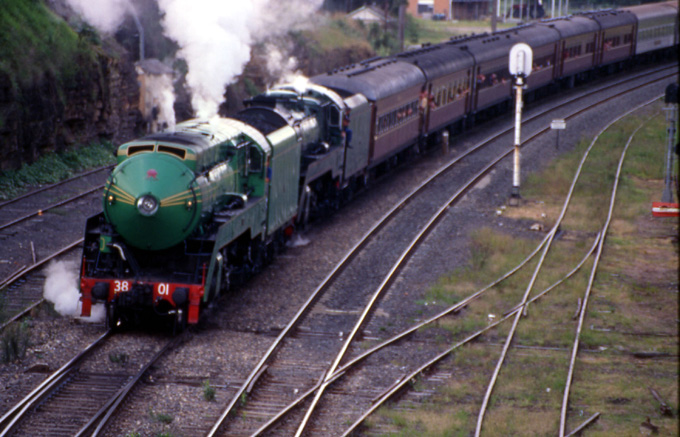
While there were some earlier operations this year, Sunday 3 March saw Preserved Pacifics 3801 and 3830 depart with a train which included preserved former Southern Aurora Lounge and Dining Cars.  These stainless steel cars formed part of Australia's finest train, an overnight Express introduced between Sydney and Melbourne in 1962.

I was unable to travel on the train, but took the following photographs of the outward journey.

Click on each thumbnail for a full size image.


cbr.jpg (115964 bytes)

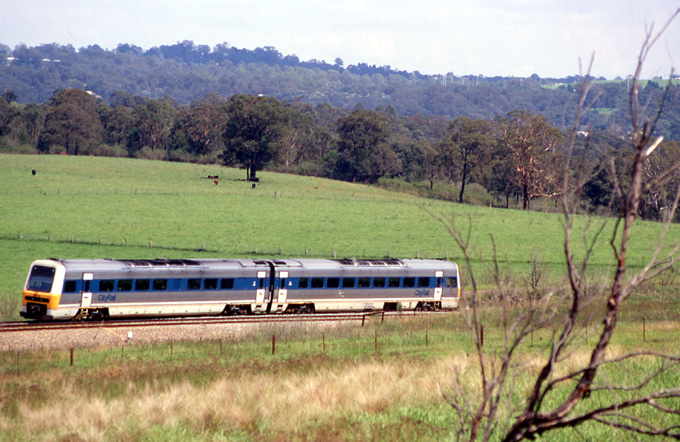
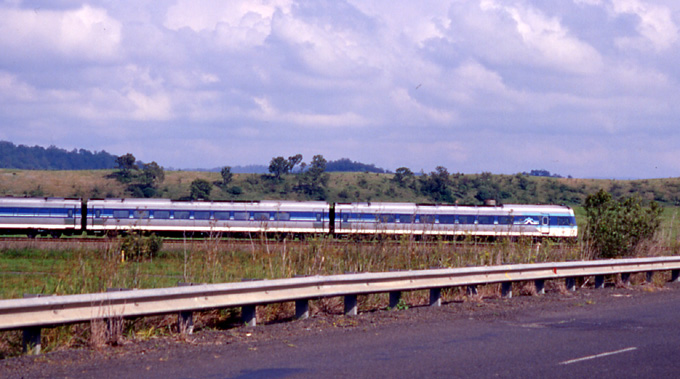
The passing  at 120-130 kmh of the three car Explorer set forming the UP Canberra train came as a sudden surprise.

sp1.jpg (170763 bytes)

After the Nepean River is crossed at Menangle, the line rises on a 1 in 70 grade known as Spaniards Hill.

sphred.jpg (108116 bytes)

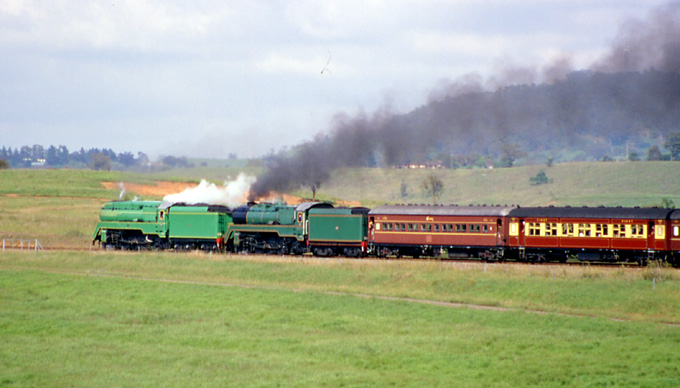
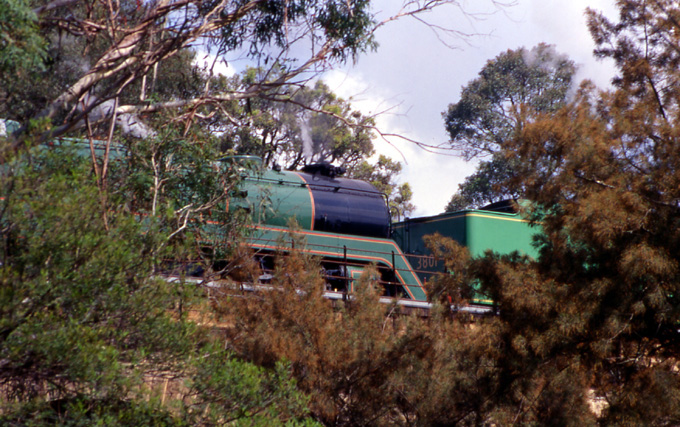
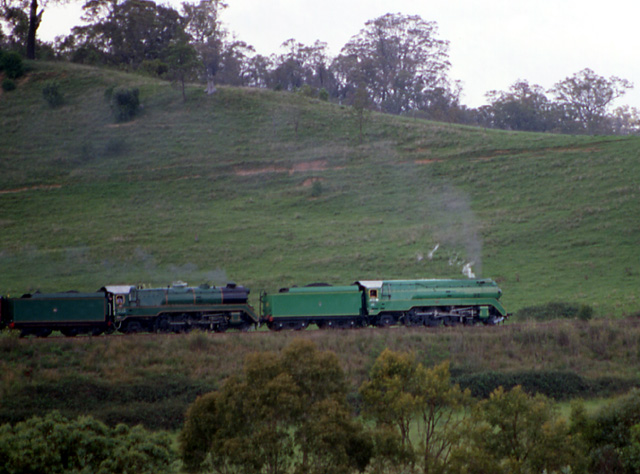
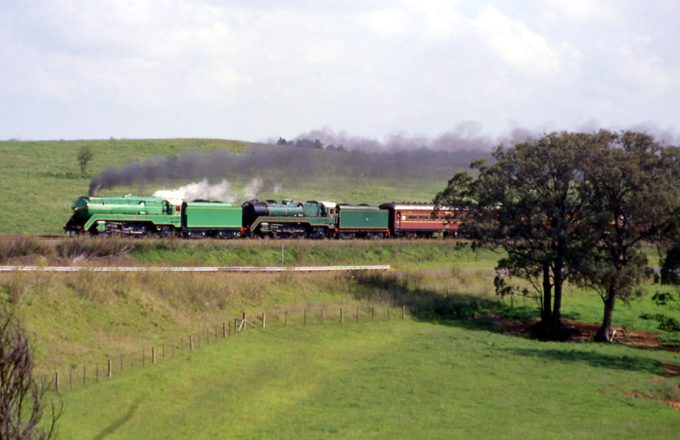
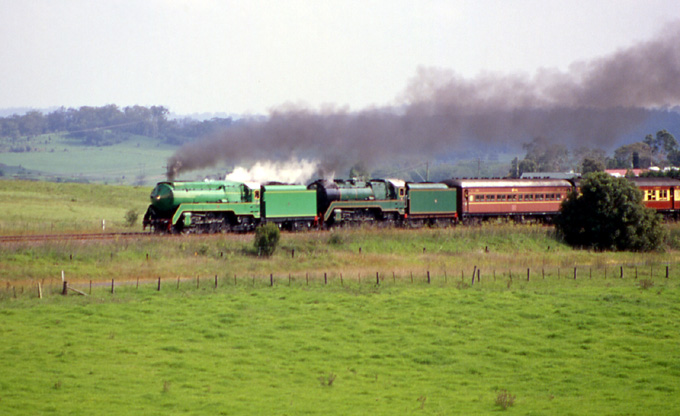
The two Pacifics were running very well on this 3 miles long grade.  The countryside is very lush after a month of consistent rain.
spred.jpg (99756 bytes) The second car has been repainted over the Summer maintenance period.
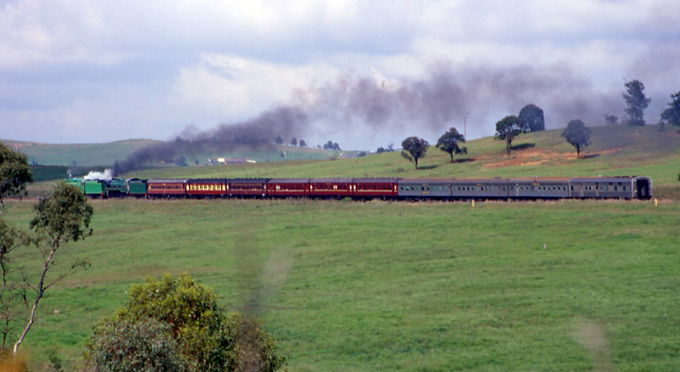
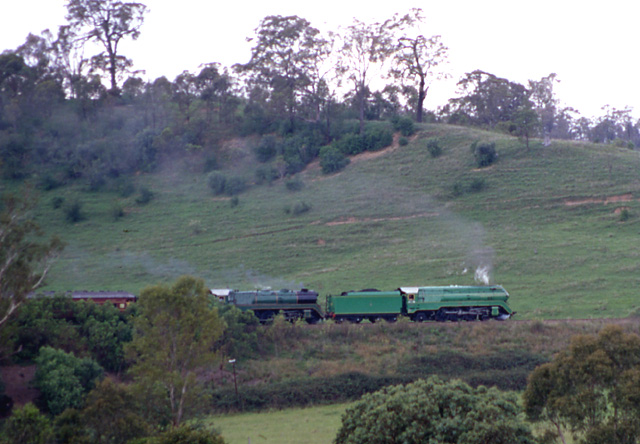
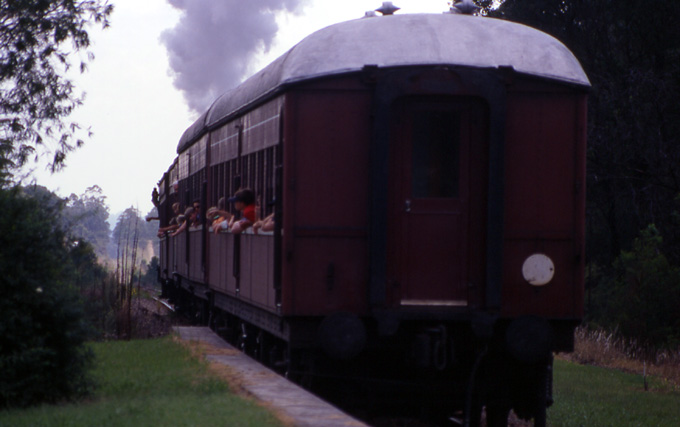
topsp.jpg (149641 bytes) I realised too late the opportunity to take a photo of the whole train.  The Dining and Lounge Cars, together with a Power Van are at the rear of the train.
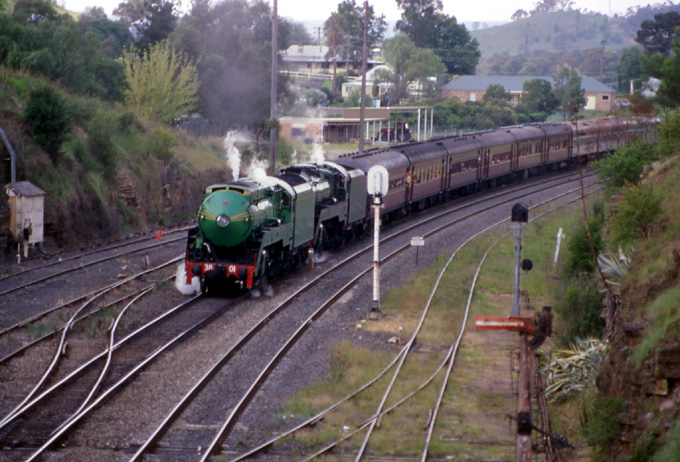
pyared.jpg (161728 bytes) Some complicated shunting is required at the junction station of Picton.  The train has already reversed from the Down Main to the Up Main.
py2.jpg (175065 bytes) This maneuver is necessary to gain access to the line to Thirlmere, which is located on the original Main Line of 1867.
py1.jpg (142668 bytes) The original single track line was replaced in 1919 by a double track deviation on easier grades, 1 in 75 against the 1 in 30 of the original.
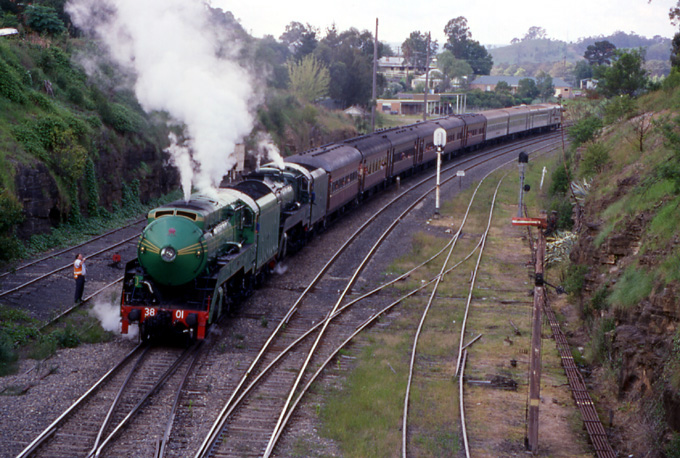
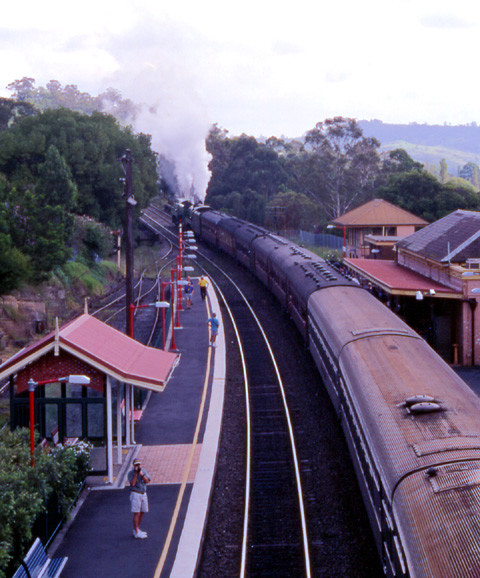
ps1.jpg (130467 bytes) The train is standing on the UP platform at Picton. Immediately beyond is an 1865 sandstone viaduct located on a 1 in 40 grade.  The line to Thirlmere branches off just after the viaduct, and the three tracks run together for some distance.
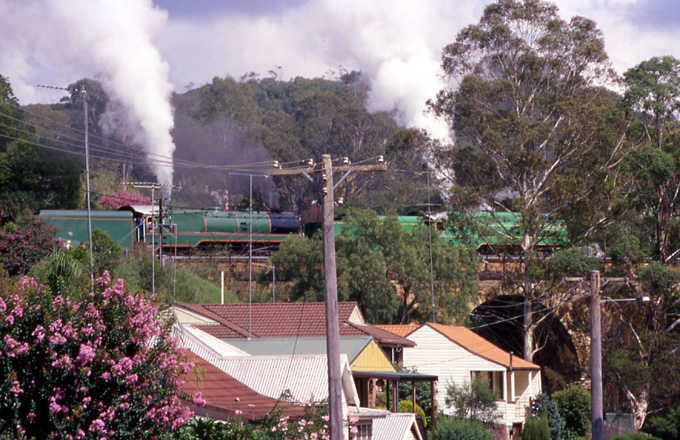
pv3.jpg (187206 bytes) The stone viaduct of the original line was built for double track and is still in use.
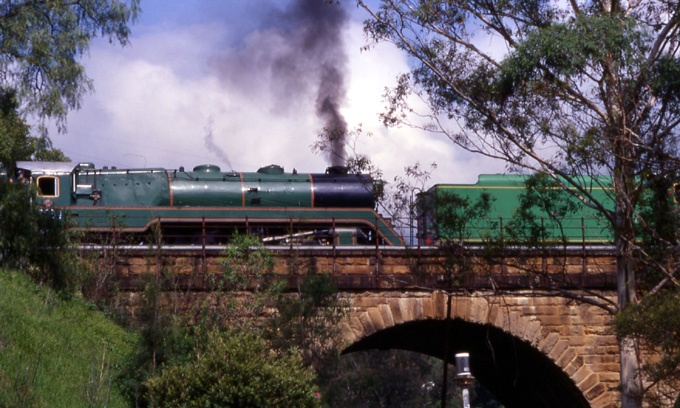
pv2.jpg (193650 bytes) 3801 on the Stonequarry Creek viaduct.
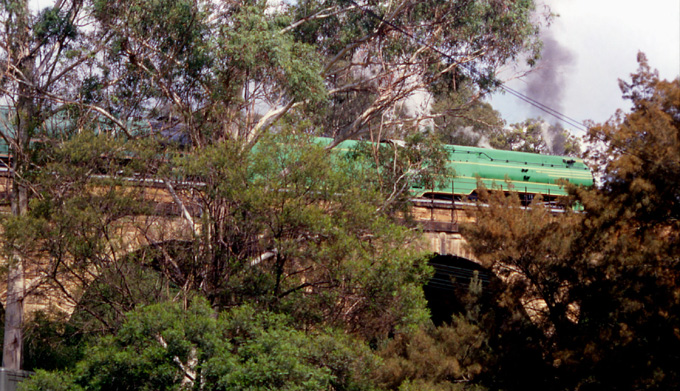
38spv.jpg (193298 bytes) 3830 on the viaduct.
pv1.jpg (160084 bytes) The train has just begun to move, and will run over the 1 in 40 grades to the Railway Museum at Thirlmere which hosts a large crowd on this day.
ph1.jpg (126467 bytes) The Thirlmere line ( the original line, known since 1919 as the "Loop Line"), has branched off.
ph3.jpg (125638 bytes) After the old and present main lines diverge, the grade on the Loop Line is 1 in 40.
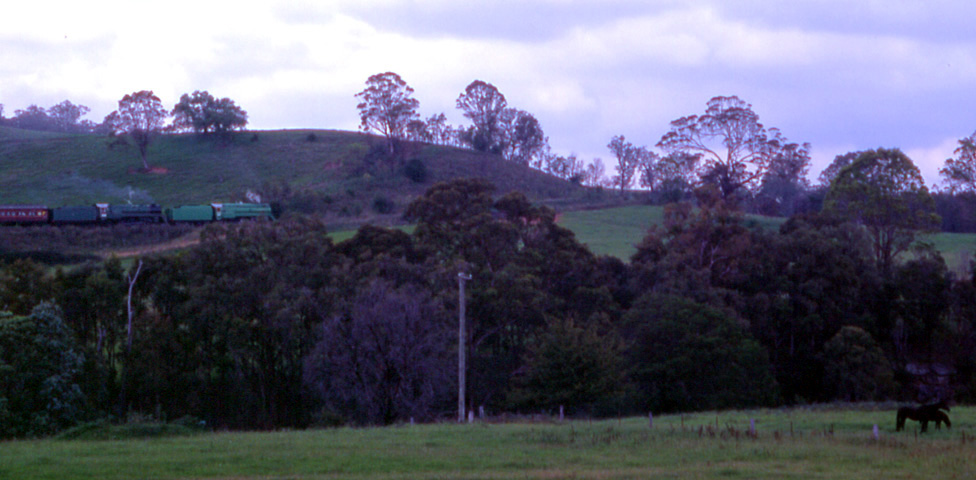
ph.jpg (164691 bytes) Clouds have rolled in, but a horse and foal are just visible as the two 38s head away from the road and towards the traffic jam of Thirlmere.
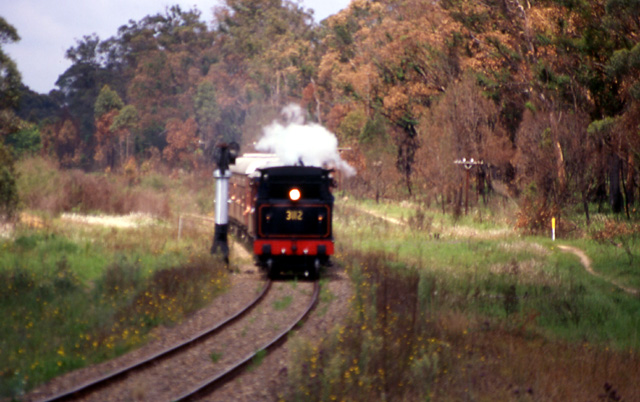
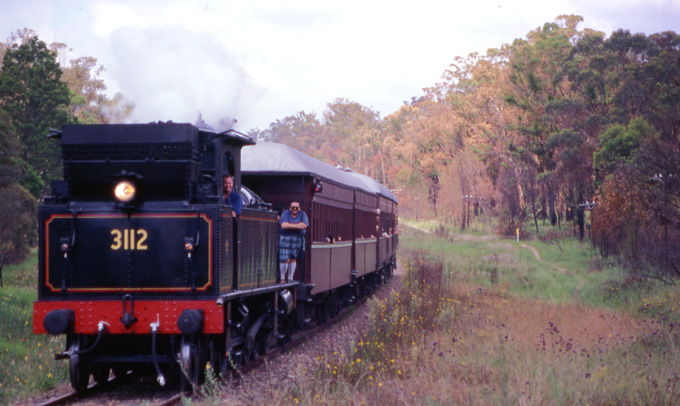
c1.jpg (120671 bytes) The Loop Line continues beyond Thirlmere.  Here 1903-designed 4-6-4 Tank 3112 brings a shuttle past one of the restored water columns at Couridjah.
c2.jpg (125081 bytes) Couridjah is the closest point to the Thirlmere Lakes, source of the water supply. The bush behind bears evidence of the January bushfires.
c3.jpg (110040 bytes) Loop Line trains pause at Couridjah station, which has appeared in television advertisements.
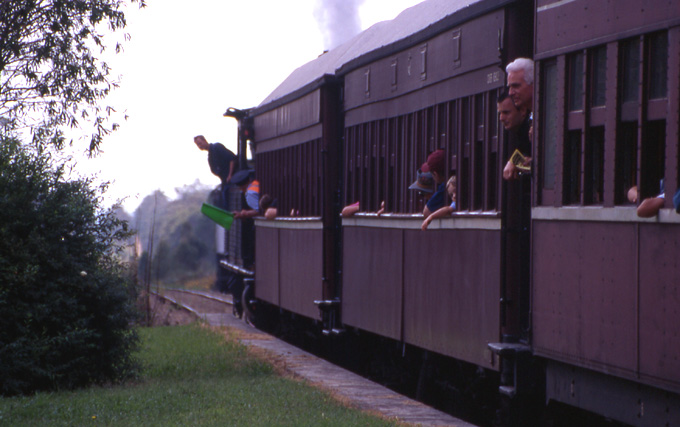
c4.jpg (83011 bytes) The train departs for Thirlmere.  the two rear cars are 1935 era all-steel corridor cars.
endea.jpg (162636 bytes) Two car railcars sets known as " Endeavours" provide the passenger services on the Main South Line.


A Week Later: 3801 Steams West


rstxpt.jpg (140353 bytes)

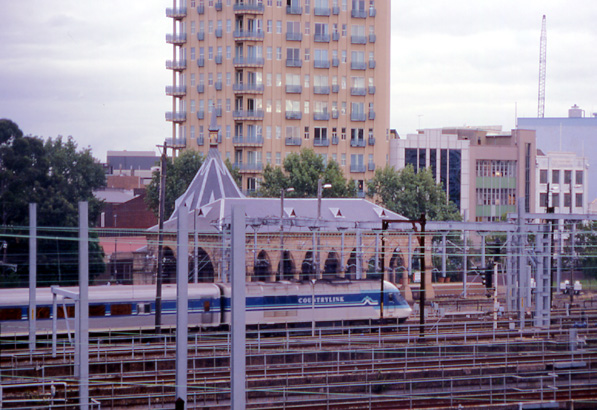
The rear Power Car of the Sydney-Melbourne XPT passes the 1869 Mortuary station building.  Funeral trains started from this platform in the nineteenth century.

st1.jpg (156368 bytes)

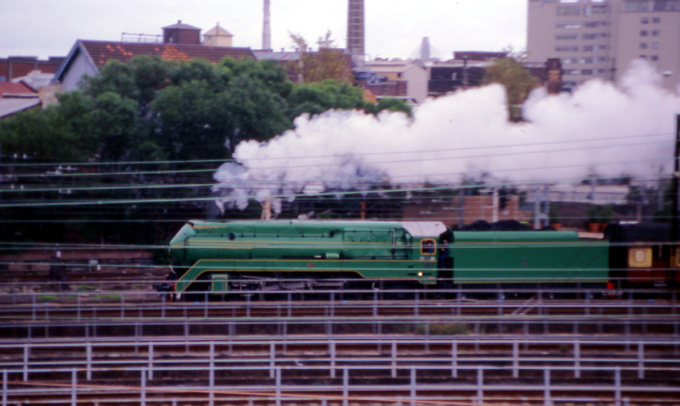
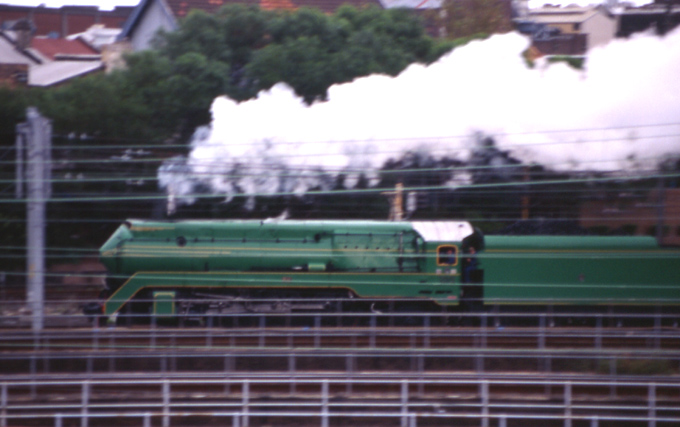
On Sunday 10 March, 3801 ran to Lithgow: here it is departing Sydney Terminal.

rst1.jpg (138030 bytes)

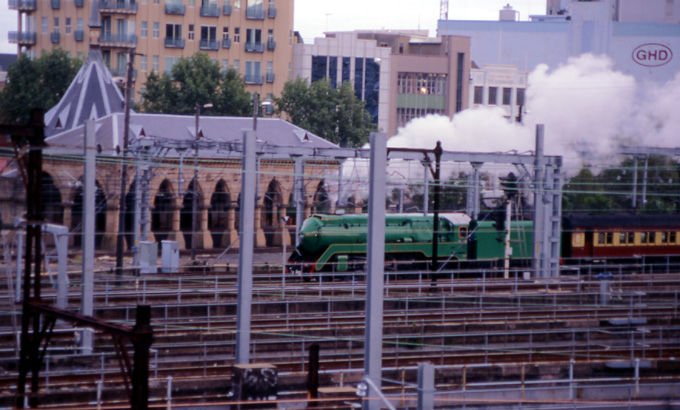
3801 passes the  restored Mortuary Station.

rst2.jpg (111976 bytes)

It was a return to overcast and gloomy weather, as 3801 left for the State Mine Museum at Lithgow.

st3.jpg (141932 bytes)

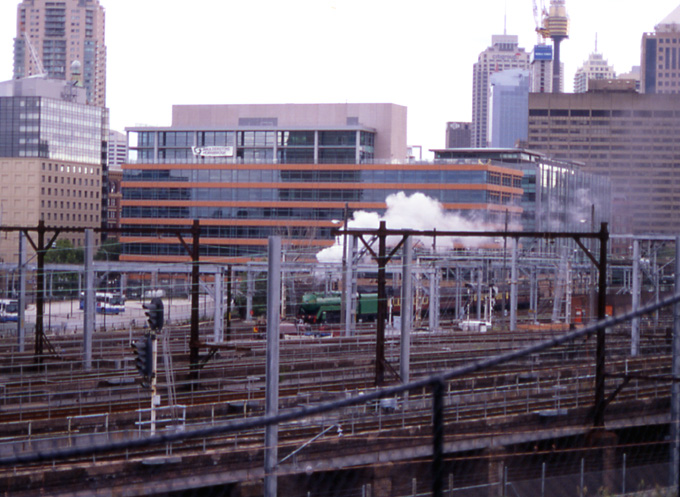
This area is known as " Flying Junctions" as the Up and Down Suburban tracks run on two levels to allow non-conflicting movements on the approaches to Sydney Central ( through Suburban) Station.  Walkways on the upper tracks can be seen.

All photographs Copyright © John Lacey 2002


Locomotive Details

The C38 class locomotives, generally regarded as the finest steam locomotive in Australia, were designed by the Chief Mechanical Engineer of the New South Wales Government Railways, Harold Young, in 1938.  This was after his design for a new Express locomotive was rejected.  The rejected design was for a high speed 4-6-4+4-6-4 Garratt, based on the remarkable Algerian double Pacifics.  This locomotive would have had 4, 18 x 28 cylinders, 250 lb Boiler Pressure,  Cossart driven poppet valves, 5'10'' diameter driving wheels, 65 sq ft grate area, and a Tractive Effort of 55, 000 lbs. Instead, 30 conventional Pacifics were built with 2, 21 1/2 x 26 cylinders, 245 lb Boiler pressure, 5'9" wheels, 47 sq ft grate area, and a Tractive Effort of 36,200 lbs.  The locomotives had an excellent front end, and with Trick ports on large diameter valves, they had a distinctive exhaust beat.  The very free steaming boiler allowed for excellent performance, and  drawbar horsepower figures up to 1,750 were produced on test runs, notably behind 3830 in 1966.  On this occasion, 3830 was tested against the newest main line diesel-electric: 3830's run up a 1 in 75 grade at 50 mph with a trailing load of 300 tons ( including dynamometer car) produced this record result which equates to a  drawbar HP on level track of 2,490 and a rail HP on straight level track of 2,800.  There were many occasions when 38 class locomotives produced more than 2,000 rail HP in more normal operating situations , or attained speeds of 80 mph.


There are three intact surviving locomotives of this class.  3820, the last in service, is preserved as a static exhibit at the NSW Rail Transport Museum. Another, 3813, was stripped for overhaul at the time of a change in management, and the new Commissioner ordered the cessation of the overhaul: various components still exist.

The story is much happier for the first and last of the class.  3801, the first of the five streamlined engines of the class, was preserved and  later received a full overhaul, returning to heritage operations in 1986, and the locomotive played a major part in the national Bicentennial celebrations of 1988, visiting every mainland state capital.  3830, withdrawn for preservation in 1967, was restored to full working condition by the Powerhouse Museum, and made its first run 30 years later.  Both locomotives make regular main line trips from Sydney, running as far as Western Victoria for the NSW Rail Transport Museum over 10 days in April, 2000.


For my other web pages, click http://www.geocities.com/history117/index.htm

 mailto:[email protected]

Hosted by www.Geocities.ws

1