For each player,
• Start with the basic pip count.
• Add 2 pips for each checker more than 1 on the ace-point.
• Add 1 pip for each checker more than 1 on the 2-point.
• Add 1 pip for each checker more than 3 on the 3-point.
• Add 1 pip for each empty point on the 4, 5, and 6-points.
In this position (72 vs. 62) we add two pips to Red's basic count (62) -- 1 for the fourth checker on the 3-point plus 1 for no checkers on
the 4-point, giving him an adjusted count of 64.
Then increase player-on-roll's count (Red) by 1/7. Red's final adjusted count is: 64 + (64/7) = 64 + 9 = 73.
Now subtract opponent's (White) count from player-on-roll's count: 73 - 72 = 1.
If the result is 4 or less, the player-on-roll should double. If the result is 2 or greater, Opponent should take.
Since the difference is only 1 in this position, the formula says White has a close pass for money.
| Cube decision | |||
|---|---|---|---|
| Rollout cubeless equity | +0.601 | ||
| Cubeful equities: | |||
| 1. | Double, pass | +1.000 | |
| 2. | Double, take | +1.087 | (+0.087) |
| 3. | No double | +0.883 | (- 0.117) |
| Proper cube action: | Double, pass | ||
• 0-ply/expert, cube:2-ply/33%, Full, 1296 games • 0-ply/expert, cubeful, Full, 576 games
-- Tom Keith [050804]
I have just written an article on cube handling in noncontact positions.
Cube Handling In Noncontact Positions
It compares several pip-counting methods to see which ones work best. To compare the methods, I collected positions from real games and rolled them out using GnuBG.
Five pip-counting methods were evaluated:
Thorp count, Keeler/Gillogly count, Ward count, Lamford count, and my own "Keith" count.
The formulas are judged on their ability to account for wastage and on how good they are at making accurate cube decisions.
There is lots of interesting information there, and several pretty graphs. Please let me know what you think.
-- Tom Keith [062104]
1) What are the strict requirements to make the database:
a) any non-contact position?
b) include positions with players owning their own midpoints (nearly non-contact)?
c) was there any requirements/restrictions on how many checkers were yet to be borne in? Already borne off?
d) I assume that a single game typically generated many entries to the database, since after each play a new valid situation results. True?
2) You appear to calculate an "average error" which I assume is sum ( abs (difference) ) / N. More common (and I'm sure for a good reason, although I'll let a real statician explain why) is a Root Mean Square error: sqrt ( sum ( diff^2) / N ) ).
How hard would it be to also include a graph of the RMS error?
-- Chuck Bower
1)
a): Yes.
b): No, though that would be interesting to do too.
c): No.
d): True.
2): I should have explained that the "average error" I calculated was actually the RMS error. I don't know why statistians like RMS, but I like it because it gives a smooth result, which is nice if you are trying to optimize it.
-- Tom Keith
What is this formula for the Keith Method?
The simple algorithm you give applies to money play but the formula is what one needs for matchplay.
-- Chuck Bower
The formula is not human-usable (it involves exponentiation, for example).
I haven't looked at match-play yet, but it should be possible to come up with some reasonably simple formula for estimating CPW from
Keith count.
-- Tom Keith
I like the simplicity of the Keith count, but I suspect its accuracy in relevant positions could be improved by tweaking some of the parameters and adding a couple of items (e.g., reduce the penalty for checkers on the 3-point, but penalize the difference between the number of checkers on the lower three points and the number on higher points).
How easy would it be for you to check alterations against the database, or to perform a least-squares regression?
--Douglas Zare
I like the simplicity of the Keith count, but I suspect its accuracy in relevant positions could be improved by tweaking some of the parameters and adding
a couple of items (e.g., reduce the penalty for checkers on the 3-point, but penalize the difference between the number of checkers on the lower three points
and the number on higher points).
An interesting idea. I'll play around with it next time I get a chance.
How easy would it be for you to check alterations against the database, or to perform a least-squares regression?
That's one reason I'm making the database of positions available. I welcome (encourage, even) anyone to use it to try out their own formulas
or tweaks.
-- Tom Keith
I had this position yesterday online.
So please let me know if this is how the Keith Count should work or not.
Red has 39 plus 10 for the ace-point checkers plus 1 for the 2-point is 50 plus 1/7 is about 57.
White has 54 plus 2 for the ace-point checker is 56.
Nothing for having a gap on the 2-point or having 2 off right?
So ahead 57-56 would be a redouble/drop as Red isn't ahead by 2.
--Rob Adams
Yes, that's how to do it.
However, a rollout shows dropping is a +0.089 error here.
In a way this is a good example. The formula can give only an approximate answer and will make its share of errors.
I don't think this is too far away from the size of error you might expect, especially with a take/drop decision.
Cube decision Rollout cubeless equity +0.523 Cubeful equities: 1. Double, take +0.911 2. Double, pass +1.000 (+0.089) 3. No double +0.844 (- 0.067) Proper cube action: Redouble, take
-- Tom Keith
Most pip count methods have a 3 or 4 pip space between initial double and take/drop, you have only 2.
(+4 is initial double, +3 redouble, +2 take, +1 drop). I would have expected based on other counts that if +4 is an initial and +3 a redouble,
then +1 would be a close take and 0 would be close drop, or 0 might even be right on the line.
That would be better with this position. Does it depend a lot on the size of the race which works best?
--Michael Sullivan
I think at least part of the discrepancy is that older methods recommended doubling too early. E.g. with the percentage method, with 2% per pip and drop/take at 78%, it recommended doubling at 70%. I believe that is lower than recent studies indicate is correct.
--Chuck Bower
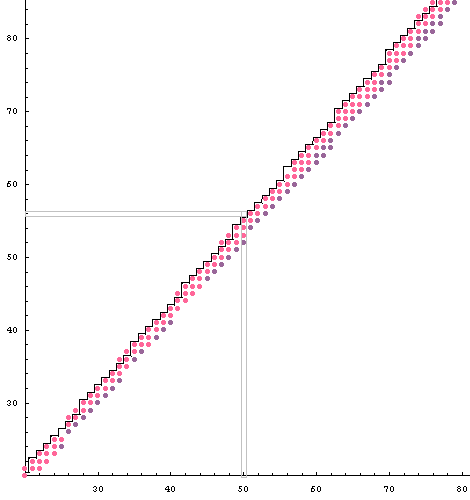
The colored dots in the graph below show the range of values for which double/take is usually correct.
(Player's count on x-axis; opponent's count on y-axis.) The dots represent the best possible decision criteria for the keith count.
The stairstep line shows the dividing line between take and pass using the current decision criteria.
This indicates the take/drop point is correct: When player-on-roll's count is 50, it is usually correct to drop when the opponent's count is 56. Rob's position just seems to be an exception.
So the problem must be in the adjustment for wastage, not the decision criteria. When you think about it, it is not too surprising that a position like this could be wrong. It would be quite remarkable if a simple rule like "add 2 pips for each checker more than 1 on the ace-point" were completely accurate for any number of checkers on the ace-point.
-- Tom Keith
A couple questions regarding the Effective PipCount (EPC) method:
1) What does EPC say about Rob's position?
This is the kind of problem I would expect EPC to handle pretty well.
2) Is the current state-of-the-art EPC method written up anywhere?
My understanding is that Walter Trice developed the EPC method and that others, particularly Douglas Zare, have modified/extended/improved/simplified it.
--Chuck Bower
Walter Trice just gave me permission to republish an article he wrote on EPC:
Effective Pip Count
So maybe DZ (or someone else) could use this as a starting point to answer your question.
-- Tom Keith
I remember this article. It was my introduction to EPC.
Unfortunately it doesn't give an EPC-->cpw conversion, only the money thresholds.
--Chuck Bower
Excerpts from "Adjusted Pip Count Methods" / W.Trice -- Beginner's Boot Camp 19 on GammonVillage
Burying vs. Bearing In / D.Zare
epc --Zare's postings on effective pip counts (2002&2003)