|
|
|


|
 |
 |
 |
 |
 |
 |
 |
 |
 |
 |
 |
 |
 |
 |

| The World's No.1 Science & Technology News Service |
 |
|
Condors' future on a cliff's edge |
|||
| 11:03 08 April 02 | |||
| NewScientist.com news service | |||
|
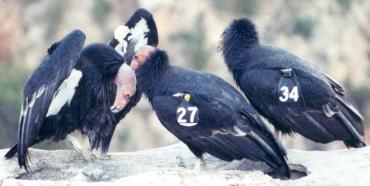
Biologists watching five nesting pairs are hoping that California Condors have reached a critical point in their recovery. There are only 182 of North America's largest and rarest bird left on the planet and the last wild-hatched chick was in 1984. Two of the pairs, located northwest of Los Angeles in the Sespe Condor Sanctuary are known to have eggs. At the other three nests, one at Sespe and two in the Grand Canyon, the pairs do appear to be trading egg incubation shifts. In the Grand Canyon, the birds are nesting in cliff face caves that are inaccessible to even the most intrepid climbers, making verification of eggs nearly impossible.
"All we can do right now is faithfully watch and wait," says Chad Olson, National Park Service Raptor Biologist. "And as the condors continue to trade nest guarding and incubation shifts, we'll become anxious to see them succeed." But biologists may have a while to wait. California Condors normally lay a single egg between late January and early April and incubate for approximately 56 days. With the California nesting birds this means there would probably not be a chick until late April and in the Grand Canyon the hatchlings might not appear until late May. Pairs also nested in 2001 but no chicks were born.
"Getting to this stage has been a lot of hard work, but through the efforts put forth by a lot of dedicated people and the support of both public and private groups we have made it a long way" says Bruce Palmer, US Fish and Wildlife Service California Condor Recovery Coordinator. "To date, we have spent 35 to 40 million dollars on the Condor, and that was a shoestring budget." "The reality is that the cost of saving a species is proportional to how endangered you let the species get," adds Jeff Humphrey, spokesman for Fish and Wildlife, "In the case of this species there were only 22 in 1984, and that's a really small number to work with." "To feel secure in removing the condor from the list of endangered species, we need to establish one captive and two wild populations - each reproductively self-sustaining and containing at least 150 individuals," adds Palmer. "Today, with 182 condors on Earth, we have the kernel of that numeric goal. If this year or next we have successful reproduction in the wild, we'll be making hard-fought conservation history," he says. |
|||
|
Matt Kaplan |
|||
|
This story is from NewScientist.com's news service - for more exclusive news and expert analysis every week subscribe to New Scientist print edition. |
|||
|
|
 |
 |
|
|
 |
For what�s in New Scientist magazine this week see Print Edition | |
|
Search the Archive for more stories like this, originally published in the Print Edition |
|
|
Subscribe to New Scientist Print Edition | |
|
Correspondence about this story should be directed to [email protected] |
|
|
Sign up for our free newsletter | |
 |
||

|
 |
|||
|
|
|
|
|
|||
 |
|
Related Stories |
|
Hundreds of Asian bird species face extinction
5 June 2001 |
|
|
Weblinks |
|
For more related stories
search the print edition Archive |
|
|
 |
|
All the best science stories from the web |
|
|
Lesbian couple choose deaf baby Washington Post |
|
Plans unveiled for China-Taiwan tunnel Guardian Unlimited |
|
|
Study suggests progress on Alzheimer's New York Times (Free registration required) |
|
Study reveals twice as many asteroids as believed Spaceflight Now |
|

|
About newscientist.com •
Subscribe •
Contact Us •
FAQ •
Media Information •
Disclaimer •
Terms and Conditions • Site Map • Privacy Policy © Copyright Reed Business Information Ltd. |
||||