 |
|


|
 |
 |
 |
 |
 |
 |
 |
 |
 |
 |
 |
 |
 |
 |

| The World's No.1 Science & Technology News Service |
 |
|
California condor chick hatches | |||
| 11:03 17 April 02 | |||
| NewScientist.com news service | |||
|
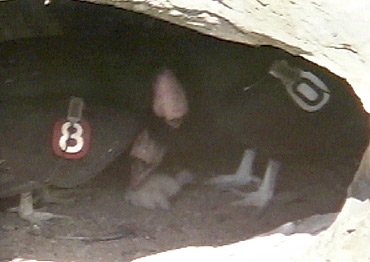
For the first time in 18 years, a California Condor egg laid in the wilderness has also hatched there. The success is the culmination of $40 million of investment and considerable social engineering. If the chick survives the challenges of growing up in the wild, it will bring the population of North America's largest and rarest bird to 183. It is thought the chick was born on Thursday.
"It was just incredible," says Allen Mee of the Zoological Society of San Diego, who was monitoring the radio-tagged breeding pair in the Sespe Condor Sanctuary. "The female went into the cave at around midday and met her mate who was sitting on the egg. She nudged him off the egg, and in attempting to incubate the egg, she inadvertently crushed the shell, exposing the chick," Mee told New Scientist. "For several hours she appeared confused, trying to incubate both the chick and the egg pieces, but eventually settled down on just the chick".
However, while all of the members of the Condor project are overjoyed, tensions are still running high. "The hatchling is in the wild and there are a number of things out there that could still lead to its death," says Bruce Palmer, the California Condor Recovery Coordinator at the US Fish and Wildlife Service. In the next two weeks, as the yolk sack attached to the chick's body is absorbed, an infection from dirt on the sack could kill the chick. And even after that, there is still the danger presented by predators like golden eagles and ravens. But the difficult task of actually hatching an egg has been completed, something this pair previously failed to accomplish. "Last year the male was copulating with two females and not attending to his egg incubation responsibilities," says Palmer. "We had to swap the egg with a fake so we could hatch it in captivity. Unfortunately when we swapped the captive hatched chick back in to the nest the second female killed it." This year the second female was captured and temporarily removed from the wild. Not surprisingly, since her capture the male has now become a much more devoted parent. | |||
|
Matt Kaplan | |||
This story is from NewScientist.com's news service - for more exclusive news and expert analysis every week subscribe to New Scientist print edition. | |||
| |
 |
 |
| |
 |
For what’s in New Scientist magazine this week see Print Edition | |
|
Search the Archive for more stories like this, originally published in the Print Edition | |
|
Subscribe to New Scientist Print Edition | |
|
Correspondence about this story should be directed to [email protected] | |
|
Sign up for our free newsletter | |
 | ||
|
|
 | |||
|
|
|
|
| |||
 |
|
Related Stories |
|
Condors' future on a cliff's edge 8 April 2002 |
|
Hundreds of Asian bird species face extinction 5 June 2001 |
|
For more related stories search the print edition Archive |
|
|
Weblinks |
|
|
 |
|
|
All the best science stories from the
web |
|
|
|
|
Europe plans tougher line than US on Microsoft Financial Times |
|
|
|
|


|
About
newscientist.com • Subscribe •
Contact
Us • FAQ •
Media
Information • Disclaimer •
Terms
and Conditions • Site Map • Privacy Policy © Copyright Reed Business Information Ltd. |
||||