
SIGNALS IN THE GREAT WAR
Various methods of communication were employed during the Great War. These included morse code, telephones, pigeons, despatch riders, etc. It has been said that a handful of mobile phones could have changed the face of history if they had been available in 1914-18.
Below is a pre-war photo of Grandad when he was with 50th Battery of the Royal Field Artillery. The scanned quality is not perfect, but you can see the flags and heliographs they used to communicate. Clifford Nation is second fron the right, standing.
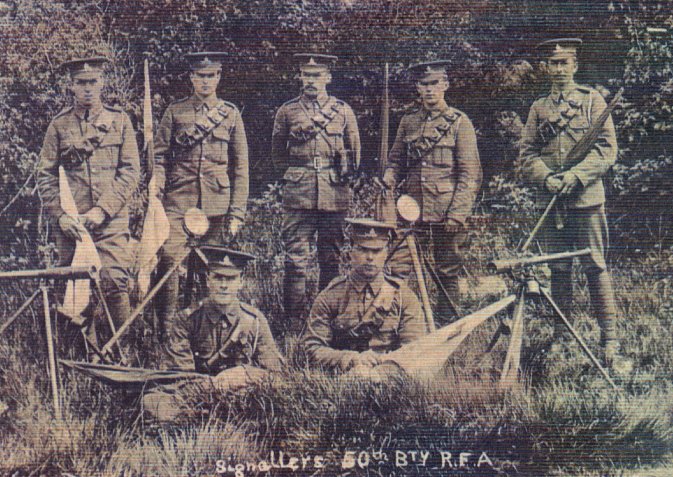
The heliograph is a signalling appliance which reflects the sun's rays by means of a mirror or mirrors. The mirror is actuated by a key and when the key is pressed, the mirror is moved so that the reflected ray is thrown towards the receiving station. When the key is released, the mirror returns to its normal position in which the reflected ray cannot be seen by the receiving station. Thus by working the key in accordance with morse code, flashing signals are transmitted to the receiving station.
The rough distance in miles at which the heliograph can be used is obtained by multiplying the diameter of the mirror in inches by ten. The range is also affected by the angles at which the sun's rays strike and leave the mirror, and the state of the atmosphere.
AMMUNITION COLUMNS
As you may have already read in his Service Record, Clifford Nation spent October 1914 until March 1915 in the Ammunition Column of the 5th Division.
The Army Service Corps provided troops with supplies such as food and clothing, as these were required on a regular basis. The need for ammunition, however, was inconsistent because units were not engaged continuously in active combat, so the need for ammunition varied according to battle plans. Divisional Ammunition Columns supplied rifle bullets, artillery shells and machine gun bullets to the Infantry and Artillery. These Columns were units of the Royal Artillery, and split into four sections. One of these supplied ammunition to a field artillery brigade and an infantry brigade, and the other to the Division's field howitzer brigade and heavy battery.
Each Infantry battalion carried its own reserve of ammunition (100 rounds per person and 8,000 rounds per machine gun).
Grandad was posted to the Ammunition Colum of 27th Brigade between March and August 1915 as each field artillery brigade also contained a brigade ammunition column which held reserves for its own unit, and also reserves of rifle ammunition for one Infantry Brigade. Wide use was made of horses to transport the ammunition, and both six- and four-horse wagons pulled the supplies across difficult terrain.