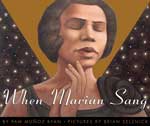
Author Pam Munoz Ryan and artist Brian Selznick combine their impressive talents in this picture book biography to paint a portrait of a young black girl in the early 20th century who rises to stardom via her distinctive twenty-four note contralto voice in spite of the racism and segregation of the time. "It was her range of notes that caused all the commotion. With one breath she sounded like rain, sprinkling high notes in the morning sun. And with the next she was thunder, resounding deep in a dark sky".
The winner of the 2003 Orbis Pictus Award opens with an elegant stage that transforms on the next page to reveal a two page spread showing young Marion singing from the window of her Philadelphia home beyond the backdrop of the stage. Selznick's sepia toned illustrations augment the text beautifully, providing easy transitions for Ryan's crisp text which is interspersed with compelling lyrics from the gospels sung by Marion Anderson.
Despite her talent, Anderson at eighteen was refused admission to a music school, "We don't take colored." When a trip to the Metropolitan Opera instilled in her a dream to perform there; she again renewed her commitment to further her study of music. Given an opportunity to audition for the famous Guiseppe Boghetti, she was again denied, until she closed her eyes and began to sing. Boghetti responded with "You will be able to go anywhere and sing for anybody." She traveled to Europe where she met acclaim everywhere, but upon her return to America, she was again denied the right to sing in Washington D.C.'s Constitution Hall because of its "white performers only" policy. With the support of President Roosevelt and his wife Eleanor and the support of many Americans, she was finally invited to sing before a crowd of 75,000 on the steps of the Lincoln Memorial. Selznick's illustrations again supply rich detail, showing a close-up of Marion's face, singing with her eyes closed on one two page spread and then transitioning to a view from the perspective of the racially mixed crowd on the next two pages as she belts out her encore performance of "Nobody Knows the Trouble." Ryan's emotionally-charged text leads readers to triumph when at age 57, Marion Anderson finally gets the opportunity to sing at the Metropolitan Opera. The book concludes, "At long last, she had reached the sun and the moon. The curtains parted�..and Marion sang."
Notes from both the author and illustrator at the end of the book describe the inspiration for the book and give further details of the life of Marion Anderson. There is also a timeline and a discography.
Ryan, Pam Munoz. 2002. When Marion sang: The true recital of Marian Anderson, the voice of a century. Illus. by Brian Selznick. New York: Scholastic Press. ISBN: 0439269679.
Former science teacher and author of numerous informational books for children, Seymour Simon, provides an introduction to the complex subject of weather in his book by the same title. His large-print, clear, concise text outlines the basic causes of weather, beginning with the affects of the sun and its unequal heating of the earth's surface. With the statement "nothing about the weather is very simple," he goes on to explain how wind currents and topographic differences also play a role in the changing weather. Diagrams with complementary text, provide an introduction to the movement of fronts.
Illustrations of various cloud types at the beginning of the book reinforce Simon's discussion of the different types of clouds and the weather that they produce more effectively than the color photos that accompany the text. He does little to clarify the "mystery of how and why tiny droplets come together to from raindrops," but his discussion of snow and hail on the following pages is much more concise and the photo of the hailstone makes real the abstract concept of the formation of hail by allowing each of the individual crystals comprising the hailstone to be seen. He ends by touching briefly on the names of instruments that are used to measure weather and the effect that man has on the weather.
The diagrams included in Weather help to clarify the text, but the uncaptioned photos that accompany much of the text are about as confusing as attempting to predict the weather. The addition of captions and labels to the photos would clarify their purpose. This book will provide a basic introduction to the complex subject of weather for younger readers.
Simon, Seymour. 1993. Weather. New York: Morrow Junior Books. ISBN: 0688105467.
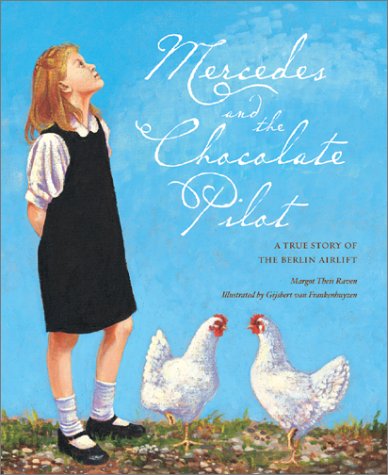
Mercedes is a young girl living in war-ravaged West Berlin during the Soviet blockade of that city in 1948. When her mother reads her a newspaper article describing the efforts of Lt. Gail Halvorsen, an American pilot who is one of the group of British and American pilots who endeavored to airlift over 4,500 tons of food a day into West Berlin, she wants to try her luck at getting candy that Lt. Halvorsen, or The Chocolate Pilot as he is affectionately known, drops for the children of West Berlin. Mercedes and her mother go to Tempelhof Air Field, but Mercedes is not as quick as the older children and she comes away empty handed. That night she sends a letter to Lt. Halvorsen telling him that the planes keep her chickens from laying eggs but that if he will "please drop some candy there, all will be ok." Lt. Halvorsen, fearing that he will not be able to find Mercedes garden with the white chickens, instead mails her a package of candy with a letter saying, "I hope that through what is with this letter, I give you a little joy."
The compelling Epilogue tells the "rest of the story." In 1972, then Col Halvorsen, again assigned to Tempelhof Air Field, is invited to dinner by a local Berlin family where he is greeted by Mercedes Wild, holding a letter she had received from a kind-hearted pilot over thirty years before. The two remain friends to this day!
Margot Theis Raven and illustrator, Gijsbert van Frankenhuyzen have teamed to create a memorable book describing one man's compassion and efforts for those who are usually forgotten in a time of conflict, the children. Raven recounts Mercedes Main's anecdotal story with compelling details, allowing young readers to feel the impact of this post-war period. Van Frankenhuyzen's oil paintings capture the essence of a young girl, touched by the kindness of a stranger, in a country that has been destroyed by war. His paintings change from bright hues depicting Mercedes at her happiest moments to somber earth tones for his paintings of a bombed-out section of the city. Van Frankenhuyzen's final painting, a portrait of Colonel Gail S. Halvorsen, a man described by the artist as "the kindest and most admirable person I have ever met," is a tribute to Lt. Halvorsen and others who recognize that war affects everyone, especially children.
Raven, Margot Theis. 2002. Mercedes and the chocolate pilot. Illus. by Gijsbert van Frankenhuyzen. Chelsea, Michigan: Sleeping Bear Press. ISBN: 0585360694.
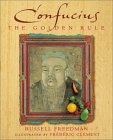
"If you study the past and use it to understand the future, then you're worthy to be a teacher." Perhaps a reading of Russell Freedman's eloquent Confucius: The Golden Rule will inspire today's students to become worthy teachers and lifelong-learners. Freedman skillfully weaves Chinese history with biographical information about Confucius, distinguishing between fact and legend, while including interesting tidbits: "He would probably laugh out loud to find that snippets of his 'wisdom' are stuffed into fortune cookies, which were invented in America and have never been popular in China."
Though he never achieved acclaim beyond his own circle of disciples during his lifetime, the profound teachings of Confucius have endured for more than 2,500 years. He was a simple man of the people who valued education for all ("When people are educated, distinctions between the classes disappear.") and taught that the right to govern should be earned, not inherited, stressing the use of honest language by government officials ("When words don't match reality, what is said isn't the same as what is meant."). The influence of Confucian teachings can be seen in the development of democratic ideals in both Europe and America.
Due to the paucity of data about Confucius, Freedman relies heavily on several translations of The Analects of Confucius. He details his research and sources of information for those desiring further research in the Notes found at the end of the book. Frederic Clement's worn, faded, Asian-inspired illustrations, some with torn borders, superimposed with berries, fruits, petals, and leaves, suggest the serenity of Confucius' thoughts while implying hope for the future. Reading this book is an invitation to introspective thought and an impetus for the acquisition of knowledge. "If a person learns from others but doesn't think, he will be bewildered," he said. "But to think without learning - that's really dangerous."
Freedman, Russell. 2002. Confucius: The golden rule. Illus. by Frederic Clement. New York: Scholastic Press. ISBN: 0439139570