And the Green Grass Grew All Around
Alvin Schwartz has compiled a collection of folk poetry that lives up to its subtitle for it is truly a collection of "Folk Poetry for Everyone." Older readers will feel as if they are taking a stroll down memory lane as they read poems like "On Top of Spaghetti", and "As I Was Going to St. Ives." Younger readers will quickly memorize and begin reciting those poems that will fit nicely into their repertoire of snappy or amusing things to say to their friends.
And the Green Grass Grew All Around is divided into fifteen chapters including People, Teases and Taunts, Riddles, and School. Schwartz adds informative notes at the end of the book that clarify what constitutes folk poetry and discuss the roots of the various forms of folk poetry. He also adds notes after some of the poems to point out the circumstances that prompted their creation.
Sue Truesdell's black and white illustrations complement the text beautifully. Her lively drawings depict perfectly how many view the "teacher's pet" and give life to the ants from "The Ants Go Marching."
And the Green Grass Grew All Around is a "must have" for any library's poetry collection. It is a book that will be read aloud again and again, finding the readers with the familiar poems running through their minds and slipping easily off of their tongues.
Schwartz, Alvin. 1992. And the green grass grew all around. Illus. by Sue Truesdall.
U.S.A.: Harper Collins Publishers. ISBN 0060227583.

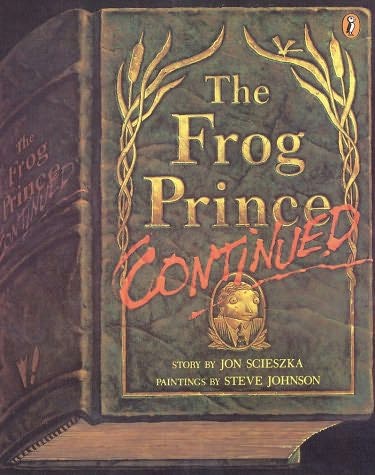
The Frog Prince ended, as do many fairy tales, with "And they lived happily ever after." But, unfortunately, they did not. The princess who once loved the prince is now turned off by his hopping on the furniture, croaking snore, and propensity to pick insects out of the air with a flick of his tongue. The prince, tired of her constant nagging, decides that the only route to lasting happiness is to find a witch who will turn him back into a frog. He sets out on his quest, encountering the witches from Sleeping Beauty, Snow White, Hansel and Gretel, and finally the fairy godmother from Cinderella. Each of the witches he meets has her own agenda for the fate of the prince. The witch from Hansel and Gretel wryly invites him in saying, "Maybe I can fit you in for lunch." The prince is finally turned into a bug eyed carriage by the "dumb, blonde" fairy godmother from Cinderella who remarks, "I've never done frogs before, you know." True to the Cinderella fairy tale, at the stroke of midnight, the prince is changed back to his former self. He returns to the castle, kisses his princess who was worried sick when he didn't return on time, and they are both transformed into frogs and live happily ever after.
Although the ending is somewhat anti-climactic, this book will be enjoyed by both young and old alike. Older readers will enjoy Scieszka's tongue-in-cheek allusions to the original fairy tales and younger readers will delight in a new twist on stories with which they are familiar. Illustrator Steve Johnson's richly detailed paintings augment the text, foretelling who the prince will encounter next on his quest and adding subtle humor such as the prince flicking a dragonfly off of the wallpaper with his unnaturally long tongue and a poisonous apple offered by the witch from Snow White that is so nasty looking that the reader wants to avoid touching that page.
Scieszka, Jon. 1991. The frog prince continued. Illus. by Steve Johnson. New York:
Viking Penguin. ISBN: 0670834211.
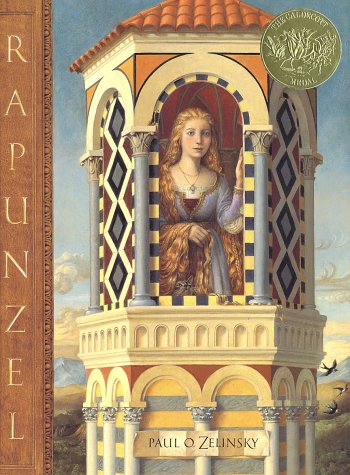
Author, Paul O. Zelinsky, received the 1998 Caldecott Award for his superb retelling of the classic fairytale, Rapunzel. He combined the best elements from the Bothers Grimm and earlier French and Italian versions of this age-old tale to produce a book that will capture the hearts and minds of readers of all ages.
A sorceress, finding a young man stealing rapunzel from her secret garden for his pregnant wife, makes him promise to give her the baby when it is born. She raises the baby girl, whom she names Rapunzel, as her own, taking her to live in a high tower deep in the woods when she turns twelve to "keep her safe, away from the whole world." But, temptation finds Rapunzel in the person of a handsome prince whom she soon marries. When the sorceress discovers that Rapunzel is with child, she cuts off her beautiful hair and banishes her to the wild country. That night when the prince comes to Rapunzel, he finds instead, the sorceress, falls from the tower, losing his vision in the fall. He stumbles around blindly in the wilderness until her hears the singing of Rapunzel. As Rapunzel hugs her lover, two tears fall in his eyes, restoring his vision. They, along with their twin son and daughter, find the prince's kingdom and live happily ever after.
Zelinsky's rich narrative and stunning Italian-Renaissance oil paintings combine to make this retelling of Rapunzel a classic. Through Zelinsky's illustrations, the reader glimpses a world of stunning beauty, full of intricate detail. This tale of a controlling mother-figure and her child coming into her own despite the sorceress' attempts to protect her from the world is not to be missed.
Zelinsky, Paul O. 1997. Rapunzel. New York: Dutton Children's Books.
ISBN: 05254560074.
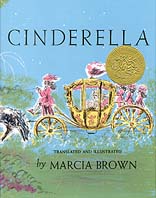
The rags to riches story of Cinderella is one of the best loved of all fairy tales: the stuff from which dreams of success despite seemingly insurmountable odds are made. Marcia Brown's retelling of the classic French fairytale, Cinderella, by Charles Perrault was awarded the Caldecott Medal in 1955. Brown's Cinderella is a lovely young woman, both inside and out, who receives the brunt of her self-indulgent step-sisters scorn. In spite of their constant ridicule and their cruel nickname, Cinderseat, which she earned from sitting near the chimney in the ashes, Cinderella continues to fulfill every desire of her siblings with a joyful heart. When her step-sisters are invited to a ball at the palace of the prince, Cinderella gladly offers to help them prepare. After they leave for the ball, Cinderella's godmother, who is also a fairy, appears, finding Cinderella in tears. She outfits Cinderella for the ball, complete with a jewel encrusted gown, horse-drawn coach, and attendants. Her only admonishment is that Cinderella leaves the ball before the stroke of midnight. At the ball Cinderella charms everyone, but none more than the prince. When she loses track of time and is forced to flee the ball in her rags, she leaves behind her glass slipper. The prince eventually tracks her down, and they get married. True to form, Cinderella does not abandon her step-sisters, but instead, finds them suitable lords to marry.
Marcia Brown creates a magical world where Cinderella's inherent goodness allows her to receive the ultimate prize, the hand of the prince. Brown's watercolor paintings perfectly complement the text, from the cherubs trying to aid Cinderella at the beginning of the book by holding back the hands of the clock to the triumphant Cinderella pulling the matching slipper from her pocket. This is a book for everyone, an affirmation of the belief that dreams can come true.
Brown, Marcia. 1954. Cinderella. New York: Charles Scribner's Sons. ISBN: 684126761.