
I answer her as well as I can - quoting, in fact, my German daughter-in-law, who has said to me, 'No one knows better than we Germans that we must tell this again and again." (Lois Lowry, Newbery Acceptance Speech, June 1994)
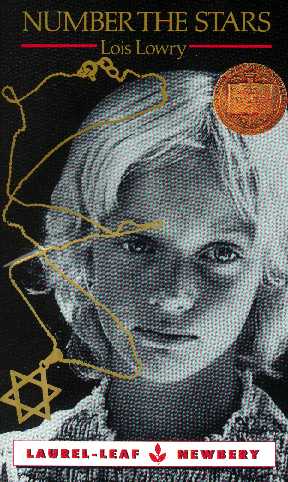
Number the Stars tells of a young Danish girl, Annemarie Johansen's experiences as she and her family aid their Jewish neighbors, the Rosens, in their escape from Nazi occupied Denmark in 1943. It is a gripping, suspenseful novel that allows its readers to become a part of the Danish Resistance, bravely doing what must be done to transport their friends to the safety of Sweden. "Readers are taken to the very heart of Annemarie's experience, and, through her eyes, come to understand the true meaning of bravery" (School Library Journal).
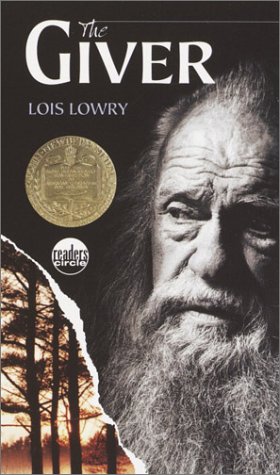
Lowry creates a seemingly utopian world in The Giver, a world in which there is no pain, no hunger, no war, no crime, no fear, no choices. When her young protagonist, Jonas, is chosen to be the receiver of all of the memories for his society, his perfect world begins to unravel as the past is revealed to him through the memories transmitted by the giver, and he begins to question and yearn for more. "The author makes real abstract concepts, such as the meaning of a life in which there are virtually no choices to be made and no experiences with deep feelings. This tightly plotted story and its believable characters will stay with readers for a long time" (Kellman).
In both books, Lowry's believable characters and fast moving plot mesmerize her readers, allowing them to experience first hand the fear of both Annemarie as she risks capture by the Nazis when she takes the important package to Uncle Henrik and Jonas as he smuggles the newchild, Gabriel, to safety. From the opening page of Number the Stars, the reader is caught up in a tale of gripping suspense complemented by just the right amount of accurate historical detail. Lowry's technique of using cliffhangers at the end of many of the chapters ensures that readers will continue to turn the pages, hoping for resolution of the conflicts. Children will be able to identify with Annemarie and become a part of what Jane Yolen describes as "that living and continuous process, forced to acknowledge that we are our past just as we are our future" (Tunnel 110). In her creation of Jonas' perfect world in The Giver, Lowry illuminates many of the truths about life by deliberately omitting those things which bring the greatest of all human pleasures from Jonas' world. When presented with a world absent of all the ties that bind us together, readers will hopefully recognize what Lowry describes as "the vital need of people to be aware of their interdependence, not only with each other, but with the world and its environment" (Biography).
Works cited:
Kellman, Amy. 1993. Review of The Giver for School Library Journal. Available from http://www.amazon.com. Accessed 01 July
2003.
Lowry, Lois. Lois Lowry's Biography. Scholastic, Inc. Available from: http://www2.scholastic.com/teachers/authorsandbooks/authorstudies. Accessed 25 June 2003.
Review of Number the Stars for School Library Journal. Available from http://www.amazon.com. Accessed 26 June 2003.
Tunnell, Michael O. and James S. Jacobs. 2000. Children's literature briefly. Columbus, Ohio: Merrill.
The Giver begins with a boy on a bicycle, riding through clean and safe streets of his community to the dwelling where he lives with his hapy, cheerful, busy family. It concludes with the same boy riding a bicycle at night - hiding by day - for many miles, through terrible danger. He saves himself - quite literally saves himself; warms and nourishes himself and finds courage - by recalling the stories from the past that have been told to him by an old man.
Each of us here today has chosen the way in which we will be a friend to children; the gifts that we will give them. The way I have chosen is to write stories. For all of us, it is our stories, as we tell them to each other, which explain the complex and tangled patterns that human lives and relationships create. They allow us to forgive ourselves for the messes we make of things we can't control. And through fiction - through stories - most of all, we remind ourselves that we are not alone in the difficult journeys we all undertake."
Lowry, Lois. "Bright Streets and Dark Paths," speech given at Brown University, March 4, 2001.