
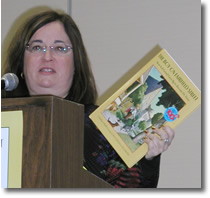
Kathleen Krull
talks about her latest book,
The Boy on Fairfield Street:
How Ted Geisel Grew Up to Be Dr. Seuss
at the conference of the
California Teachers of English (CATE)
in 2004
(See review under
"Kinds of Nonfiction")
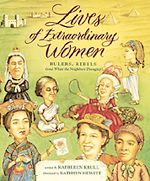
Written by Kathleen Krull, Illustrated by Kathryn Hewitt
Two extraordinary talents, author Kathleen Krull and artist Kathryn Hewitt have again pooled their talents to present another outstanding volume in their "Lives of�" series in Lives of Extraordinary Women: Rulers, Rebels (and What the Neighbors Thought). This collective biography of "twenty women who wielded significant political power, as queens, warriors, prime ministers, revolutionary leaders, Indian chiefs, first ladies, and other government officials" is "offered here to inspire awe at the power of women throughout history - and ever after" (Krull, p. 9). Many of the twenty women biographied here are familiar names, Cleopatra, Joan of Arc, Queen Isabella, Marie Antoinette, and Eleanor Roosevelt, while others are more obscure to American readers, Nzingha, Aung San Suu Kyi, and Rigoberta Menchu.
Employing her self-confessed penchant for nosiness and pouring over biographies in search of those facts that make each individual unique and interesting, Krull packs her short biographies, three to five pages, with juicy tidbits of information about each of these women that more traditional biographers tend to overlook: Cleopatra bathed in donkey's milk, Isabella took only two baths in her life, and Eleanor Roosevelt would not wear any clothing that she felt was the product of unfair labor conditions. Krull's innate ability to find those gossipy details that people crave, sets her work apart from that of others and her voice breathes new life into historical figures who have been extensively biographied. "By humanizing these giants of the past, we'd like to empower kids with knowledge, to keep them "in the loop" of the history of civilization" (Krull 2004).
Kathleen Krull humbly gives credit for the inspiration of the "Lives of��" books to her talented friend and illustrator, Kathryn Hewitt. "With almost every other book I have worked on, the text has come first. But this is a case where the art came first-- her caricatures inspired me to write equally eccentric biographies" (Krull 2004). Hewitt's watercolor and colored pencil caricatures featuring characters with oversized heads grace the beginning of each biography. Details abound in Hewitt's art, giving readers visual clues to the character of each woman. "Hewitt's illustrations remain dazzling: the oversized heads of the full-page figures sport headgear eminently suitable: Jeannette Rankin wears the Capitol dome and Aung San Suu Kyi her trademark flowers. Artifacts related to the women's stories appear as incidental images" (Kirkus 2000).
Each entry features a section labeled "Ever After" providing additional details the lives of these famous women that were not covered in the text. The bibliography aids those who desire to perform more extensive research on the featured women, and a table of contents provides quick access to the section on each woman.
Lives of Extraordinary Women is an excellent introduction to some of the more prominent women from our past, supplying student researchers with information for reports and providing much needed acclaim for the role that women have played in shaping our history. "Fabulous reading, great for research, deliciously and subversively feminist, this will sit happily on the shelf with the presidents, artists, musicians, and others this duo has covered so well" (Kirkus 2000).
Krull, Kathleen. 2004. Kathleen Krull FAQ. Kathleen Krull.com. http://www.kathleenkrull.com/faq.html (accessed March 16, 2005).
Krull, Kathleen. 2000. Lives of extraordinary women: rulers, rebels (and what the neighbors thought). Illustrated by Kathryn Hewitt. New York: Harcourt, Inc. ISBN 0-15-2000807-1.
Review of Lives of Extraordinary Women. 2000. Kirkus Associates on amazon.com. http://www.amazon.com/gp/product/product-description/0152008071/ref=dp_proddesc_0/002-8440837-2536027?%5Fencoding=UTF8&n=507846 (accessed March 16, 2005).
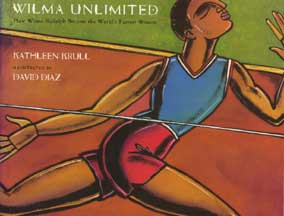
Written by Kathleen Krull, Illustrated by David Diaz
Wilma Rudolph was a sickly child who was born prematurely. "No one expected such a tiny girl to have a first birthday" (Krull, unpaged). Then, when she was stricken with polio at the age of five, it appeared that choices would be limited for young Wilma. But, an indomitable spirit led Rudolph to overcome not only her physical limitations, but also those imposed upon blacks and women in the 1940s in the Deep South. In 1960, "Wilma Rudolph became, at age twenty, the first American woman to win three gold medals at a single Olympics" (Krull, unpaged).
In Wilma Unlimited: How Wilma Rudolph Became the World's Fastest Woman author Kathleen Krull and Caldecott Award winning artist David Diaz combine their talents to produce an inspiring account of the life of Wilma Rudolph that is both a literary and visual delight. Although the topic lends itself to sentimentality, Krull's narrative avoids this pitfall. Nevertheless, through her use of a steady, conversational voice, Krull manages to inspire young readers through the character of Wilma Rudolph. "I have two stepdaughters around Rudolph's age when she really took off--the age when girls are now thought to be most in danger of succumbing to fear and losing previous self-esteem. Rudolph seemed a role model for how to emerge from this stage more powerful, not less, and I was interested in exploring why" (Krull 2004).
The artwork of David Diaz complements the text, adding an element of beauty which enriches Krull's text. His acrylic, watercolor, and gouache drawings in rich, bold hues are superimposed on original, sepia-toned photographs that further extend the text. Rudolph's despair at being left behind when her siblings go to school because she cannot walk features a portrait of Wilma seated in a chair by a window as her brothers and sisters are seen through the window heading off to school. The painting is juxtaposed against a photograph of a white rail fence, permitting readers to experience her feelings of isolation. "Enhancing the text are Caldecott medalist Diaz's richly colored, stylized illustrations that--though painted--have the look and permanence of wood carvings. These single-and double-page pictures are set on sepia-tone backgrounds that, like his Caldecott Medal-winning art for Smokey Night (1994), Diaz assembled and photographed" (Cart 1996). Diaz also designed an original font, Areil, for the book.
Though the text only takes readers through Wilma Rudolph winning her third gold medal, an author's note provides additional information on the life of Wilma Rudolph who became a teacher, lecturer, advocate, and inspiration to many young athletes, especially women. There are no other access features in Wilma Unlimited, but its brevity makes the inclusion of an index or table of contents unnecessary. However, the inclusion of a bibliography would be beneficial to those desiring additional information on the life of this spectacular woman.
Wilma Unlimited: How Wilma Rudolph Became the World's Fastest Woman, with full-page paintings on every two-page spread, is a perfect read aloud for students of all ages. It is a feel-good story masterfully presented that will be enjoyed by all.
Cart, Michael. 1996. Review of Wilma Unlimited. Booklist on amazon.com. http://www.amazon.com/gp/product/product-description/0152020985/ref=dp_proddesc_0/002-8440837-2536027?%5Fencoding=UTF8&n=507846 (accessed March 18, 2005).
Krull, Kathleen. 1996. Wilma unlimited: how Wilma Randolph became the world's fastest woman. Illustrated by David Diaz. New York: Harcourt Brace & Company. ISBN 0-15-201267-2.
Krull, Kathleen. 2004. Other biographies. Kathleen Krull.com. http://www.kathleenkrull.com/otherbio.html (accessed March 18, 2005).
School Library Journal
Best Book 1996
Jane Addams Picture Book Award
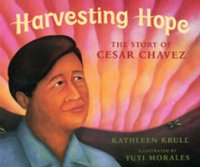
Written by Kathleen Krull, Illustrated by Yuyi Morales
Cesar Chavez is to Mexican-American farm workers as Dr. Martin Luther King, Jr. is to Black Americans. In Harvesting Hope: The Story of Cesar Chavez, Kathleen Krull accurately portrays the life of Cesar Chavez beginning at the age of ten when his family lost their ranch and home that had been purchased and built by Chavez' grandfather many years earlier due to the drought that devastated Arizona during the Depression years of the 1930s. Forced to leave their ranch when they could no longer make the payments, the Chavez family along with young Cesar, migrated to California in search of work in California's vast agricultural region.
Remembering the richness of his earlier life on the family ranch in Arizona, Chavez was dismayed at the conditions and treatment that his family was forced to endure working and living on the farms of others in California. "Once, after Cesar broke the rule about speaking English at all times, a teacher hung a sign on him that read, I AM A CLOWN. I SPEAK SPANISH" (Krull, unpaged). In his early twenties, scenes like this and the general treatment of farm workers inspired Chavez, following the non-violent teachings of his heroes, Dr. Martin Luther King, Jr. and Mahatma Gandhi, to begin efforts to organize farm workers. Gaining support one person at a time, Chavez eventually began the National Farm Workers Association, or La Causa as it came to be called. Through his efforts, organizing strikes and marches, Chavez was able to reach an agreement with farm owners and in 1965, signed the first ever agreement with farm owners on behalf of the National Farm Workers Association guaranteeing pay raises and better working conditions for farm laborers. "Much more work lay ahead, but the victory was stunning. Some of the wealthiest people in the country had been forced to recognize some of the poorest as human beings" (Krull, unpaged).
From cover to cover, this book is both a visual delight and an accurate chronicle of the life of a man who made a difference in the lives of so many with his adherence to non-violent principles in his quest for better treatment of farm workers. Illustrator, Yuyi Morales' acrylic paintings in bright hues of pink, turquoise, green, and yellow are reminiscent of a tour of the barrio. Krull's text is superimposed on Morales' paintings which fill every page of the book. The flow of the artwork aids the flow of the text as readers are greeted with each turn of the page by stunning depictions, full of minute details, of scenes of Chavez, California farms, and marching workers. The final page shows a picture of a reverent Chavez, gazing heavenward, thankful for what he has been allowed to accomplish.
The large serif typeface makes this book ideal for reading aloud to students of all ages, from kindergarten through high school. An author's note, supplying further details of the life of Cesar Chavez, follows the text. "While sufficient background information is provided to support the story and encourage further research, focusing on one event makes the story appealing to younger readers" (Morgan 2003). Harvesting Hope serves as an excellent introduction to the life and work of Cesar Chavez, but the lack of a bibliography forces those wanting additional information on Chavez to search elsewhere. It is obvious that Krull conducted extensive research while writing this book, and unfortunate that this information is not shared with readers.
This book should be included in all collections as an introduction to Chavez and his non-violent means of obtaining positive results for farm workers. In a classroom setting, pair the book with the historical fiction, Esperanza Rising by Pam Munoz Ryan to further student understanding of this time in history and the plight of farm workers.
Krull, Kathleen. 2003. Harvesting hope: the story of Cesar Chavez. Illustrated by Yuyi Morales. New York: Harcourt, Inc. ISBN 0-15-201437-3.
Morgan, Sue. 2003. Review of Harvesting Hope. School Library Journal. http://reviews.schoollibraryjournal.com/bd.aspx?isbn=0152014373&pub=sl (accessed March 19, 2005).
Ryan, Pam Munoz. 2000. Esperanza rising. New York: Scholastic Press. ISBN 0-439-12041-1.
2004-05 Texas Bluebonnet Book
Jane Addams Peace Association Honor Book
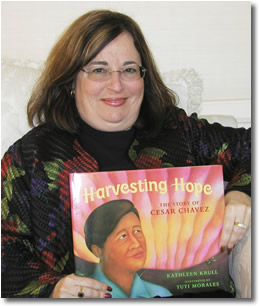
at the annual conference of the California Association of Teachers of English in 2004
911 Sartain Drive
Andrews, TX 79714
E-mail: [email protected]
Updated March 20, 2005