
Douglas Florian
Florian studied art at Queens College where one of his professors "taught me to treat a drawing like a person: with love and affection"
(Douglas Florian 2000). After college, he worked as a cartoonist for the New York Times, but soon yearned to escape from the deadlines and frantic pace of a newspaper. He began illustrating children's books for others and eventually began writing non-fiction books for children, mostly about nature.
As he was browsing through items in a flea martket one day, Florian happened upon a book of poems, Oh, That's Ridiculous by William Cole. He enjoyed the poems so much that he was inspired to write some poetry of his own, and soon found his niche in the writing world as a writer/illustrator of children's poetry.
Florian frequently uses bad grammar or invents whimsical words to increase the impact of his poems. He says that the only rule to writing good poetry is that there are NO rules (Douglas Florian 2001). He invents words to paint a clearer picture for his readers such as the caterpillar who eats and eats and becomes a fatterpillar. Children love his sense of playfullness and adults enjoy his wry sense of humor.
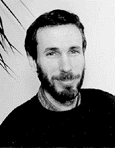
Photo from: www.embracing the child.org
" Lives in New York City with his wife and 5 children
" Got in trouble in school for not following directions
" Spells words incorrectly on purpose to achieve an effect
" Father was an artist and he grew up surrounded by art
" Favorite book that he has written is A Winter Day
" Hates to write and paint on the same day, or even the same week
" Researches each topic he writes about by reading nonfiction books
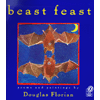
" Won the Lee Bennett Hopkins Poetry Award and received an ALA Notable Children's Book Award for Beast Feast
" Got a D in college poetry - said they studied Paradise Lost and it was lost on him
" Thinks that poetry is well-suited for his quirky nature
" Uses words as he uses paints - any way he wants
" Reads Walt Whitman or Henry David Thoreau to get in touch with nature and inspire himself before he writes
Introduction: Children are the world's best at wondering and asking why something is as it is. Use this poem as a means of introducing a discussion about things "wondered about."
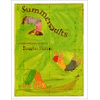
"Graze Days" (from Summersaults)
On sunny days
We cows all graze.
For days we graze on grass.
And all we've seen
Is grass so green,
Green grass as hours pass.
We chew and chew
The grass that grew,
Green grass from day till night.
And wonder why
That by and by
Our milk is always white.
Extension: Have students tell their own stories of how they spend their summer days. Encourage them to create questions at the conclusion of their stories with a surprise, like Florian did in Graze Days.
Introduction: Younger children love everything about Halloween. Bring pumpkins of all sizes for the children to look at and touch. After reading the poem, allow students to create their own jack-o-lanterns either with paint or adult supervision if there is cutting involved.
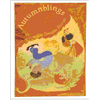
"Pumpkins Grin" (from Autumnblings)
Once we were tiny
Once we were green.
Now we are orange
To toast Halloween.
Soon we'll have noses,
Eyes and mouth too.
Then we will sneak up
Behind you and ---
Boo!!!
Extension: This is a great short poem for children to read chorally. They will love sneaking up on each other and shouting "Boo."
Introduction: In science, one of the most interesting concepts for young children is witnessing a complete metamorphosis such as egg, larva, pupa, butterfly. Use this poem to introduce the concept and vocabulary of metamorphosis, even with younger students. They love learning big words and Florian's poem is the perfect introduction to this interesting concept.
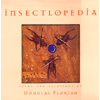
"The Caterpillar" (from Insectopedia)
She eats eight leaves at least
To fill her,
Which leaves her like a
Fatterpillar,
Then rents a room inside
A pupa,
And checks out: Madame Butterfly --
How super!
Extension: Purchase larva from an educational supply company. Allow the students to construct a habitat for the larva and watch them go through the stages of eating the specially supplied food, forming pupas, and finally emerging as butterflies.
Introduction: Americans regularly use idioms in their communications. These idioms often are confusing to students learning English as a second language. Introduce some of the more frequently used idioms such as "It's raining cats and dogs!" and "By the skin of his teeth." Discuss the meaning of these and ask students to think of other idioms that are a regular part of their vocabulary. Ask students to listen for an idiom in Florian's poem, "The Praying Mantis."
"The Praying Mantis" (from Insectlopedia)
Upon a twig
I sit and pray
?For something big
To wend my way:
A caterpillar,
Moth,
Or bee --
I swallow them
Religiously.
Extension: Discuss what doing things "religiously" means. Look for other examples of the use of idioms in poems.
Introduction: One of the trademarks of Douglas Florian's poetry is his use of what he terms "poetic license" in creating new words or using conventional words in unusual ways. "The Boa" shows his talent for using words creatively.
"The Boa" (from Beast Feast)
Just when you think you know the boa,
There's moa and moa and moa and moa.
Extension: Have students examine a number of other books of poetry by Douglas Florian. Have each of them to locate at least one of Florian's poems that uses language in a creative way. Allow students to share the poem that they found with the class if they want.
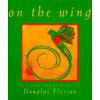
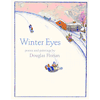
Most of Florian's poems come from nature. Many of them lend themselves readily to the study of the natural sciences. Incorporate his work into units of study on insects (Insectlopedia), animals (Beast Feast, Mammalabilia, On the Wing), or the seasons and weather (Autumnblings, Summersaults, Winter Eyes).
Use the short and often humorous poems of Florian for a moment of levity, a "poetry break," during the day.
Florian's creative use of language can entertain and inspire the creativity of students. Encourage students to try a little "poetic license" in the poetry that they write.
Florian says that he gets some of his inspiration from the writing of Walt Whitman. Use Florian's experience to introduce older students to some of the poetry in Walt Whitman's Leaves of Grass.
Florian's artwork is as creative as his poetry. Encourage students to illustrate original works of poetry, or if they have difficulty writing their own poetry, allow them to copy a favorite poem and illustrate it with the "no rules" approach of Florian.

Company.
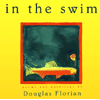
York: Harcourt Brace & Company.
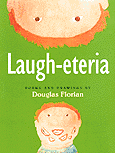
New York: Harcourt Brace & Company.
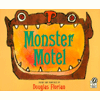
Company.
New York: Harcourt Brace & Company.
Author information: Douglas Florian. 2004. Available from: http://www.harperchildreens.com/teacher/catalog/author_xml.asp?authorID=16495. Accessed 6 June 2004.
Douglas Florian. 2001. Available from: http://www.storybookart.com/meet_dflorian.html. Accessed 6 June 2004.
Meet Douglas Florian. 2000. Available from: http://embracinghtechild.org/aflorian.htm. Accessed 7 June 2004.
Q&A with Douglas Florian. 2001. Available from: http://skateboardmom.homestead.com/douglasflorian.html. Accessed 6 June 2004.
Spring into summer with Douglas Florian's playful poems. 2002. Available from: http://www.bookpage.com/0204bp/douglas_florian.html. Accessed 6 June 2004.
Stevenson, Deborah. 1999. Douglas Florian. The Bulletin of the Center for Children's Books. Available from: http://alexia.lis.uiuc.edu/puboff/bccb/0999true.html. Accessed 6 June 2004.
911 Sartain Drive
Andrews, TX 79714
E-mail: [email protected]