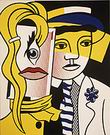
Pop
Art A
reaction against the seriousness
of abstract expressionism
According
to British encyclopedia, pop
art is a movement that first
emerged in Great Britain at
the end of the 1950s as a reaction
against the seriousness of abstract
expressionism. British and American
pop artists employed a common
imagery found in comic strips,
soup cans, and Coke bottles
to express formal abstract relationships.
By this means they provided
a meeting ground where artist
and layman could come to terms
with art. Incorporating techniques
of sign painting and commercial
art into their work, as well
as commercial literary imagery,
pop artists such as Roy Lichtenstein
and Andy Warhol attempted to
fuse elements of popular and
high culture to erase the boundaries
between the two.
In
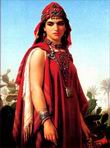
July of 1798 Napoleon marched
into Egypt with an army. He defeated
the Turks at the battle of the
Pyramids, stayed for a few weeks
and then was driven out by the
British. In the small amount of
time that he was there he managed
to do what he did best: he changed
everything.
Following him came first a trickle
and then a torrent of westerners
into the Near and Middle East.
The writers who wrote about their
experiences and the artists who
painted what they saw became known
as the Orientalists. They traveled
through Turkey, Iraq, Persia,
Egypt, Lebanon, Palestine, Arabia
and North Africa. With time this
became an art movement and today
we call it Orientalist art.
This
movement spanned over a century
and included hundreds of known artists.
Many of them were giants of the
art world and created beautiful
paintings that seem almost photographic
in detail. Many of them took incredible
risks and endured considerable hardship.
Disease was the greatest hazard
and gun battles with bandits were
commonplace. At other times they
were received with the greatest
kindness and made lasting friendships.
They came from all over the world:
from England, France, Belgium, Germany,
Italy, Russia, America, and Australia.
Some of them specialized in landscapes,
in archeological themes, or in people.
Some of them were very religious
and created biblical scenes, some
specialized in military history.
Others recorded the flora and fauna
of the Near and Middle East. Encompassing
many different painting styles and
political leanings, the only generalization
that can be made about them is that
they were extremely diverse.
One common thread unites them; all
who went were changed by the experience.
From Charles Gleyre lying on the
deck of a ship in the Mediterranean
so sick that the captain and crew
discussed if he were still alive
or not, to Etienne Dinet making
his pilgrimage to Mecca, the journey
affected these men deeply. Some
even died there and others remembered
their travels with crystalline clarity
to the end of their lives. As great
art has the power to change the
lives of the those who create it;
so it has the power to change the
lives of those of us who view it.
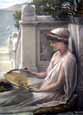
Victorian
Classicism
Britain, mid to late 19th century
Aesthetic
attitudes and principles based on
the culture, art and literature
of ancient Greece and Rome, and
characterized by emphasis on form,
simplicity, proportion, and restrained
emotion.
Classicism and Neoclassicism, in
the arts, historical tradition or
aesthetic attitudes based on the
art of Greece and Rome in antiquity.
In the context of the tradition,
Classicism refers either to the
art produced in antiquity or to
later art inspired by that of antiquity;
Neoclassicism always refers to the
art produced later but inspired
by antiquity. Thus the terms Classicism
and Neoclassicism are often used
interchangeably.
Term
that, with the related words `classic'
and `Classical', is used in various
(and often confusing) ways in the
history and criticism of the arts.
In its broadest sense, Classicism
is used as the opposite of Romanticism,
characterizing art in which adherence
to recognized aesthetic ideals is
accorded greater importance that
individuality of expression. The
word often implies direct inspiration
from antique art, but this is not
a necessary part of the concept,
and according to context the word
might be intended to convey little
more than the idea of clarity of
expression, or alternatively of
conservatism. In the context of
Greek art, the term `Classical'
has a more precise meaning, referring
to the period between the Archaic
and Hellenistic periods, when Greek
culture is thought to have attained
its greatest splendor. The term
`classic' is used to refer to the
best or most representative example
of its kind in any field or period.
This is what W?lfflin meant when
he gave the title Classic Art to
his book on the Italian High Renaissance.
Thus, in this sense, it would be
legitimate, if wilfully confusing,
to refer to Delacroix as the classic
Romantic artist. The three terms
`classic', `Classical' and `Classicism'
are, then, often not used with discrimination
or exactness, the conflation of
historical term and value judgement
reflecting the idea (dominant for
centuries) that the art of the Greeks
and Romans set a standard for all
future achievement. To clear up
(or perhaps add to) the confusion,
the rather ungainly word `classicistic'
has also entered the lists--it conveys
the idea of dependance on ancient
models but without any sense of
qualitative judgement.
Lanna kingdom was a rich historical
period which has been little studied
but much appreciated by connoisseurs
of Southeast Asian art. In fact,
the Royal Collection of Lanna Art
was begun by the Mae Fah Luang Foundation
in order to help save Lanna art
from dissemination worldwide and
make it possible for northern Thai
people to be educated about their
own cultural heritage.
Inside the Haw Kham Luang, Buddha
images, candelabra and other ritual
objects may be viewed by the public.
They are part of the Mae Fah Luang
Royal Collection of Lanna Art. During
the years 1986-1987 many changes
occurred in the northern region
as a result of economic prosperity
and the benefits brought home by
people working overseas. Because
of this, there were many offerings
by local people in order to make
merit at their temples, causing
old items to be replaced by those
of contemporary taste. In particular,
the "sattaphan" or ritual
candelabra were being discarded
or dismembered for decorative uses.
The Mae Fah Luang Foundation felt
that it was important to preserve
these relics of a passing era, purchasing
them as they were sold into the
antique market. Many objects were
also donated to the Foundation at
this time.
The
"sattaphan", in particular,
are a unique expression of Lanna
culture and it is hoped that the
northern visitor to the Haw Kham
Luang will be re-inspired to use
them in the temples. In the Haw
Kham Luang, one also finds a Buddha
image donated to the Foundation
by a temple in Phrae as a gesture
of goodwill. The name of the image
is "Phra Phraa To"; it
was created in 1893. The legend
associated with it states that it
was built at a time when the town
of Phrae was being developed by
migrants to the area. They did not
have the tools to create a refined
Buddha image, so they used a large
knife to create this strong, solid
image. It is hoped that this image
would be an inspiration to those
who build Rai Mae Fah Luang, as
it was to those pioneering migration.
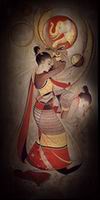
Noh, the classical, aristocratic
Japanese drama, was developed
during the 14th century and is
still performed today. Kan'ami
(1333-1384) is regarded as the
founder of the form. Dance, mime,
music, chant, masks, and costumes
have all been influenced by the
original works of Kan'ami. Less
well known is his influence on
traditional Japanese brush painting.
But, for the artisan monks of
the Kikawa Monastery, Kan'ami
painting was given religious reverence.
In keeping with the purity, tradition,
and discipline of other Noh art
forms, the Noh painters sought
only to reinterpret the seminal
paintings of master Kan'ami. However,
during his life, the master painted
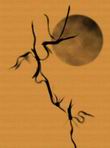
only one painting, "Clouds"
(circa 1380). As a result, all
the forms in a Noh painting are
composed only of transformations
of "Clouds". Despite
this rigorous constraint, the
Noh painters were able to achieve
many lyrical effects.
<The
Rocket>
My
Favourite Flash Design
It was designed by Doug Baker. It's
for free! You can "Download"
right here. If you don't have Flash
Player, you can download this programme
-Click
Here-
<Astro 3DMax>
3DMax Design Work
This character was made in 3DMax, created by Dario Arnaez. See the other works of him at http://www.arnaezcs.com And if you want to see the professional 3D works from various artists, just go to http://www.mediainspiration.com
Some example photos of 3D works at Mediainspiration.com -Click Here-
<"YW" Graphic art>
Graphic Design
This creative graphic art was designed by Liquid Diamond. Its name is "YW". In truth, there are many graphic works today that show creative idea. You can go to Mediainspiration.com and find out new graphic works of famous artists.


 -
-
 Some example photos of 3D works at Mediainspiration.com -