The 79th New York Volunteer Infantry was originally formed and chartered as a New York State Militia unit on June 9, 1859. The unit was sponsored by the Caledonian Society of New York City, for Scots and Scottish immigrants and American born descendants. The roster originally contained eight companies but was reorganized into six companies (A thru F) after some men were disqualified. The regiment would be chartered by the state totaling 256 men and officers.
April 11, 1861 brought the firing on Ft. Sumter, and President Lincoln's call to the northern states for volunteer troops. The 79th was one of the first state militia regiments to answer the President's call. The 79th was called for federal service on May 27th 1861 and formal enlistment proceedings went on for the next two days. By May 29th the enlistments had brought the unit up to nearly full regimental strength and were formally chartered. The ranks of the 79th were opened to all nationalities during this enlistment period in order to achieve the required full regimental strength.
They marched out of New York City, 795 strong, on June 2nd, in full regimental dress uniforms led by pipers and their new colors provided by The Caledonian Society of New York. They were bound for Washington DC, arriving later that month. They were attached to Sherman�s Brigade of Tyler�s Division.
The 79th first saw action in the skirmish of Blackburn's Ford on 7/20/61, which developed into a full-scale engagement, 1st Bull Run, the next day. The 79th was then under the brigade command of Col. (at that time) William T. Sherman (later to become Gen. U. S. Grant's most trusted colleague, Gen. "Billy" Sherman). In the battle, the 79th participated in the attack on Henry House Hill (defended by Gen. James (Stonewall) Jackson) along with the 2nd Wisconsin and the 69th New York Regiments. The 79th would lose its commander, Col. James Cameron (brother of Simon P. Cameron, Lincoln's Secretary of War) and 32 others killed, 51 wounded and 115 captured in the battle. The 79th and 69th New York Regiments were credited with helping to avert a total disaster of the routed Union forces during the retreat, by defending the stone bridge against confederate cavalry who were pursuing the fleeing Union troops.
The 79th spent the rest of 1861 in and around Washington DC, and were placed under the command of Col. Isaac Ingalls Stevens. At this point, the morale of the 79th reached a record low. After losing their commander and many comrades at Bull Run, they were being reorganized with a new commanding officer, who insisted on regular army dress. With the traditional uniform ordered replaced by standard Federal issue, and a cancellation of a promised furlough, the 79th mutinied. When General McClellan was informed he quickly dispatched Regular Army troops to Washington to surround the rebellious 79th with artillery. Col. Stevens called upon the 79th, "You are soldiers, and it is duty to obey. I am your colonel, and your obedience is due to me." as the Regulars filed around the 79th preparing to fire into the ranks, the mutiny came to an end.
An order from Gen. McClellan deprived the 79th of their colors. The flag was not to be returned to the unit until they learned that the first duty of a soldier is to obey, and that they prove on the field of battle that they are not wanting in courage. Col. Stevens drilled the 79th in all aspects of a soldier's life with an unrelenting insistence on regular army dress and deportment. After an impressive series of skirmishes with the Confederates at Lewinsville, Virginia on October 10th -12th, Stevens arranged for the return of the 79th's colors. General McClellan made the presentation in person, telling the men that they had acquitted themselves as true soldiers.
Stevens had won the 79th's hearts and minds to the extent that when he was promoted to Brigadier General in the spring of 1862, the 79th requested to be transferred with him to his new command. They presented him with an ornate sword, sash and spurs. Colonel David Morrison, former British officer in the famed 42nd Highland Infantry, the "Black Watch" would assume command of the 79th.
Stevens would take the 79th on an expedition aboard Admiral DuPont's ships, against the protests of Gen. McClellan, with 12,000 other infantry bound for Port Royal, South Carolina (Stevens' 2nd Brigade, Sherman's South Carolina Expeditionary Corps, April, 1862). During their stay in South Carolina, the 79th would acquire two dogs and an alligator, that were kept as pets. One of the dogs, named "Tip" became the 79th's mascot and remained with the unit until May of 1864. It is believed that Tip may actually have been responsible for Gen. Longstreet's defeat at Ft. Sanders, in Knoxville a year later. The 79th would fight in the battles for James Island (June 3-4, �62) and Secessionville (6/16/62), in which they would suffer 110 casualties out of 474 engaged. Brigadier Gen. Henry W. Benham was in temporary charge of the 2nd brigade and one other. He ordered the 79th on a devastating and hopeless attack on the fort. The approach to the fort was surrounded by swamp and defended by rifle pits, trenches and obstacles. The 79th approached the fort behind the 8th Michigan Infantry, cut down by devastating fire before reaching the works. The Highlander's advanced and took the forward trenches, but were pinned down in that position. Promised reinforcements never arrived and the 79th was forced to retreat back across the treacherous grounds they had so bravely fought through to reach the fort. The Union attack failed, but the 79th was praised by the local newspapers stating:
"It was left to the valiant Paladins of the North, to the brave 79th Highlanders, to testy the unadulterated cold steel of our southern nerves, but they terribly mistook their foe, for they were rolled back in a tide of blood. Thank God Lincoln has or had only one 79th Highlander Regiment; for there is only a remnant left to tell the tale. The soldiers who can make such a charger, and those who can stand it, their condition being equal, are parties to win a war"
(The Charleston Mercury News, in its account of the Battle of Secessionville)
The campaign was a limited success, in that progress was made, but the ultimate goal, the re-taking of Charleston was never achieved (Charleston would stave off federal occupation until abandoned in 1864).
On July 8th, the 79th would be transferred back to Virginia and returned to the Army of the Potomac (AOP) to fight under Gen. A. Burnside's 9th Army Corps, 1st Division, Third Brigade. In the battles of 2nd Bull Run (8/29-30) and Chantilly (9/1), Virginia, Gen Reno was in charge of the IX corps, but had fallen ill and tactical command was passed to Gen Stevens. Col Morrison took charge of the 3rd Brigade. Under the command of Col. Morrison at Chantilly, the 79th would lose five consecutive color guards (one of them was Sgt. Alexander Campbell), in a fierce struggle for control of the field, on extremely rare night battle...during a lightening and rainstorm. Their beloved commander, Gen. Stevens, rallying his forces in a charge against Stonewall Jackson's troops at the edge of the woods, shouted, "Highlanders, my Highlander's, follow your general!" when he was struck in the head by a bullet and killed. He would die on the field in the arms of his son, also wounded, Lt. Hazard Stevens. After the war, the surviving 79th members sent the ripped and bloodstained banner to Steven's widow with a note that read, "His memory is engraven on the hearts of every one of his Highlanders."
That fall, they moved on with the AOP to follow Gen. R.E. Lee's first invasion of Maryland for the battles of South Mountain (9/15) and Antietam (9/17). On the bloodiest day in American history, the 79th would suffer only 40 casualties in the fighting at Burnside�s Bridge and at Sharrick's farm. Later the same year, they would participate in the protecting of artillery placements and guarding pontoon bridges in the Union's devastating defeat at Fredericksburg, Va. (12/13-14).
In early '63, the 79th would be moved west, to fight in Kentucky, Tennessee and Mississippi. They would participate as a rear guard, protecting the supply trains during Gen. U. S. Grant's siege of Vicksburg (6/17-7/4) and then seeing minor combat action in small battles for Jackson (7/10-11). They along with the IX Corps, were then moved to back Lexington, Kentucky to recuperate. Although combat losses had been low, the Corps had lost many to disease and sun-stoke. One 100th Pa soldier estimated the loss to be around 2000 men, leaving the IX Corps at a strength of about 6000 men by mid September. The IX Corps would be officially transferred to the Army of the Ohio, then promptly moved back to Tennessee, reaching the Cumberland Gap on Sept 20th.
On 26 September, 1863, Burnside�s IX Corps forces reached the key rail city of Knoxville. There in Knoxville the IX Corps would occupy many forts or �works� built by the Confederates who had hastily retreated with the approach of the IX Corps. From their new Knoxville �base� they would engage the Confederates, now trying to regain control of Knoxville in numerous small battles, including the battle of Blue Springs on Oct. 10th, which resulted in an overwhelming Union victory. The 79th would only sustain 12 casualties in the battle. Another episode would follow at Campbell�s Station on November 16th
To defend the city from repeated confederate assaults trying to re-take the city, the Union troops built several forts. The 79th occupied an existing fort, Fort Loudon (later named Ft. Sanders) on the northwest approach to Knoxville. The 79th would be hand chosen by Lt. Benjamin, commander of the 2nd US Artillery, Battery E, to assist his unit in the successful defense of the fort. Longstreet's Corps began a 12 day siege of the city, on November 17th (confederates were desperately trying to regain the vital railroad links into Virginia and to retain control of Tennessee). These attacks were designed to further divert Union troops away from Gen Braxton Bragg�s defense of Chattanooga. Chattanooga would later fall to the Union on November 25th.
Aware of the imminent attack, preparations were made for defense of the fort including wire entanglements and a twelve foot wide ditch with vertical sides just outside the exterior slope of the fort. Gen Longstreet had spied a Highlander walking a dog (probably Tip and William Sam of Company B), directly in front of the fort. Not knowing that Tip and Private Sam were walking on a plank spanning a ditch, Longstreet assumed the fort was not such an obstacle. This mistake was to cost the Longstreet the battle. Longstreet�s skirmishers would drive in Union pickets on the night of the 28th. The occupiers of the fort poured what available waste water they had into the ditch and during the night the water would freeze making it more difficult to breach. The main attack would begin at dawn on the 29th, the Confederate attacking with three brigades after an artillery barrage. The Confederates charged the fort eventually reaching the ditch, and they began to slip and slide. The Highlanders threw artillery shells provided by Lt. Benjamin, with lit fuses into the ditch. The explosions devastated the attackers. At one point, 79th 1st Sgt. Francis Judge, of Co. K, leaped into the ditch yanked the 51st Georgia Infantry colors from the flag-bearer and retreated back to the fort. He would be awarded the Medal of Honor (on November 2, 1870) for this action. Longstreet�s confederates were forced to retreat after sustaining heavy losses. The attack would last only about 20 minutes. The 79th shouted, "Remember James Island", referring to their own failed attack at Secessionville, a year earlier. In the assault on the fort, Longstreet would lose 813 killed or wounded, and a small number who entered the fort were wounded, killed or captured. The fort defenders (79th NY, 8th Michigan and the 2nd US Battery E) sustained only 8 killed and 5 wounded.
The 79th would endure the winter of '63-'64 as garrison troops, at the fort at Strawberry Plains, TN., east of Knoxville. On 1/21/64, the 79th would survive a heavy bombardment, in the Confederates last major effort for control in the region, but they did not relinquish control of the fort. In a continuing action the next day, they provided the cover for the federal forces retreating from action at Armstrong's Ferry, back into the safety of federally occupied Knoxville. They were credited with using a bayonet charge to repel a Confederate cavalry attack, to stop the pursuit of the retreating Union forces. Longstreet would give up on Tennessee, and re-join Gen. Lee's forces in Virginia.
In the spring of 1864, the 79th would march north, back into Kentucky where they would board trains for Annapolis, Md. for re-organization. They would later join Gen. Grant's Army of the Potomac for the new campaign. For 26 days they marched to meet Grant to an area known as, "The Wilderness" (May 5th and 6th). They were to meet Longstreet one final time, at the battle of Spotsylvania, on May 8th through the 13th. The 79th would move forward against the veteran troops of Longstreet, smashing fences to drive them from the field. Col. Morrison was wounded and command of the 79th was passed to Col. Laing. The 79th would lose 3 killed and 6 wounded at Spotsylvania. Eight days later, the original three-year enlistments up, and the 79th would march back to New York with only 120-130 of the original members remaining. They received a hero's welcome at Mercer House and were mustered out of service.
The 79th would sustain 423 total battle casualties, with 165 missing and unaccounted for, 12 would die of disease and 11 died as POW's.
Col. Samuel Elliott would take over command from Col. Laing and the remaining men, which would be re-organized into companies A and B before leaving New York. They would be moved to Camp Distribution, on June 19th, being assigned as provost for the XVIII Corps under Gen. W. F Smith. On the 10th of September the 79th would be returned to the IX Corps under Gen Parke (succeeding Gen Burnside). Companies C and D were filled by January with men attached from other regiments, including remnants of the 51st and 100th Pa., and new enlistees. Company E would be formally added by February of 1865. After the reorganization, the 79th returned to the fighting front in the Petersburg Campaign, where they would participate in the battle of Hatcher�s Run (Jan. 5th through 7th) and then assigned garrison duty, at Ft Stedman just outside Petersburg. They would later participate in the final assault on the city, April 5th, ending nearly a year of siege. Following the fall of Petersburg they would continue with the AOP in the pursuit of Gen. R. E. Lee all the way to Appomattox Court House and they were present for the surrender.
The 79th was one of the most traveled units of the Union army throughout the war. After the end of the war, the 79th was re-designated as National Guard Unit (often referred to as Veteran Infantry), serving until 1876 when the unit was formally disbanded.
A special thanks to Dan Munson, 1st Lieut. Co. K, 100th Pennsylvania Volunteer Infantry for correcting some mistakes in my earlier version.
79th New York Infantry Data
Demographics
The 79th left New York with 795 men and officers in June of 1861. An addition 49 enlistments were added in the same year as �replacements�. The additional 469 enlistees for the war years are given by year, below:
1862: 123
1863: 9
1864 140
1865 197
More records are available for the �replacement� enlistments than that of the original 795. The ages of these men range from 14 to 48 years, with 331 men between the age of 18 and 26. None of the enlistees had an age of 17 and only one was 16 years old. 159 men were 30 years old or over, and 31 of these were over 40 years old.
Of the 518 total �replacements, 30 of these listed New York City as �Nation or State of Origin� while an additional 62 listed New York State as home. 181 listed Ireland, 68 listed Scotland, 49 listed England and Wales and 40 listed Germany.
The men ranged in height from 5�1� to 6�5�, with the greatest number being 5�4� (143 men). 296 of the men listed a height between 5�5� and 5�9�.
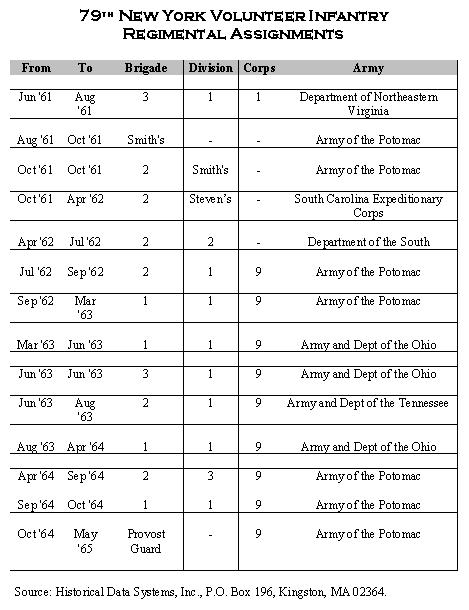
Command Progression
Organized at New York City and mustered in federal service on May 29, 1861. Left New York State for Washington, D.C., June 2, 1861. Attached to Mansfield's Command, Dept. of Washington, until late June, 1861. Then placed under Col W. T. Sherman's Brigade, Tyler's Division, McDowell's Army of Northeast Virginia, through August, 1861.
W. F. Smith's Brigade, Division of the Potomac, until October, 1861.
Stevens' Brigade, Smith's Division, Army of the Potomac, through October, 1861.
Stevens' 2nd Brigade, Sherman's South Carolina Expeditionary Corps, until April, 1862.
2nd Brigade, 2nd Division, Dept. of the South, to July, 1862.
2nd Brigade, 1st Division, 9th Army Corps, Army of the Potomac, to September, 1862.
1st Brigade, 1st Division, 9th Army Corps, to April, 1863.
1st Brigade, 1st Division, 9th Army Corps, Army of the Ohio, to June, 1863.
3rd Brigade, 1st Division, 9th Army Corps, Army of the Tennessee, to August, 1863.
1st Brigade, 1st Division, 9th Army Corps, Army of the Ohio, to April, 1864.
2nd Brigade, 3rd Division, 9th Army Corps, Army of the Potomac, to September, 1864.
1st Brigade, 1st Division, 9th Army Corps, to October, 1864.
Provost Guard, 9th Army Corps, to July, 1865.