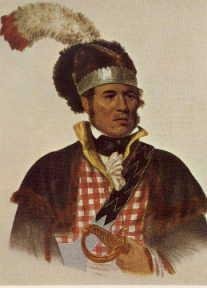
Chief William McIntosh (1775 ca - 1825)
Called Tustunnugee Hutkee (White Warrior), William McIntosh was the son of Captain William McIntosh, a member of a prominent Savannah, Georgia family sent into the Creek Nation to recruit them to fight for the British during the Revolutionary War. His mother, a Creek named Senoya, was a member of the prominent Wind Clan. Raised as an Indian, he never knew his Tory father who, after fathering a second son by another Creek woman, returned to Savannah. Because among the Creeks, descent was determined through one's mother; the fact that his father was white was of little importance to the Creeks.
A cousin of Georgia Governor George M. Troup, he gained the enmity of Alabama's Upper Creek Indians by leading General Andrew Jackson's Indian troops during the Creek Indian War of 1813 - 1814, during which the Upper Creeks were defeated. For his services at the Battle of Horseshoe Bend and elsewhere, he was commissioned a brigadier general in the United States Army.
During the War of 1812, a civil war between the Upper and Lower Creeks broke out, and McIntosh was selected to head a kind of national police force established by Benjamin Hawkins, an Indian agent, to deal with nativistic Creeks, who were led by another half-Scottish Creek, Peter McQueen.
"Now increasingly evident was the impending estrangement between the nativistic Upper Creeks and the Lower Creeks, who were increasingly swayed by Hawkin's policy of acculturation, his political system, and his argument for the necessity of the law menders [like McIntosh] to see justice done." ["McIntosh and Weatherford, Creek Indian Leaders" by Benjamin W. Griffith, Jr.]
In an 1817 letter written to President Madison and signed by McIntosh, Madison was told that, while the more influential Cherokees of mixed blood wanted to swap their land, the "not so much civilized" pure bloods feared the mixed-bloods would--as they did--swap all their land, leaving them "without any land to walk on." The Creeks feared that these Cherokees might--as they already had--take land from the Creeks.
After the Creek Indian War, McIntosh built a plantation on the Chattahoochee River in Carroll County called Lockchau Talofau (Acorn Bluff) that was worked by 72 slaves. (It is near Whitesburg and is today maintained as a park by Carroll County.)
McIntosh also fought for the United States in the First Seminole War. He gained fame during this war by playing a major role in the capture of a "Negro Fort" located on the lower Apalachicola. (Georgia slaves escaped and took refuge with the Seminoles in British-held Florida.) This fort was occupied by about 300 black men, women, and children, 20 renegade Choctaws, and a few Seminole warriors. Its defenders were led by a black named Garcon. The downfall of the fort was brought about by an American cannon ball heated red hot setting off a tremendous explosion when it landed in the fort's magazine. (A magazine is where black gun powder is stored.)
Despite the fact the Upper Creeks had vowed to kill anyone who signed away any more Indian land, McIntosh, along with eight other chiefs, on February 12, 1825 signed the Treaty of Indian Springs; thus relinquishing all the Creeks' land in Georgia in exchange for $400,000, which was then worth vastly more than it is today. Whether he signed the treaty for personal gain or because he believed signing it was in the best interests of the Creek Nation is still argued.
Despite Governor Troup's promise to protect him, on April 30th about 200 Creeks set fire to McIntosh's plantation and killed him. If his enemies had waited much longer, McIntosh wouldn't have been there, as he was planning to leave soon to look over land promised him along the Arkansas River.
McIntosh's home served as an inn and tavern on the Federal Road where it crossed the Chattahoochee, and because the River was then above its banks, some travelers had decided to spend the night there, hoping the waters would recede. Thus, there were several witness to the terrible events that took place there besides McIntosh's family.
Just before daybreak, a party of Upper Creeks set fire to an outbuilding in order to light up the yard so as to prevent anyone from escaping. They called to the white guests and women to come out, saying they would come to no harm. McIntosh's son Chilly and another mixed-blood escaped from an outbuilding they were sleeping in because there wasn't room for everybody in the main house.
Shot in the front doorway of his home, McIntosh managed to climb the stairs to the second floor, from which he began shooting at his assailants. Forced to leave when they set fire to the house, he was shot and dragged some distance from the house. Raising himself on an elbow, he gave them a defiant look as he was stabbed in the heart. An eyewitness estimated that his corpse was shot about 50 times. After destroying what they could not carry off--slaves, horses, and cattle--the assassins left
After his death,
his wife Peggy complained in the Cherokee Advocate that, "I
do not blame the Creeks, the Creeks treat me well, the Cherokees
treat me well--it was by Government my husband lost his
life--Government say to my husband 'Go Arkansas, go to Arkansas,
and you will be better off.' My husband wished to please the
Government--my house is burned, myself and my children run--my
children naked--no bread--one blanket, is all--like some stray
dog, I suffer; with one blanket I cover my three children and
myself--the Government say 'Go!' The Indians kill him; between
two fires my husband dies; I wander--Government does not feed
me--Creek does not feed me--no home, no bread, nothing! nothing!
Till Gen. Ware gives me a home, I suffer like some stray Indian
dog."


The Same Thing, Only Different
McIntosh also spent much time with his father and stepmother in the Savannah area. It was here that he learned to read, write and speak English. He learned his business skills from his father as well. Feeling comfortable with both his mother's people and his father's people helped McIntosh to gain the confidence necessary to become a leader
His mother was of the Wind Clan, the clan from which leaders are usually chosen. McIntosh became a Micco or king of the Lower Creek villages. That is he was elected orator or chief spokesman for these loosely aligned villages.
White's Historical Collections of Georgia, an early Goergia history, described McIntosh as intelligent and brave, in person he was tall, finely formed and of graceful and commanding manners. His first cousin was George Troup who served as Governor of Georgia.
McIntosh's military rank was earned by fighting with American forces under the command of Andrew Jackson in the War of 1812. He fought well at the battles of Autossee, the Battle of Horse Shoe and in the Florida campaign. His rank was Brigadier General.
An astute businessman, McIntosh amassed considerable wealth. His plantation in Carroll County was the home of 40 slaves, many head of cattle and sheep as well as much land under cultivation. McIntosh was married three times to Sasanna Coe, a Creek woman, Peggy a Cherokee and Eliza. Each lived in her own home on a nearby plantation.
By 1823 when the first of the treaties for land in Georgia were being signed, McIntosh was aware that the Americans were going to acquire more and more land. Having fought along side them, McIntosh felt strongly that the Creeks should sell their land and take the money and land promised in the West. It was to this end that he signed the Treaty of 1825 at the Indian Spring Hotel. Unfortunately McIntosh was unable to convince the leaders of the Upper Creek villages or the Cherokee at New Echota. He wrote to his cousin, Governor Troup asking for support, but the promised troops never arrived. While the Treaty was being signed on the bar, leaders of the Upper Creek villages stood outside the hotel and swore revenge on McIntosh.
McIntosh was followed to his home in Carroll County where he was found and killed. His slaves were run off, his crops burned and his cattle slaughtered. His plantation was burned. McIntosh fought valiantly, but was mortally wounded and driven by fire from his home. After falling, McIntosh was scalped. His wife Susanna threw herself over his body and protected it for 3 days until troops arrived and buried McIntosh on the spot.

Click Here To Send An Email
Bogie
