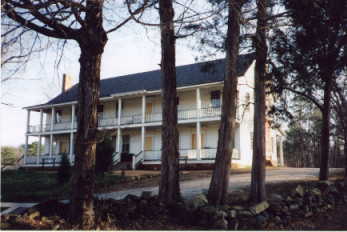
The hotel is unique and extremely significant to the history of the State of Georgia. It is the only known ante-bellum mineral springs hotel in Georgia still standing. It's history yields much data on the culture, society and architecture of Georgia throughtout the 19th century.
The Federal style architecture, hand planed wide boards, wooden pegs and handmade bricks clearly indicate an early 19th century construction date. The foundation was made of native stone.
Indians had been coming to the Spring for many decades prior to 1800. They believed in the medicinal qualities of the water. No permanent structures were built near the waters due to the fear that crying children and talking women would scare the "healing spirits" away from the waters. However, William McIntosh built a cabin here in 1800.
In 1838 the Indian Spring Hotel was the only public house at the Spring. It appears to have been a reasonably successful establishment that would have compared favorably with any other in the state. The Inn was gaining a reputation as Georgia's finest. While the momentous events at the Indian Spring Hotel in 1825, and the aftermath of the treaty would certainly be the most outstanding single historical event in the history of the hotel, the decades from 1840 to 1860 proved to be the heyday of the hotel.
There is no doubt that by the 1840's, the Indian Spring Hotel with its resort style architecture (wrap around porches), ballroom, bar, billard room, and other amenities, had taken on the appearance of a "Springs" resort much like those found in Virginia and New York.
In 1840, the Democratic-Republican Party held a dinner at the Springs following a meeting in Milledgeville, Some 10,000 people attended the dinner, with 5,000 being seated at one time. During this convention, orators spoke "on the piazza of the Indian Spring Hotel". Political events, particularly large rallies such as this one, were important social events in the 19th century.
The Varner family owned the hotel the longest, 103 years (1850-1953). Miss Joe Varner was very politically active and entertained many important people at the hotel
By 1900, the Indian Spring Hotel had ended its hotel career. The old hotel had given Indian Springs the impetus for its early development. It was Indian Spring's first hotel and for many years its finest. It had a history unequaled by any other hotel in the state.
In 1953, the hotel was sold to J. H. Elliott, an antique dealer, who operated it as a museum. In 1974, Mr. Elliott sold the hotel to the State of Georgia. The state had planned to restore the building, but gave up the idea when they estimated it would take $300,000 to get the hotel back in shape. In 1982, the state deeded the property to Butts County and the county leases it to the Butts County Historical Society for $1.00 per year.
The society began its restoration work in 1985. Due to some errors in earlier attempts at restoration, the hotel began to develop structural problems. Since that time (approximately 10 years ago), the society has endeavored to correct the problems. The work continues with the help of donations,grants and fund raisers.
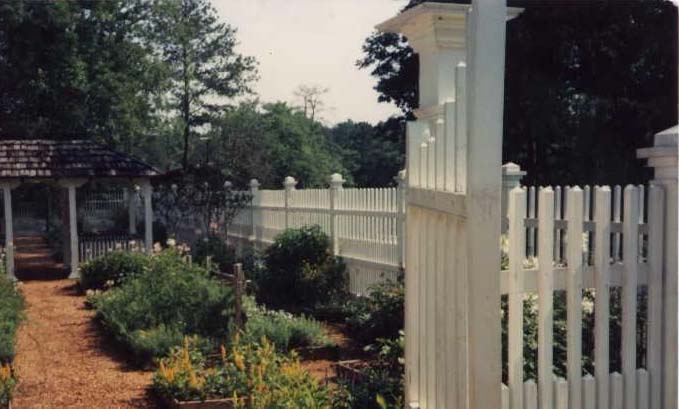
From these once numerous gardens, seeds and cuttings were disbursed throughout the South by the hotel guests. The society is continuing this tradition by offering plants, bulbs and seeds for sale in the Spring. The early 1800's garden contains raised beds of roses, annuals, perennuals, trees, shrubs and herbs that would have grown in this area during that time period.The design of the fence, gates, Summerhouse, flower beds and selection of all plants and roses were made by our design consultant.
In June 1990, the garden was dedicated to the First Lady of Georgia, Mrs. Elizabeth Harris. Funding for the garden was made possible by a friend of Mrs. Harris.
The garden can be rented for weddings during the Spring and Summer months when it is in full bloom.
The Indian Spring Hotel and Garden is located 50 miles South of Atlanta or 50 Miles North of Macon off I75, exit 67, follow signs to Indian Springs State Park. Hotel and Garden are located across the road from the state park.

The Chapel contains the original kerosene light fixture, colored glass windows, and brass bell placed with it was built. The bell in the tower has been tolled practically every Sunday since it was hung. Also located in the chapel are wooden benches. The benches are much older than the church and may have been saved from another church that burned, being torn down or from the church that originally stood on the property. Recently an old pump organ that sat in the Carmichael House in Jackson, Ga. for many years was placed in the chapel
As part of the historic restoration of the building, a paint analysis has been done by a color expert to determine the original colors. The analysis shows that Ochre was the first coat of paint which was also the color of the Wigwan Hotel. The church has recently received a new roof and coat of Ochre paint.
In July of 1992, Mr. Jimmy cornell, Mr. Asa Maddox, Mrs. Tootie McMichael and members of the Indian Springs Baptist Church voted to turn the chapel over to the Butts County Historical Society for preservation.
The chapel is used on Sunday mornings for church services and can also be rented for weddings. The building has a seating capacity of 75 to 80 people.


