FEATURE
The Value of Human Rights
by Brian Joseph Matillano
In the Philippine Constitution, the whole Article III manifests the Bill of Rights. Individual. It is a declaration and enumeration of a person's rights and privileges in which the Constitution is designed to protect against violations by government, institutions, or individuals. The Constitutions guarantees freedom of the press, freedom of assembly, freedom of petition, freedom of religion, etc. Filipino citizens are protected by this law, insofar as it is executed for the benefit of the public.
Notably, these rights are often curtailed, especially by those people who are in authority. They use their dominance if ever their ego is affected, especially if it is for their defense. There are so many cases of unjust treatment and operation, wherein a person in authority is "attacked" by subordinates. Ironically, sovereignty resides in the people, especially in the masses.
The Bill of Rights guarantees individuals the liberty to express what is in their mind. It also guarantees them the liberty not to express what is in their mind. This freedom also includes the right to an audience, in the sense that the State cannot prohibit the people from hearing or reading what the person has to say, whatever be the quality of his thoughts. It also includes the right to listen and the right not to listen. Voltaire said: "I may not argue with what you say, but I will defend to death your right to say it."
The right of freedom of speech and of the press is essential to the preservation and operation of democracy. But even this right is not absolute at all times and under all circumstances. It is always subject to some regulations by the State, in order that it may not be injurious to the right of others and the community.
These are not mere rights; these are duties. Each citizen is obliged to
exercise his duties without hesitations, as long as they are on the trail
of truth and righteousness. Furthermore, the Constitution states that
"No law shall be passed abridging the freedom of speech, of
expression, or of the 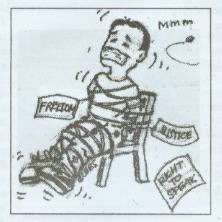 press, or the right of the people to assemble
peaceably and petition the government for redress of grievances."
Supporting this provision, the Bill of Rights, in Section 18, has this
rule: "No person shall be detained solely by reason of his beliefs
and aspirations."
press, or the right of the people to assemble
peaceably and petition the government for redress of grievances."
Supporting this provision, the Bill of Rights, in Section 18, has this
rule: "No person shall be detained solely by reason of his beliefs
and aspirations."
Our country is said to be a democratic country. If democracy really reigns
in our society, let us exercise our rights, and nobody will thwart us if
we are on the trail of truth and righteousness. The only freedom which
deserves the name is that of pursuing our own good in our own way, as long
as we do not deprive others their freedom or impede their effort to attain
it. This is not just a cry but a challenge.
Finally, freedom comes from man; it is his nature. It does not come from laws, nor from anybody else. According to Abraham Lincoln: "Those who deny freedom to others deserve it not for themselves."