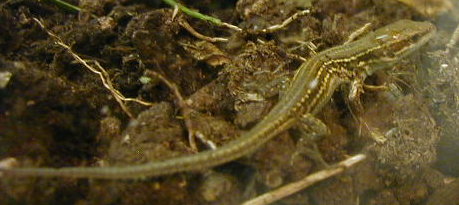
So you are thinking of doing some laundry, and you want to see lizards running around while your clothes slosh about. There is place. It's discovery was made by chance by Topeka native - Wayne McCall - avid railroader and lizard hunter. On one of his Friday evening forays to the Seabrook Laundry, he noticed a lizard run under a concrete slab. After walking around the premises and into the vacant yard in the back, he noticed lizards along a fence bordering the laundry property. There were also lizards running along the foundation of the building. McCall made mention of the discovery to Hansen during the course of a work day. Hansen immediately was in trouble with railroad management for discussing non-railroad related topics. After a trip to the local library, Jeff Hansen - ex-railroader and avid Soylent green proponent - found a book: Reptiles and Amphibians of Kansas. He showed McCall a picture of the Italian Wall Lizard and made a positive identification. After attending an open house reptile presentation at Washburn University, he determined that the southwest part of Topeka had been colonized by Italian Wall Lizards, that had escaped from a pet store long ago. Being a supersleuth that he is, Hansen enrolls at Washburn in the class: Reptiles, Amphibians, and Turtles of Kansas taught by the author of Reptiles and Amphibians of Kansas - one Joe Collins. More information was obtained and Hansen learned that a guy by the name of Charles Burt sold snakes and lizards through a biological supply house in Topeka in the 50's and 60's. When he died in 1963, his wife wasn't as enthused about reptiles and turned everything loose. Of all the critters that were set free, two survived - the wall lizard and the green lacerta (rarely seen). The Italian wall lizard really found Topeka to its liking, and since has colonized much of the city. Turns out, Topeka is the only place in North America with a breeding population. During the Great Topeka Lizard Hunt of 2001, Hansen learned that the Lizard Laundry is located on the former site of the biological supply house property. The shed behind the laundry was one of the original building that housed reptiles. He had found ground zero for the lizard colony! Now McCall had decided that Hansen needs a breeding colony at his house, so they started catching wallys (topekanese for wall lizards). First they tried catching them by hand, which is doable, but only for the juveniles (juveys). After more research, Hansen determined that a pitfall trap was the answer. Basically you bury a jar in the ground and cover it with a board. When the wally creeps under the board, he falls in and can't get out. This method worked great and we often would catch a few lizards every day or so. We released about twenty lizards in my yard last summer, and some survived the winter. Hansen isn't sure fi he has a breeding population yet, but has created rock walls, and used railroad ties for raised beds - all of which will create more lizard habitat. Wall lizards actually prefer living in cities with lots of buildings and concrete and garbage. A few of the adults they caught in the pit fall trap laid eggs. McCall gave Hansen four eggs and he put them in a jar of moist potting soil. Two months later he had three baby wall lizards. They are the cutest little guys - about 2 inches long. After a couple of days, they were turned lose - hopefully they survived. Only time will tell if the Wally's will colonize my suburban surroundings, but after one year, things are looking good. Stay tuned for other tales of Kansas lizards. |
| LIZARD LAUNDROMAT OF TOPEKA by Jeff Hansen |
 |