
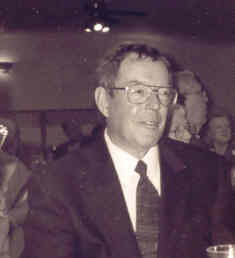
AUTOBIOGRAPHY
Byron Winn, 01/08/04
I was born on November 21, 1933 in Canton, MO. My parents were Colman K. Winn of
Oakwood, MO, and Kiula Ingold of Canton. My father had not attended High School but
instead had gone to work on the railroad as he had to support his mother and siblings.
However, my maternal grandfather was a Christian Minister and mathematics professor
at Culver Stockton College in Canton. He met my father through church and, after
several years, convinced him to come live with him and go to Culver Stockton after
attending an academy for one year. That is how he met my mother and how I came to be
born in Canton. I was the second child and came three years after my older sister, Mary,
was born. Subsequently, a younger brother, Robert Earl, came along but died in infancy.
Later another brother, Don Winn, joined the clan and fmally my sister, Elsie, completed
the family.
The family moved to Wellsville, MO, just before I entered the first grade. However, I
came down with rheumatic fever and missed the first grade. When I got out of the
hospital I was sent to live with my Uncle and Aunt who farmed near Kirksville. I'm not
sure why I was sent to the farm. I was later told that the reason was that it was believed
that the fresh country air would be good for me. Anyway, my Aunt home schooled me,
and the next year I entered the second grade in Wellsville. Then, when I had started in
the third grade my family moved to Fulton for a short time and then to St. Charles, all in
the same year. I did not enjoy the third grade! Three different schools in three different
towns made for an unpleasant experience. The following year we moved two more
times, first to Edmundson Terrace and then to Ferguson, both suburbs of St Louis. So
that year I was in only two different schools in two different towns. I got into lots of
fights. The reason for all of the moves was the Second World War. I managed to remain
in Ferguson through the eighth grade" but we then moved to Mendon. IL, where I spent
my freshman year in high school. The next year we moved to Biggsville, IL, where I
spent my sophomore year. Then my parents moved again affer-one-yeaar, this time to
Kinderhook, IL. I did not want to move again and attempted to refuse to move; I wanted
to remain in Biggsville and live with relatives. Fortunately, I was not allowed this
freedom and was brought to Kinderhook just before the start of school. However, the
local high school in Hull had burned and those students were being sent to Hannibal High
School. Arrangements were made for me to go along with the Hull students. That was
one of the best things that ever happened to me. At Hannibal High School I was able to
have teachers and classes that I could not have had in the smaller schools. HHS prepared
me for what was to come.
After graduation I received an academic scholarship to the University of Illinois, where I
majored in Aeronautical Engineering. However, after my sophomore year I foolishly
volunteered for the draft and went into the U.S. Army. I was sent to Camp Chaffee for
basic training during which I volunteered for the airborne. I was then sent to Fort
Campbell, KY, to the 11 th Airborne Division (now the 1015). It turned out that they were
looking for baseball players so I was put on the baseball team when I finished jump
school. So I only parachuted 9 times, five to get my wings and once every three months
afterwards in order to maintain proficiency (and collect hazardous duty pay). I was sent
to Fort Benning, GA, in the spring of 1954 as the Division was being deployed to
Germany and I had less that one year remaining on my time. I was again assigned to the
baseball team where I played with and against several major league baseball players,
including Tito Francona, Wilmer (Vinegar Bend) Mizell, and a pitcher for the Minnesota
Twins (Fred Katt, I think). It was fun, but I didn't learn any useful skill during my time
in the army.
I managed to obtain an early release from the army in order to return to college. I needed
to fmd a school that was on the quarter system in order to get the early release so I ended
up at Eastern Illinois University, where I met my wife, Donna Taylor. It was love at first
sight; she was a very pretty chemistry student. We got engaged within about two months
but weren't married for another seventeen months. We were married in August, 1957,
and got an apartment in Villa Grover, IL, while I returned to the University of Illinois and
Donna continued at Eastern. She graduated in June 1958, and I graduated in August. I
was awarded a scholarship to attend graduate school at Stanford University and also a job
with Lockheed Missiles and Space Division. Thus we moved to California where I
worked three-quarters time for Lockheed and went half-time to Stanford, while Donna
took care of our first child, Byron Lowell, who was born October 8, 1958. The Lowell
was for Lowell Bonifield, my closest friend in High School. During my work at
Lockheed I worked on the "Spy-in-the-Sky" satellite. This project was ordered by
President Eisenhower after Francis Gary Powers was shot down by the Russian Military
while flying a U-2 and taking photographs of Russian military installations. This was
very exciting work; however, by the time I had finished requirements for my Master's
Degree in Aeronautics and Astronautics we had decided that there were too many people
in California and that I was too much of a Type A personality to survive the traffic.
Therefore we moved to Denver where I went to work for Martin, again working in the
area of astrodynamics. Our second child, Derek, was born in Denver. While in Denver I
began teaching part-time for the Aerospace Engineering Sciences Department at the
University of Colorado. After about two years I decided that I would prefer to teach full-
time and consult for industry part-time, rather than the way I had been doing. The Head
of the Aerospace Engineering Sciences Department told me that if I would return to
Stanford and complete my Ph.D. he would hire me full-time. So Donna, Byron Lowell,
Derek and I moved back to California, where I went back to work at Lockheed and to
graduate school at Stanford. I also began teaching part-time at Santa Clara University.
We needed the income to support the family, which had been increased by the birth of
our daughter, Julie, our final child. In the spring of 1966 I wrote a letter back to the
department head at UC-Boulder and stated that I would be finishing my doctoral
dissertation that summer and was ready to return to Colorado. Unbeknown to me, there
was a new department head that wrote back to me. He began his letter with "Who the
hell are you?" As I wanted to move back to Colorado, I applied to Colorado State
University instead of UC-Boulder and was hired as Associate Professor of Mechanical
Engineering in August 1966. I had the last laugh, as the person from UC-Boulder tried to
hire me away from CSU a year later. I resisted the temptation to reply in kind, and am
happy to have remained at CSU.
Shortly after starting at CSU I applied for and received a grant from NASA to use
satellites to determine more accurately the earth's gravitational field. I had devised a
method by which placing satellites in specific orbits and tracking their positions very
accurately I could get a much more accurate model of the gravitational field of the earth.
This would be very useful to NASA and the military. In order to complete this I needed
thirty satellites; this would be very expensive, considering that the cost per launch would
exceed a million dollars. However. I came across an article in a magazine where it was
stated that an organization in Canada claimed to be able to launch a satellite from a huge
gun at a cost of $25.000. I contacted the organization and was immediately invited to
Montreal to meet with Dr. Gerry Bull, President of Space Research Corporation. I was
met at the airport by a chauffer and driven in a limousine to Dr. Bull's estate. I felt like I
had stepped into a James Bond adventure. There were guards. guard dogs, and cannons
everywhere. It turned out that Dr. Bull was an arms dealer but his ambition was to
launch a satellite from his large gun on Barbados. Consequently. I consulted for him for
several years while we attempted to get NASA approval. which we never did. Dr. Bull
offered me the position of Technical Director of the corporation at a much higher salary
than I was earning at CSU. plus stock. I declined the offer as I didn't want to be involved
in arms deals. That turned out to be a good decision, as Dr. Bull was ultimately
assassinated, allegedly by the Israeli Intelligence Agency, for attempting to build a big
gun for Saddam Hussein.
In 1972 I was serving half-time in mechanical engineering and half-time as Associate
Director of the University Computer Center. We had the third fastest computer in the
world at the time. However, I had been at CSU for six years and was eligible for a
sabbatical leave. As a result of my research for NASA, I was offered the position of
Deputy to Dr. Wernher Von Braun at NASA Headquarters in Washington, D.C. My
sabbatical was approved but, shortly before I was to leave for Washington, I received
word from NASA that Dr. Von Braun had resigned. So, instead of going to Washington
we went to Australia where I taught Communications Theory in the Electrical
Engineering Department at the University of Newcastle. I had a private pilot's license in
the U.S. before leaving so. on arriving in Australia, I took the steps to become licensed in
Australia. This enabled us to see much more of the country than we would have been
able to see otherwise. I would rent a small aircraft and we would fly to places such as the
Great Barrier Reef. We spent six months in Australia, then a month in New Zealand and
Hawaii. and then went to the University of Texas in Austin where I spent the spring
semester working with graduate students. While in Hawaii I became a "streaker." We
were in a hotel in Honolulu when, at around 2:00 a.m. one morning, I was awakened by
someone yelling for help! I went to our door and looked out into the hallway where there
were two men fighting over an airline bag. Without thinking. I immediately ran out into
the hallway to help. ~The mugger ran away and the person being mugged grabbed me by
the hand and bowed and said .'thank you, thank you, thank you" over and over.
Unfortunately, I was completely naked and the commotion had awakened nearly
everyone on that floor of the hotel and people were standing outside their rooms
watching. Anyway, I didn�t get arrested and I made a Japanese tourist very happy for
having saved him from being robbed.
After spending the spring term at UT -Austin we left for Paris, France where I worked for
the French on a navigational satellite project. We had an apartment one block from the
Bois de Boulogne park and one block from the Seine. We spent four months in Paris and
about a month touring around Europe and then returned to the U.S. just when the oil
embargo of 1973 took effect. Since there was a shortage of oil, I decided to switch fields
and go into solar energy research. I immediately received funding from the federal
government to conduct research into solar energy. A colleague and I also started a
private company, Solar Environmental Engineering Co., Inc. I designed and installed a
number of solar heating systems for various clients such as McDonalds, Malcolm Forbes,
clients in Aspen, etc. I also did the original design for a solar heating system for the
White House for President Carter. I traveled to many places, such as China, Korea, Japan,
South America, India, Africa and Europe for the National Science Foundation, the
National Research Council and the Department of Energy. I served on the Board of
Directors of the International Solar Energy Society and the American Solar Energy Society
for several years. Unfortunately, our company went broke in the early 1980�s. My involvement
with solar energy continues to the present and I remain on the Board of Directors of the Solar Rating and Certification Corporation. Several of my former students have gone on to positions at the National Renewable Energy Laboratory.
I was appointed as Mechanical Engineering Department Head in 1983 and continued in that
position until 1996, when I was appointed as Associate Dean for Engineering and Research in the
College of Engineering. In the mid-1980's I was invited to the University of Mosul in Northern Iraq to discuss a potential graduate program Between that university and CSU. They were to pay my expenses but kept delaying. About a year later I received a reimbursement check, authorized by Saddam Hussein. I retired in 1997 and have become a tree farmer. We have a cabin and 80 acres near the Wyoming border and would be happy to have any of the class of 1951 visit. Donna and I have seven grandchildren, four in Fort Collins and three in Manchester-by-the-Sea, Massachusetts, and feel that we are indeed blessed.