
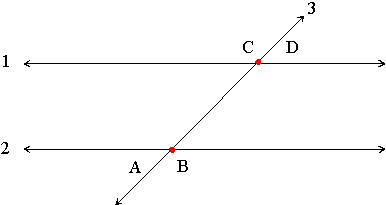
Given: Lines a and b are parallel.
Prove: angle 1 is congruent to angle 2
To prove this theorem we are going to use an indirect proof.
Assume that angle 1 is not congruent to angle 2. Then there must be another line c, that intersects the transversal at p to form an angle, angle 3, that is congruent to angle 2, but alternate interior angles lead to parallel lines thus c is parallel to b, then line b is parallel to two lines in the plane. this contradicts the parallel postulate which states there can be only one parallel line through a point not on the line, therefore angle 1 is congruent to angle 2.
Theorem: If two parallel lines are cut by a transversal then the alternate exterior angles are congruent. (The proof for this theorem is similiar to the one above)
Theorem: If two parallel lines are cut by a transversal then the corresponding angles are congruent. Knowing that the alternate exterior angles are congruent and the alternate interior angles are congruent, you can use algebra to prove this theorem.