Basic Information!
PARALLELOGRAMS
1. The opposite sides are parallel by definition.
2. The opposite side are congruent.
3. The opposite angles are congruent.
4. The diagonals bisect each other.
5. Any pair of consecutive angles are supplementary.
RECTANGLES
1. All the properties of a parallelogram by definition.
2. All the angles are right angles.
3. The diagonals are congruent.
KITES
1. Two disjoint pairs of consecutive sides are congruent by definition.
2. The diagonals are perpendicular.
3. One diagonal is the perpendicular bisector of the other.
4. One of the diagonals bisects a pair of opposite angles.
5. One pair of opposite angles are congruent.
RHOMBI
1. All the properties of parallelograms and kites apply by definition. (Note: Properties 3-5 of kites, referred to as half-properties, become full properties.)
2. All the sides are congruent.
3. The diagonals bisect the angles.
4. The diagonals are the perpendicular bisectors of each other.
5. The diagonals divide the rhombus into four congruent right triangles.
SQUARES
1. All the properties of a rectangle apply by definition.
2. All the properties of a rhombus apply by definition.
3. The diagonals form four isosceles right triangles.
ISOSCELES TRAPEZOIDS
1. The legs are congruent by definition.
2. The bases are parallel.
3. The lower base angles are congruent.
4. The upper base angles are congruent.
5. The diagonals are congruent.
6. Any lower base angle is supplementary to any upper base angle.
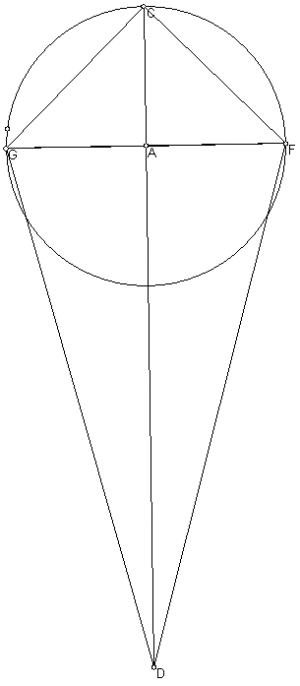
Given: Quadrilateral ABCD; Circle W; angle BWC is
a rt. angle:
Prove: ABCD is a kite
1. ------- p; 1. Given
2. AW is congruent to CW 2. All radii of a circle are congruent
3. BD is perpendicular to AC 3. Perpendicular lines form rt. angles
4. BD is perpendicular bisector to AC 4. Definition of perpendicular bisector
5. ABCD is a kite 5. If one diagonal of a quadrilateral perpendicularly
bisects the other, then the quad. is a kite
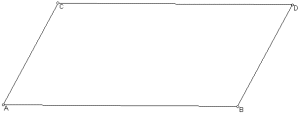 Given:
ABCD is a quadrilateral; tri. AEB is congruent to tri. CED
Given:
ABCD is a quadrilateral; tri. AEB is congruent to tri. CED
Prove: ABCD is a parallelogram
1. ------------ ; 1. Given
2. AB is congruent to CD 2. CPCTC
3. angle 1 is congruent to angle 2 3. CPCTC
4. AB is parallel to CD 4. If alt. int. angles are congruent, then parallel lines.
5. ABCD is a parallelogram 5. If 1 pr. opp. sides are congruent & //, - > the quad. is a parallelogram.
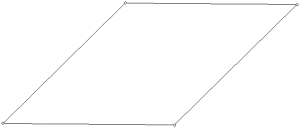 Given:
ABCD is a parallelogram; tri. ABD is congruent to tri. ADC
Given:
ABCD is a parallelogram; tri. ABD is congruent to tri. ADC
Prove: ABCD is a rhombus
1. ------------ ; 1. Given
2. angle 1 is congruent to angle 2 2. CPCTC
3. angle 3 is congruent to angle 4 3. CPCTC
4. CA bisects angle BAD 4. Def. of angle bis.
5. AC bis. angle BCD 5. Def. of angle bis.
6. ABCD is a rhombus 6. If diag. of parallelogram bis. 2 angles of parallelogram -> it is a rhombus.
 Given:
ABCD is a parallelogram; AB is perpendicular to BC, AD is perpendicular to DC.
Given:
ABCD is a parallelogram; AB is perpendicular to BC, AD is perpendicular to DC.
Prove: ABCD is a square
1. --------------- &nbbsp; 1. Given
2. AB is congruent to DC 2. opp. sides //ogram =.
3. AC is congruent to AC 3. Reflexive
4. angle ABC, angle ADC rt. angles 4. Perp. lines form rt. <s.
5. tri. ABC, tri. ACD rt. triangles. 5. Def. of rt. tris.
6. Tri. ABC is congruent to tri. ACD 6. HL
7. angle 1 is congruent to angle 2, angle 3 is congruent to angle 4. 7. CPCTC
8. CA bis. angle BAD, AC bis. angle BCD 8. Def. of angle bis.
9. ABCD is a rhombus 9. If diag. //ogram bis. 2 <s of //ogram-> rhombus.
10. ABCD is a rectangle 10. If a //ogram contains 1 rt. angle -> it is a //ogram.
11. ABCD is a square 11. If //ogram is a rect. and a rhombus->square.
Given: ABCD is a parallelogram; triangle AEB
is congruent to triangle CED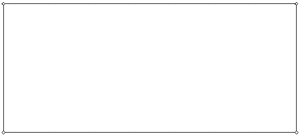
Prove: ABDC is a rectangle
------------ 1. Given
AE is congruent to DE 2. CPCTC
BE is congruent to CE 3. CPCTC
AD is congruent to BC 4. Addition
ABCD I a rectangle 5. if diags of a //ogram congruent, //ogram is a rect.
Given: ABCD is a trapezoid w/ bases AD & BC; tri. ABE
is congruent to tri. DCF
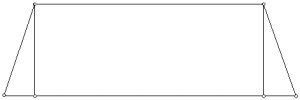
Prove: ABCD is an isos. trap.
3. ABCD is an isos. trap. 3. if lower base angles of a trap. are congr. -> it is isos.